Watts vs Watt-Hours: What Is the Difference?
A portable power station rated at “1000W” and one rated at “1000Wh” are not the same kind of number, and confusing them is one of the fastest ways to buy the wrong backup power system. One describes how fast the unit can deliver energy at any given moment. The other describes how much total energy it can store and eventually deliver. A system can be strong on one figure and weak on the other, and a buyer who only checks the bigger number can end up with a power station that either cannot start a refrigerator or cannot keep it running for more than an hour.
This distinction, power versus energy, sits underneath nearly every calculation in battery technology, backup power sizing, and device charging. Getting it wrong does not just cause confusion. It causes people to size battery banks incorrectly, misjudge runtime, and misread product specifications that manufacturers list correctly but readers interpret incorrectly.
Quick Answer
| The short version Watts (W) measure power: the rate at which energy is being used or delivered right now. Watt-hours (Wh) measure energy: the total amount of energy stored or consumed over a period of time. Formula: Energy (Wh) = Power (W) × Time (h). Practical takeaway: a device’s wattage determines whether a power source can run it at all. A battery’s watt-hour rating determines how long it can keep running. |
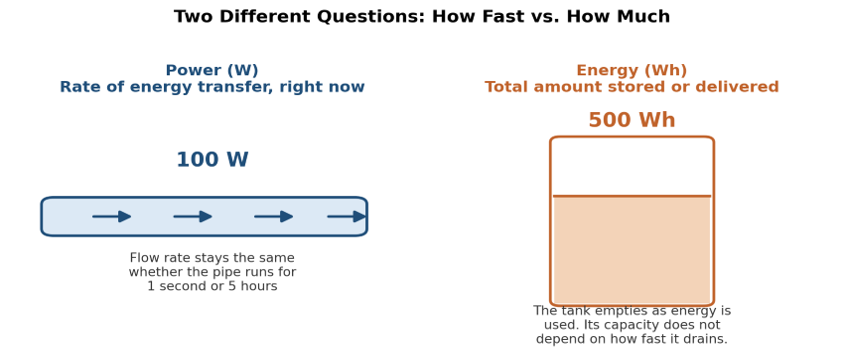
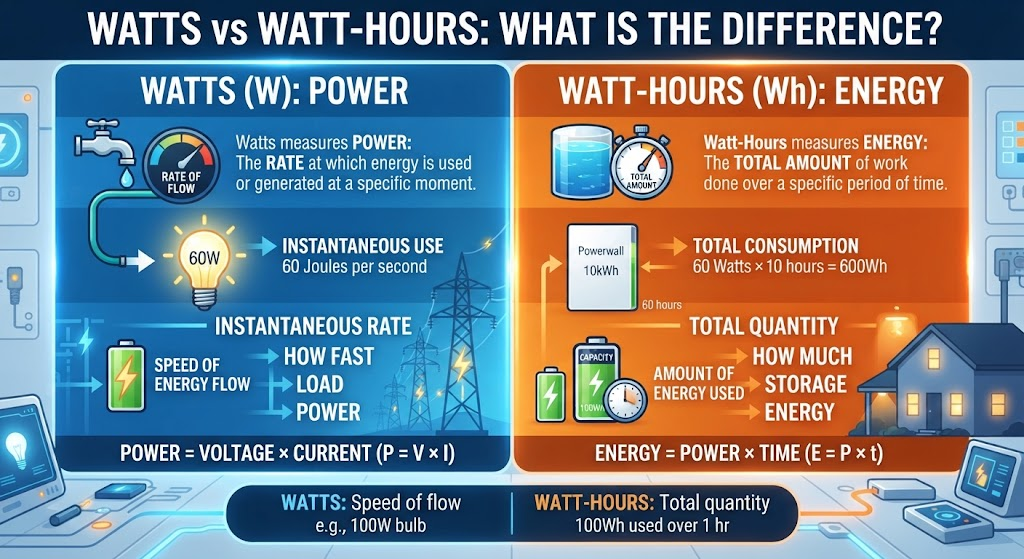
Figure 1. Power behaves like a flow rate through a pipe. Energy behaves like the amount stored in a tank. Conceptual illustration.
What a Watt Actually Measures
A watt is a unit of power, and power is a rate. It expresses how quickly energy is being transferred at a given instant, the same way speed expresses how quickly distance is being covered. A 100W light bulb consumes energy at a rate of 100 joules per second, whether it has been on for two seconds or two hours.
Power is defined by a simple relationship between voltage and current:
P = V × I
Where P is power in watts, V is voltage in volts, and I is current in amperes. A device that draws 5 amps at 12 volts consumes 60 watts at that instant. That figure never changes with time on its own. It only changes if the voltage or current draw changes, for example when a compressor motor starts and briefly pulls far more current than it does once running.
Wattage answers one specific engineering question: can this power source deliver energy fast enough, right now, to run this load? A power station rated for 300W continuous output cannot run a 500W appliance, regardless of how much energy is stored inside it. The battery could be enormous and it still would not matter. Continuous output is a ceiling on rate, not a reservoir of energy.
What a Watt-Hour Actually Measures
A watt-hour is a unit of energy. It represents the total amount of energy transferred when a given power level is sustained for a given period of time. One watt-hour is the energy delivered by a one-watt load running for one hour.
Where a watt is analogous to speed, a watt-hour is analogous to distance traveled. Speed alone does not say how far a car has gone. Distance depends on speed and how long that speed was maintained. Energy works the same way:
E (Wh) = P (W) × t (h)
A 100W load running for 5 hours consumes 500 watt-hours of energy, regardless of whether it ran at 100W the entire time or, in principle, at a different rate for a different duration that happens to multiply out to the same total. The chart below illustrates this using a constant 100W load. Power stays flat over time, because the rate of consumption never changes. Energy climbs steadily, because it accumulates the longer that rate is sustained.
Also Read: What Size Portable Power Station Do I Need?
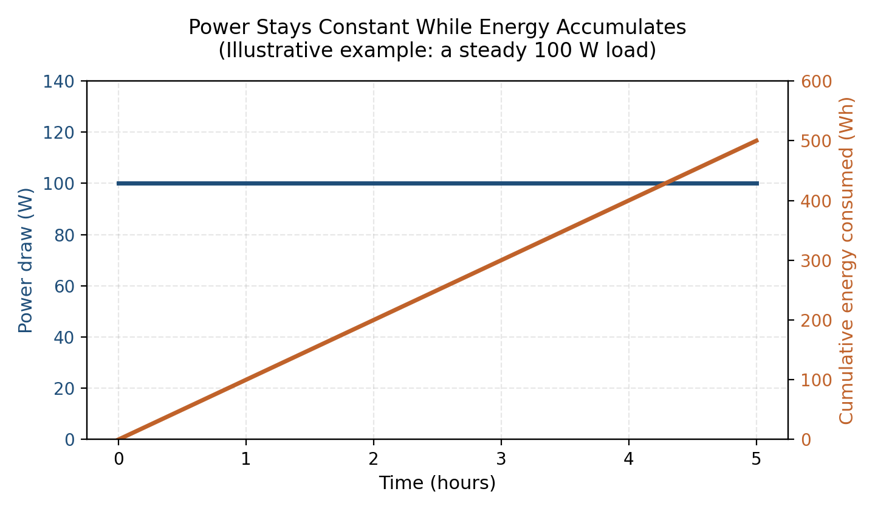
Figure 2. A constant 100W load produces a flat power line and a rising cumulative energy line. Illustrative calculation, not measured data.
Worked Example: Why the Two Numbers Tell Different Stories
Consider a portable power station rated at 500Wh of stored energy with a 300W continuous AC output. A household is running a 60W device from it, such as a small fan or a modem and router combined.
Step 1: Check the power rating
The device draws 60W. The power station can deliver up to 300W continuously, so the power requirement is comfortably within range. This confirms the system can run the device at all.
Step 2: Calculate the theoretical runtime
t = E ÷ P = 500 Wh ÷ 60 W ≈ 8.3 hours
On paper, the stored energy divided by the load’s power draw gives an estimated runtime of roughly 8.3 hours.
Step 3: Apply a real-world adjustment
That 8.3-hour figure assumes the battery delivers 100 percent of its rated energy to the load, which does not happen in practice. Converting stored DC battery energy into usable AC output passes through an inverter, and inverters are not perfectly efficient. According to Penn State University’s utility solar engineering course materials, high-quality pure sine wave inverters are typically rated between 90 and 95 percent efficiency, while lower-quality modified sine wave units run closer to 75 to 85 percent, with efficiency also falling off at low load levels [1]. Applying a conservative 90 percent efficiency factor changes the outcome:
Usable runtime ≈ (500 Wh × 0.90) ÷ 60 W ≈ 7.5 hours
The 500Wh number never changes. What changes is how much of that number actually reaches the appliance. This is why a runtime calculated directly from the headline Wh figure is consistently optimistic, and why SIELECTRONIX treats a straight energy-divided-by-power calculation as a starting estimate rather than a specification. The efficiency factor used for any specific product should come from that product’s own datasheet rather than a general assumption whenever the manufacturer publishes one.
Where the Distinction Actually Matters
The practical value of separating watts from watt-hours shows up in three recurring situations.
- Sizing a backup power system. The wattage of a device determines whether a power station can run it. The watt-hour capacity of the battery determines for how long. Both numbers have to be checked separately, and a shortage in either one produces a system that fails the intended purpose.
- Reading power bank and charger specifications. A power bank’s capacity is normally printed in milliamp-hours (mAh), a related but distinct unit from watt-hours, and a charger’s output is printed in watts. Neither figure alone predicts how many times a device can be recharged.
- Comparing products by a single headline number. A 2000W power station and a 2000Wh power station are answering different questions, and treating the two labels as interchangeable is one of the more common purchasing mistakes SIELECTRONIX sees in this category.
Common Confusions That Cause Real Mistakes
Treating power output and stored energy as the same specification
A power station’s continuous watt rating describes its inverter’s output ceiling, not the size of its battery. A unit can have a very large inverter and a comparatively small battery, or the reverse. Both numbers need to be checked independently against the intended load and required runtime.
Confusing milliamp-hours with watt-hours
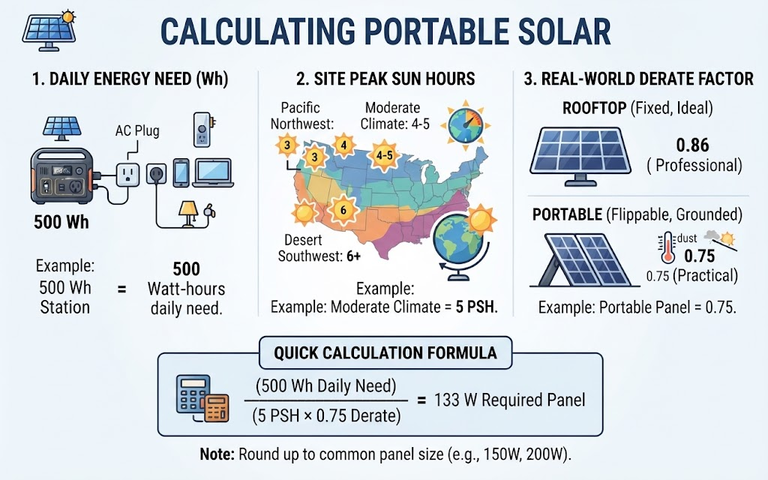
Power bank capacity is usually printed in mAh, which measures charge, not energy. Converting it to watt-hours requires the battery’s nominal voltage:
Wh = (mAh ÷ 1000) × V
A 20,000mAh power bank built around a 3.7V lithium cell stores approximately 74Wh, not 20,000 of anything directly comparable to a device’s watt rating. This is why two power banks with identical mAh ratings can store meaningfully different amounts of energy if their internal voltages differ.
Assuming rated capacity equals usable capacity
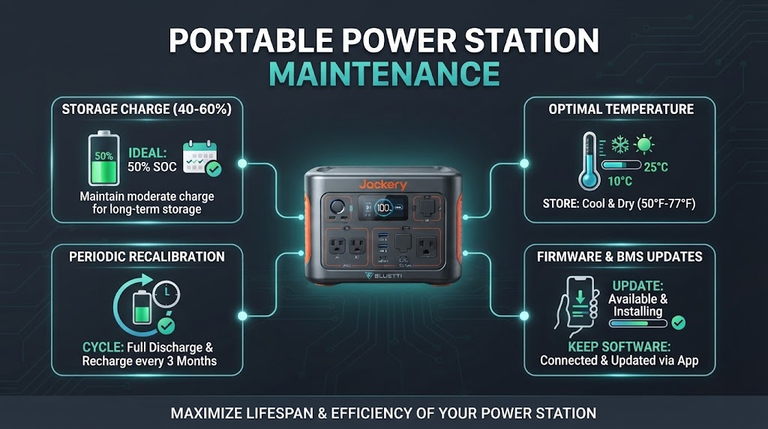
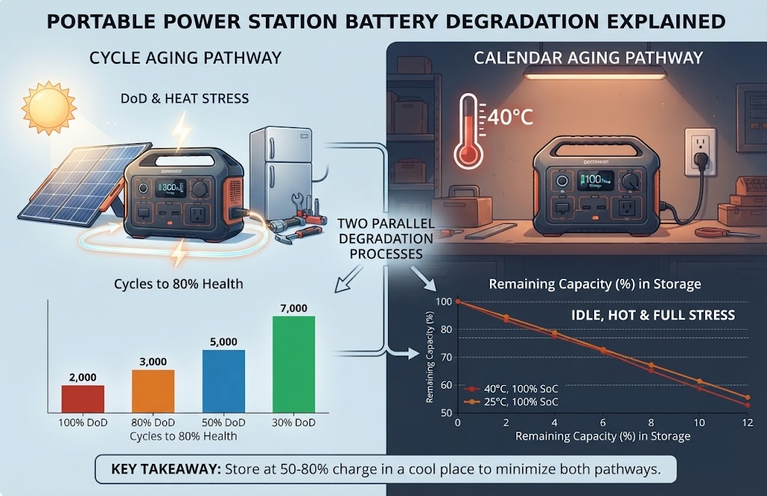
Manufacturer Wh and mAh figures are nominal values measured under controlled conditions. Actual usable energy is reduced by conversion losses, the battery management system’s reserved margin, and, over time, cell aging. Treating the label as a hard guarantee rather than a reference point produces runtime estimates that run consistently short in practice.
Also Read: How to Calculate the Battery Capacity for Portable Power Station
Ignoring kilowatt-hours on utility-scale figures
A kilowatt-hour (kWh) is simply 1,000 watt-hours, used because household and grid-scale energy consumption is inconvenient to express in single watt-hours. A home using 900Wh in an hour is using 0.9kWh. The unit changes for convenience of scale, not because the underlying concept is different.
Watts vs Watt-Hours at a Glance
| Quantity | Symbol | Unit | What It Measures | Everyday Analogy |
| Power | P | W (watts) | Rate of energy transfer at a given instant | Speed of a car |
| Energy | E | Wh (watt-hours) | Total energy delivered or stored over time | Distance a car travels |
| Charge | Q | Ah / mAh | Amount of electric charge, not directly energy | Size of the fuel tank, before knowing fuel type |
| Utility-scale energy | E | kWh (1,000 Wh) | Same as watt-hours, scaled for household/grid use | Distance measured in miles instead of feet |
Common Mistakes
Using a power station’s wattage rating to estimate runtime is incorrect. Wattage says nothing about how much energy is stored; it only says how fast that energy can be delivered. Runtime has to come from the watt-hour figure, divided by the load, and adjusted for conversion losses.
Assuming a higher watt-hour number always means a better product for the application is also incorrect. A power station with abundant stored energy but a low continuous watt rating will still fail to start a compressor-driven appliance, because starting current can briefly exceed the continuous rating by several times. Surge capability and continuous wattage both need to be checked against the load’s startup behavior, not just its steady-state draw.
Adding an arbitrary safety margin without identifying which number the margin applies to is not a substitute for checking both figures separately. A margin added to watt-hours does nothing to fix an undersized inverter, and a margin added to watts does nothing to fix insufficient stored energy.
Frequently Asked Questions
Is a higher wattage rating always better than a higher watt-hour rating?
No. The two numbers answer different questions. A higher watt rating means the unit can run more demanding or higher-power devices. A higher watt-hour rating means it can run devices for longer. The correct priority depends on the load being powered, not on which number happens to be larger.
Can a device rated in watts run indefinitely from a battery rated in watt-hours?
No. The watt-hour figure is a fixed, finite reservoir of energy. Dividing it by the device’s steady wattage gives an estimated runtime; once that stored energy is depleted, the device stops running regardless of how the power station’s continuous watt rating is specified.
Why do some products list mAh and others list Wh?
mAh is conventional for small consumer electronics such as phone power banks, where the voltage is fairly standardized. Wh is more common for larger devices such as portable power stations, where voltage varies significantly between products and a charge-based unit would not allow meaningful comparison between different systems.
Does a 1000Wh battery deliver exactly 1000Wh to a connected device?
No. Inverter conversion losses, battery management overhead, and battery aging all reduce the usable portion of the rated capacity. A well-designed AC-output power station with a high-quality pure sine wave inverter typically delivers somewhere in the 90 to 95 percent range of its rated Wh to a connected AC load, based on published inverter efficiency research; lower-quality inverters and low-load conditions can push that figure lower [1].
Conclusion
Watts and watt-hours are not two versions of the same specification. Watts describe how fast a system can deliver energy, and that figure determines whether a device can run at all. Watt-hours describe how much total energy is available, and that figure determines how long the device keeps running. A backup power system, a power bank, or a charger has to be evaluated on both dimensions independently, because a strong number on one axis does not compensate for a weak number on the other.
Before choosing a power station, power bank, or backup system based on a single headline figure, both the continuous and surge power requirements of the intended load and the watt-hour energy requirement for the required runtime should be calculated separately, then checked against the product’s specifications rather than against its marketing number.
External Sources
Referenced in this article: