How to Calculate Solar Panel Size for Portable Power Station
Quick Answer
Required panel wattage is the daily energy that needs replacing, divided by the site’s peak sun hours, divided again by a real-world derate factor. In formula form:
| Required Panel Watts = Daily Energy Need (Wh) ÷ (Peak Sun Hours × Derate Factor) |
For a household replacing a full 1,000 Wh of daily use in a location averaging 4.5 peak sun hours, a practical derate factor of 0.75 puts the requirement at roughly 296 W of panel, which in practice means a common 300 W folding panel rather than a 100 W unit. The derate factor matters as much as the peak sun hour figure, and most articles online skip it entirely or misapply the number used for permanently mounted rooftop arrays.
Why the Panel’s Wattage Rating Isn’t the Whole Answer
A solar panel’s nameplate wattage, the number printed on the panel and used in its marketing, is measured under Standard Test Conditions: a fixed irradiance of 1,000 W/m², a cell temperature of 25°C, and the panel pointed directly at the light source. A portable panel propped against a cooler or laid flat on the ground rarely meets any of those three conditions for more than a few minutes at a time. The panel still produces useful power, but not its rated wattage, and not for every hour of daylight.
Sizing a panel correctly means answering three separate questions in order: how much energy needs replacing each day, how much usable sunlight the location actually receives, and how much of the panel’s rated output survives the trip from photovoltaic cell to battery once heat, angle, and conversion losses are accounted for. Skipping any one of the three produces a system that is either badly undersized (a battery that never fully recovers) or unnecessarily expensive (a panel far larger than the situation requires).
Step 1: Determine the Daily Energy Requirement
The starting number for solar sizing is not the power station’s total capacity. It is the amount of energy that actually needs replacing in a typical day, which depends on the loads being run.
Two common situations call for different numbers:
- Full daily recharge (camping, remote work, off-grid use): the goal is to fully refill the battery from a significant daily discharge. Use the portable power station’s rated capacity in watt-hours, or the amount typically drawn down, as the daily energy figure.
- Sustaining a fixed daily load (a router, a small fridge, lighting during an extended outage): the goal is for solar input to match or exceed daily consumption so the battery does not trend toward empty. Calculate the actual daily watt-hour draw of the connected devices rather than the station’s full capacity.
Sielectronix’s guide to calculating battery capacity for a portable power station and its companion piece on portable power station runtime calculation both walk through how to total appliance wattage into a daily Wh figure. That number, not the battery’s headline capacity, is the correct input for this calculation whenever the goal is sustaining a specific load rather than a full recharge from near empty.
A household is running a small 65 W fridge for 10 hours a day and a router drawing 8 W continuously. Daily consumption is (65 × 10) + (8 × 24) = 650 + 192 = 842 Wh. That figure, not the station’s 1,000 Wh rated capacity, is what the solar array needs to replace each day to avoid a slow decline in stored charge.
Step 2: Find the Location’s Peak Sun Hours
A peak sun hour is a unit of measurement, not a clock reading. It represents one hour during which a location receives solar irradiance averaging 1,000 W/m², the same reference intensity used to rate the panel itself. A place that gets five peak sun hours per day is not necessarily sunny for exactly five hours. It receives a total daily solar energy equivalent to five hours at full intensity, spread across a longer period of weaker morning and evening light plus a stronger midday window.
The continental United States averages roughly 4 to 4.5 peak sun hours a day. The desert Southwest, including Arizona and New Mexico, regularly exceeds 6. The Pacific Northwest and parts of the upper Midwest often run closer to 3.5. Winter values in most locations fall 25 to 50 percent below the annual average, so a system sized only on an annual figure will underperform in December and January.
For a precise, location-specific number rather than a regional estimate, the National Renewable Energy Laboratory’s PVWatts calculator provides peak sun hour and irradiance data for any U.S. address, drawn from the National Solar Radiation Database.
Step 3: Apply a Realistic Derate Factor
This is the step most sizing guides skip, and its absence is the main reason casual online advice tends to run either wildly oversized or badly undersized. Between the panel’s nameplate rating and the energy that actually reaches the battery, several losses stack up:
- Angle and tracking loss: a fixed rooftop array can be tilted and oriented for the site’s latitude. A portable panel is usually laid flat, propped at a rough angle, or repositioned once or twice a day at best, which typically costs more output than a properly angled fixed array.
- Temperature derating: panel output falls as cell temperature rises above the 25°C test condition. A panel sitting on hot ground or asphalt in direct sun can run well above that figure.
- MPPT or PWM conversion loss: a Maximum Power Point Tracking controller, standard on modern portable power stations, typically converts at 95 to 99 percent efficiency. Older or simpler PWM controllers lose more, particularly when panel voltage doesn’t closely match battery voltage.
- Cloud, haze, and soiling: dust on the panel surface and thin cloud cover both reduce output even on a technically clear day.
The National Renewable Energy Laboratory’s PVWatts tool uses a default combined system loss of 14 percent (a derate factor of about 0.86) for professionally installed, properly angled, permanently mounted residential arrays. That figure is a reasonable starting point for a rooftop system. It is too optimistic for a portable folding panel that is laid flat, moved only occasionally, and exposed to more variable conditions than a fixed installation.
A practical derate factor for portable solar panels charging a power station is 0.70 to 0.80, with 0.75 serving as a reasonable middle estimate for casual daily placement and repositioning. A panel that is carefully aimed and periodically adjusted through the day can perform closer to 0.80. A panel left flat on the ground in one fixed position all day, or one that spends part of the afternoon in partial shade, should be planned closer to 0.65 to 0.70.
Worked Examples
Example 1: Weekend Camping, 500 Wh Station
| Daily energy to replace: 500 Wh (full recharge target) Location: moderate climate, 5 peak sun hours Derate factor: 0.75 (portable panel, hand adjusted) 500 ÷ (5 × 0.75) = 500 ÷ 3.75 = 133 W required |
A 133 W requirement means a common 150 W or 200 W folding panel provides a reasonable working margin, since real conditions rarely match the planning assumptions exactly and a cloudy afternoon should not prevent a full recharge overnight readiness.
Example 2: Daily Router and Small Fridge Backup, 1,000 Wh Station
| Daily energy to replace: 842 Wh (calculated in Step 1) Location: northern climate, 4 peak sun hours Derate factor: 0.75 842 ÷ (4 × 0.75) = 842 ÷ 3 = 281 W required |
This falls between the common 200 W and 300 W panel sizes. Choosing the 300 W option provides headroom for overcast days and winter’s reduced peak sun hours, while the 200 W option would only sustain the load reliably in consistently sunny conditions.
Example 3: Extended Outage Backup, 2,000 Wh Station
| Daily energy to replace: 2,000 Wh (full recharge target) Location: desert Southwest, 6 peak sun hours Derate factor: 0.75 2,000 ÷ (6 × 0.75) = 2,000 ÷ 4.5 = 444 W required |
A single 400 W panel falls slightly short of the calculated figure; two 220 W panels wired for a combined 440 W, or a single 450 to 500 W unit where available, brings the array in line with the requirement. This is also a case where checking the power station’s maximum solar input rating matters, since some 2,000 Wh class units cap solar input well below 500 W even though the battery could theoretically absorb more.
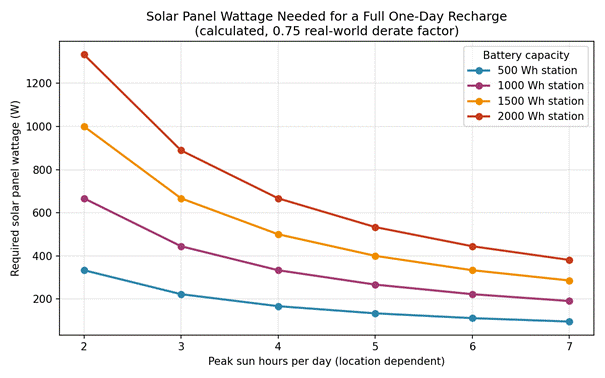
Figure 1. Required solar panel wattage for a full one-day recharge across a range of peak sun hour values, calculated using a 0.75 derate factor for four common battery capacities. Values are calculated, not measured, and assume the panel’s rated wattage is achievable under the stated derate assumption.
Quick Reference: Required Panel Wattage by Capacity and Sun Hours
Calculated using the formula above with a 0.75 derate factor, for a full one-day recharge from a substantially depleted battery. Actual requirements should be rounded up to the nearest commonly available panel size.
| Battery Capacity | 3 PSH | 4 PSH | 5 PSH | 6 PSH |
| 500 Wh | 222 W | 167 W | 133 W | 111 W |
| 1000 Wh | 444 W | 333 W | 267 W | 222 W |
| 1500 Wh | 667 W | 500 W | 400 W | 333 W |
| 2000 Wh | 889 W | 667 W | 533 W | 444 W |
Panel Voltage Compatibility: The Step Wattage Alone Doesn’t Cover
Matching wattage is necessary but not sufficient. A portable power station’s solar input accepts a specific voltage window, commonly printed on the unit as a range such as 11 to 60 V or, on larger units, up to 100 to 150 V. Two figures on a panel’s datasheet determine whether it fits that window:
- Vmp (voltage at maximum power): the voltage the panel produces while actively charging at its most efficient point. This is the number that matters for continuous operation.
- Voc (open circuit voltage): the voltage the panel produces with no load connected, typically 15 to 20 percent higher than Vmp. Because the panel briefly sits at Voc before the charge controller connects, the station’s stated maximum input voltage should never be exceeded by the panel’s Voc, including on a cold morning, when Voc rises further.
Wiring panels in series adds their voltages together while current stays the same; wiring in parallel adds current together while voltage stays the same. A station with a low voltage ceiling, common on compact 300 to 500 Wh units, generally needs panels in parallel to avoid exceeding the input limit. A station with a high voltage ceiling, common on larger 2,000 Wh and above units, can often accept two or more panels in series, which allows thinner cabling and lower resistive loss over a long cable run. The correct wiring configuration depends on the specific station’s rated input window, which should be checked against the panel’s datasheet before connecting anything, not assumed from a similar model.
Sielectronix’s explainer on how portable power stations work covers how the built in MPPT controller manages this conversion once voltage and wattage are within range.
Full Recharge vs. Sustaining a Fixed Load
Two different goals call for two different sizing philosophies, and conflating them is a common source of both overspending and disappointment.
- Sizing for full recharge targets returning the battery from a significant discharge, such as an overnight camping draw, back to full within a single day of sun. This favors more panel wattage relative to daily use, since the recharge window is compressed into daylight hours only.
- Sizing for sustained load targets keeping the battery roughly level over many days while a modest continuous load, such as a router or security camera, runs around the clock. This requires solar input to meet or exceed the daily average consumption, but the panel does not need to fully replace a large single-day drawdown, so a smaller array is often adequate as long as it clears daily use by a reasonable margin.
A backup system intended to run a small refrigerator through a multi-day outage benefits from sizing closer to the full recharge philosophy, since a refrigerator’s daily energy use is substantial and inconsistent solar days should not compound into a growing energy deficit. Sielectronix’s guide to portable power station refrigerator runtime has the appliance-side numbers for that scenario.
Common Mistakes
Treating Panel Wattage as a Multiple of Battery Capacity
Some online sizing advice recommends solar wattage equal to 1.5 to 2 times the power station’s watt-hour capacity, which for a 1,000 Wh station would suggest 1,500 to 2,000 W of panels. That figure does not hold up against the underlying physics. A location averaging even a strong 6 peak sun hours would need only about 222 W to fully recharge a 1,000 Wh station in a single day before any derate is applied, and roughly 300 W after a realistic 0.75 derate factor.
A 1,500 to 2,000 W recommendation appears to confuse solar wattage with a household or vehicle inverter’s AC output rating, an unrelated specification measured in different units for a different purpose. Sizing a panel from the peak sun hour formula in this article, rather than from a fixed multiple of battery capacity, avoids the error.
Ignoring the Panel’s Voltage Window
Wattage compatibility does not guarantee voltage compatibility. A panel or series string whose open circuit voltage exceeds the station’s rated maximum can prevent charging entirely or, in some cases, damage the input circuit. Checking the station’s solar input voltage range against the panel’s Voc, including its cold-weather value, is a five-minute check that prevents an expensive mistake.
Assuming Nameplate Wattage Equals Delivered Wattage
A 200 W panel rarely delivers 200 W to the battery for the majority of a charging session. Between suboptimal angle, temperature rise, and controller conversion loss, real-world delivery commonly runs 65 to 80 percent of the nameplate figure even under good conditions. Sizing without a derate factor, as many simplified guides do, produces a system that consistently underperforms its own marketing.
Sizing Only for a Sunny Day
A system sized exactly to the calculated requirement performs as planned only when conditions match the planning assumptions. A run of overcast days, a temporary shading obstruction, or a fixed panel angle that is wrong for the season can all reduce output below the target. Adding 20 to 30 percent panel wattage beyond the bare calculated requirement, where the station’s input rating and budget allow it, builds in resilience against a string of below-average days rather than requiring perfect weather to hit the daily energy target.
Frequently Asked Questions
Can a solar panel be too big for a portable power station?
The station’s maximum rated solar input, stated in both watts and volts, is the limit that matters. A panel or array exceeding the station’s maximum input wattage typically will not cause damage, since the MPPT controller only draws what it can use, but it wastes potential output. Exceeding the maximum input voltage, particularly the panel’s open circuit voltage on a cold morning, is the condition that risks the charge controller rather than simply capping unused wattage.
Does cloud cover really cut output that much?
Light haze may cost only a small percentage. Thick, consistent cloud cover can reduce output by 50 percent or more, since the panel is no longer receiving direct irradiance near the 1,000 W/m² reference intensity that peak sun hour figures are built around. This is part of why the derate factor and a reasonable oversizing margin matter more in climates with unpredictable weather than in consistently clear desert regions.
Is a larger panel better if the station’s charging speed is already fast enough?
Once panel wattage exceeds the station’s maximum rated solar input, additional wattage stops helping, since the controller caps what it draws. At that point, the more useful upgrade is typically a second panel wired to a separate input port, if the station has one, or accepting the existing charge rate as the practical ceiling for that unit.
Conclusion
Sizing a solar panel correctly comes down to three numbers multiplied in the right order: the daily energy that actually needs replacing, the site’s real peak sun hours, and a derate factor that reflects a portable panel’s real-world conditions rather than a professionally installed rooftop array. Skipping the derate factor is the single most common reason online advice runs inconsistent, sometimes suggesting panels several times larger than physics requires. Once the wattage figure is set, checking the panel’s voltage against the station’s rated input window is the final step that prevents a wattage-appropriate panel from failing to charge at all.
For readers who have not yet worked out how much daily energy their setup actually needs, Sielectronix’s guide to what size portable power station you need is the logical starting point before returning to this calculation.