How Much Power Does a TV Use?
| Quick Answer Most televisions draw between 30 and 250 watts while actively displaying a picture, and the number is driven mainly by screen size and display technology rather than brand. A common 50 to 55 inch LED model draws roughly 80 to 120 watts. In standby, an ENERGY STAR certified set is limited to 0.5 watts or less. Multiplying watts by hours of use gives watt-hours, the figure that actually matters for an electricity bill or a backup power calculation, not the instantaneous wattage alone. |
A power station rated at 1,200 watt-hours sounds like more than enough to keep a television running through an evening blackout, until the actual load is added up: the TV itself, the soundbar, the streaming box, and the router that has to stay powered so the household still has internet. Sizing backup power around a guess at TV wattage is one of the more common and more avoidable mistakes in emergency power planning.
This guide establishes the real range of TV power consumption by size and technology, explains why the number on the spec label is not the number the TV actually draws during normal viewing, and shows how to turn that wattage into a watt-hour figure that can be used to size a UPS, portable power station, or home backup system.
What “Watts” on a TV Actually Means
A television’s power rating describes power, the rate at which it draws electrical energy at a given instant, measured in watts (W). This is a different quantity from energy, the total amount consumed over time, measured in watt-hours (Wh) or kilowatt-hours (kWh). A TV that draws 100 W and runs for 5 hours has consumed 500 Wh of energy, not 100 Wh and not 500 W. Treating a wattage rating as if it were an energy total is one of the most common errors in appliance-power discussions, and it produces backup power estimates that are wrong by an order of magnitude.
The number printed on the back of a TV or in its manual is usually a maximum rated power, tested under a bright reference picture. During normal viewing, most TVs draw noticeably less than that rating because on-screen content, not just the TV’s design, determines how hard the backlight or OLED panel has to work. A dark movie scene can draw 30 to 50 percent less power than a bright HDR sports broadcast on the same television.
Typical TV Power Draw by Screen Size
Screen size is the single strongest predictor of TV wattage. Larger panels have more area to illuminate and, in most product lines, higher native resolution, both of which raise power draw. The relationship is not perfectly linear, but consumption commonly rises by roughly 15 to 25 percent for every 10-inch increase in diagonal screen size.
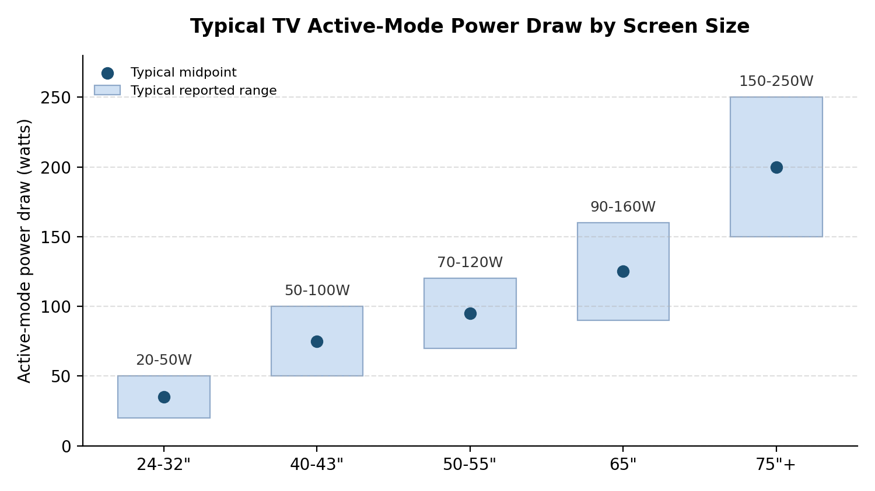
Figure 1. Typical active-mode power draw by screen size, compiled from manufacturer specifications and industry measurement sources. Ranges reflect normal variation across brands, panel types, and picture settings, not a single fixed value.
| Screen size | Typical active-mode draw | Common midpoint |
| 24–32 inches | 20–50 W | ≈35 W |
| 40–43 inches | 50–100 W | ≈75 W |
| 50–55 inches | 70–120 W | ≈95 W |
| 65 inches | 90–160 W | ≈125 W |
| 75 inches and larger | 150–250 W or more | ≈200 W |
Ranges compiled from manufacturer specification sheets, ENERGY STAR product data, and independently measured TV power consumption data across multiple current TV models. Individual units can fall outside these ranges depending on picture mode and settings.
Typical TV Power Draw by Display Technology
Screen size sets the general scale, but display technology determines where a specific TV falls within that range.
LED and LCD
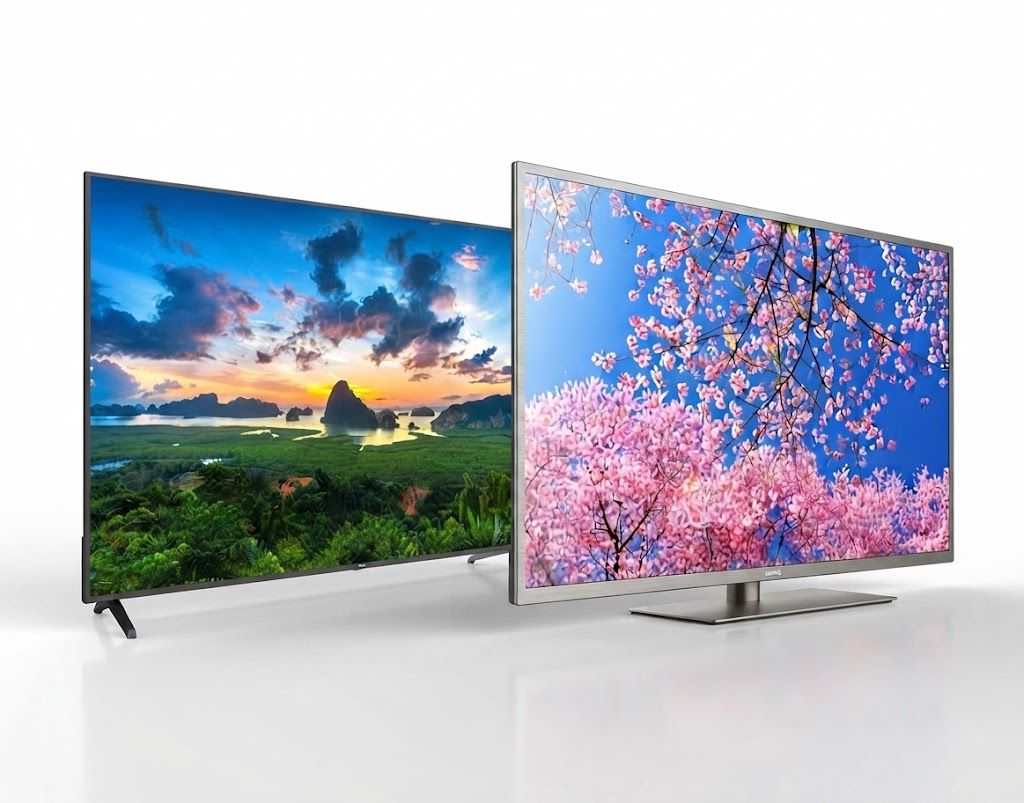
Standard LED-backlit LCD televisions are currently the most power-efficient mainstream display technology, because the backlight can be dimmed independently of picture content in many designs. A mid-size LED TV commonly falls at or below the midpoint of the ranges in Figure 1.
QLED
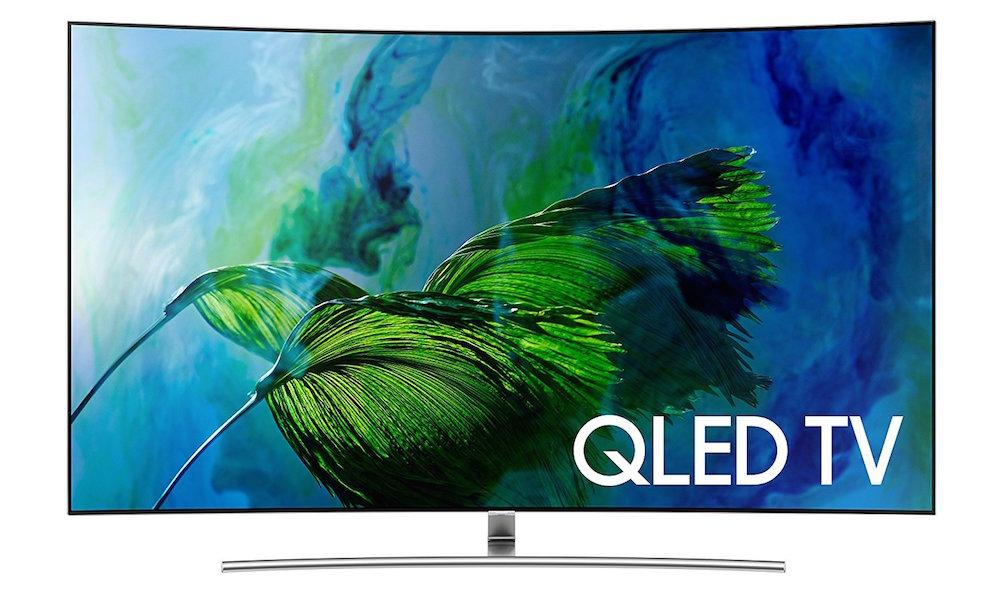
QLED televisions are LED-backlit LCD panels with an added quantum-dot filter layer that improves color and peak brightness. That extra brightness capability typically pushes power draw 10 to 20 percent above a comparable standard LED model at the same screen size, particularly when HDR content is displayed at high brightness.
OLED
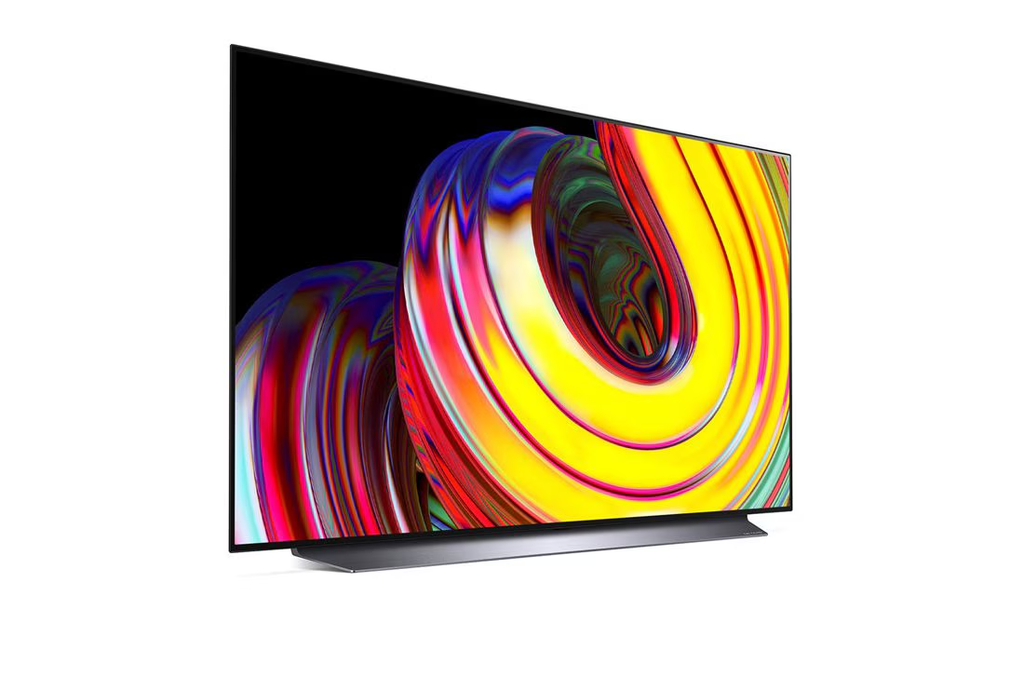
OLED panels are self-emissive: every pixel produces its own light rather than being illuminated by a backlight. This makes OLED TVs highly efficient on mostly dark content, since unlit pixels draw almost no power, but power draw rises sharply with average picture brightness. A bright HDR scene can push an OLED set to 200 W or more even at a mid-size screen, while a dark film scene on the same TV may draw a fraction of that. This content dependence is larger for OLED than for LED-backlit designs, and it is why a single wattage figure is less meaningful for OLED sets than for LED sets.
Plasma (legacy)
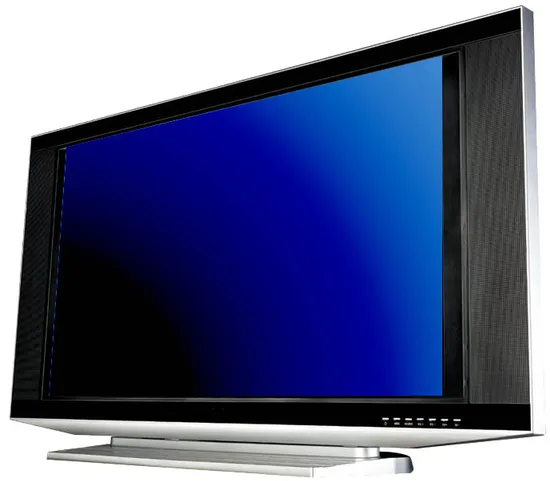
Plasma televisions, now discontinued from new production, drew substantially more power than any current display technology, commonly 200 to 500 W depending on size and brightness. A plasma set still in service should be treated as a high-draw appliance for any backup power calculation.
Standby Power
A television that appears to be off while plugged in is usually in standby (sleep) mode, drawing a small but continuous amount of power to enable quick startup, maintain smart-TV connectivity, and respond to a remote or voice command. Under the current ENERGY STAR specification, a certified television must draw 0.5 W or less in sleep mode. The U.S. Department of Energy’s Federal Energy Management Program treats ENERGY STAR certified products as meeting a 1 W low-standby-power threshold for federal purchasing guidance. Older or non-certified sets, and TVs with certain always-on smart features enabled, can draw more than this.
Check Out: How to Calculate the Battery Capacity for Portable Power Station
Standby draw is negligible for a single evening of backup power planning, but it matters for two other calculations: whole-home standing load on a UPS that stays connected continuously, and the annual electricity-cost figure printed on a TV’s federal EnergyGuide label, which factors in standby hours alongside active-mode hours.
| Reading an EnergyGuide Label Correctly The FTC television EnergyGuide label reports an estimated annual kWh figure based on a standardized assumption of 5 hours of active-mode use and 19 hours of standby use per day, at a fixed reference electricity rate. That annual figure describes a specific usage pattern, not the TV’s instantaneous wattage. Dividing the annual kWh by 8,760 hours does not produce the TV’s running wattage, because the calculation blends two very different power levels (active mode and standby) across two very different amounts of time. For a backup power calculation, use the active-mode wattage from Figure 1 or the rear-panel label, not the EnergyGuide annual total. |
Calculating TV Energy Consumption
Once an active-mode wattage figure is established, energy consumption over any period follows directly from one relationship.
E = P × t
Where E is energy in watt-hours (Wh), P is power in watts (W), and t is time in hours (h).
Worked example: daily and monthly consumption
Consider a 55-inch LED television with a typical active-mode draw of 95 W, watched for 4 hours per day.
- Daily energy: E = 95 W × 4 h = 380 Wh
- Monthly energy (30 days): 380 Wh × 30 = 11,400 Wh ≈ 11.4 kWh
- Annual energy (365 days): 380 Wh × 365 = 138,700 Wh ≈ 138.7 kWh
At a representative U.S. residential electricity rate of roughly $0.16 per kWh, that works out to approximately $22 per year for the television alone, before accounting for a connected soundbar, streaming device, or game console, each of which adds its own load on top of the TV.
Sizing Backup Power for a TV
Backup power sizing uses the same E = P × t relationship in reverse: the target runtime and the connected load determine the required energy capacity, then that theoretical figure is adjusted upward to account for real losses.
Step 1: Add up the connected continuous load
A TV is rarely the only device on the circuit. A realistic entertainment-system load during an outage might include:
- 65-inch LED television: 125 W (typical midpoint, Figure 1)
- Soundbar: 20 W
- Streaming device: 15 W
- Wi-Fi router: 10 W
- Total continuous load: 170 W
Step 2: Calculate the theoretical energy requirement
For a target backup duration of 5 hours:
E = 170 W × 5 h = 850 Wh
Step 3: Account for inverter and battery-management losses
A portable power station does not deliver its full rated watt-hour capacity as usable AC output. Converting stored DC battery energy to AC power through the built-in inverter typically loses roughly 10 to 15 percent to conversion inefficiency, and the battery management system reserves a small margin of capacity that is not available for discharge. A combined usable fraction of approximately 85 percent is a reasonable planning assumption for a modern pure sine wave unit, though the exact figure varies by model and should be checked against the manufacturer’s specifications where precision matters.
Required rated capacity = theoretical energy ÷ usable fraction:
850 Wh ÷ 0.85 ≈ 1,000 Wh
Step 4: Match to a practical unit size
An 850 Wh theoretical requirement translates to roughly a 1,000 Wh class power station once realistic losses are included, not an 850 Wh unit. Rounding up to the next commonly available capacity class, rather than to the calculated figure exactly, leaves margin for battery aging, colder operating temperatures, and a slightly longer outage than planned.
| Continuous Power Matters More Than Surge Power Here Loads such as refrigerator compressors and power tool motors draw a brief surge current at startup that can be several times their running wattage, which is why sizing guides for those appliances emphasize a power station’s surge rating. A television has no comparable startup surge. The specification that matters for TV backup sizing is the inverter’s continuous power rating and the available watt-hour capacity, not its surge rating. A power station with a 300 W continuous rating and 850 Wh of usable capacity is a better match for a 170 W entertainment-system load than a unit with a higher surge rating but less stored energy. |
Common Mistakes in TV Power Calculations
Using the maximum rated wattage instead of typical active-mode draw
The maximum figure on a spec sheet represents a worst-case bright-picture test, not ordinary viewing. Using it for every calculation tends to oversize backup power unnecessarily, though it remains a reasonable safety margin when the exact typical figure for a specific model is unknown.
Treating the EnergyGuide annual kWh figure as running wattage
As explained above, the annual kWh figure blends active and standby hours under a fixed usage assumption. It answers “how much will this cost to run over a year,” not “how many watts does this draw right now.”
Ignoring everything connected to the TV
A soundbar, game console, streaming box, or cable box often draws as much power as the television itself, and in the case of a modern game console under load, can exceed it. A backup power or runtime calculation built around the TV alone will fall short in practice.
Assuming rated battery capacity equals usable AC energy
As shown in Step 3 above, inverter conversion losses and battery management limits mean that a power station’s printed Wh rating is not fully available as AC output. Sizing to the rated capacity figure, without applying a usable-fraction adjustment, is a common source of backup power systems that run out earlier than expected.
Frequently Asked Questions
Does a bigger TV always use more power than a smaller one?
In general, yes, screen size is the strongest single predictor of TV wattage. It is not an absolute rule, however: a large, efficient LED model can draw less power than a smaller OLED or plasma set displaying a bright image, because display technology and picture brightness also affect the result.
Can a small portable power station run a TV overnight?
It depends on the power station’s usable capacity and the TV’s actual draw, not on the TV alone. A 100 W TV run for 8 hours requires roughly 800 Wh of theoretical AC energy, which corresponds to approximately 950 Wh of rated battery capacity after accounting for typical conversion losses. A small 300 Wh class power station is not sized for an 8-hour run at that load.
Does turning a TV off at the wall save meaningful energy?
For an ENERGY STAR certified set, standby draw is limited to 0.5 W or less, so unplugging it saves only a small amount of energy compared with active-mode viewing. For an older or non-certified TV with a higher standby draw, or for other connected devices such as cable boxes that often draw far more in standby than a TV does, unplugging can be more worthwhile.
Do OLED TVs use more power than LED TVs?
It depends on the content. OLED panels use very little power on dark scenes because unlit pixels draw almost nothing, but power draw rises sharply on bright content, often exceeding a comparably sized LED TV under the same conditions. There is no single correct answer independent of what is on screen.
Conclusion
A television’s power draw is not a fixed number stamped on the box. It is a range set primarily by screen size and display technology, and it moves within that range depending on picture brightness and content. For most planning purposes, the typical active-mode figures in Figure 1, rather than the maximum rated wattage or the EnergyGuide annual total, are the right starting point.
For backup power sizing specifically, the calculation that matters is not the TV’s wattage in isolation. It is the full connected load, converted to watt-hours over the intended runtime, and then adjusted upward for inverter and battery-management losses before it is matched to an available power station or UPS capacity. Skipping that adjustment is the most common reason a backup system that looks adequate on paper runs out before the outage ends.
Before sizing a UPS or portable power station around a television, the next specification worth checking is the unit’s continuous AC output rating against the full entertainment-system load, not just the TV by itself, since a soundbar, streaming device, and router are usually part of the same circuit.
Sources
- ENERGY STAR, U.S. EPA – “Televisions” product specification page (sleep-mode and on-mode requirements)
- U.S. Department of Energy, Federal Energy Management Program – “Purchasing Energy-Efficient Televisions” (standby power threshold, EnergyGuide annual-use methodology)
- Federal Trade Commission – Television EnergyGuide labeling requirements (5-hour active / 19-hour standby test assumption)
- Lawrence Berkeley National Laboratory, prepared for ENERGY STAR TV specification revision – average power consumption by display type (CRT, LCD, plasma, DLP)
- RTINGS.com – independent LED and OLED TV power consumption testing, compiled alongside manufacturer specification sheets for the screen-size ranges in Figure 1