Can a Portable Power Station Run a CPAP Machine?
Quick Answer
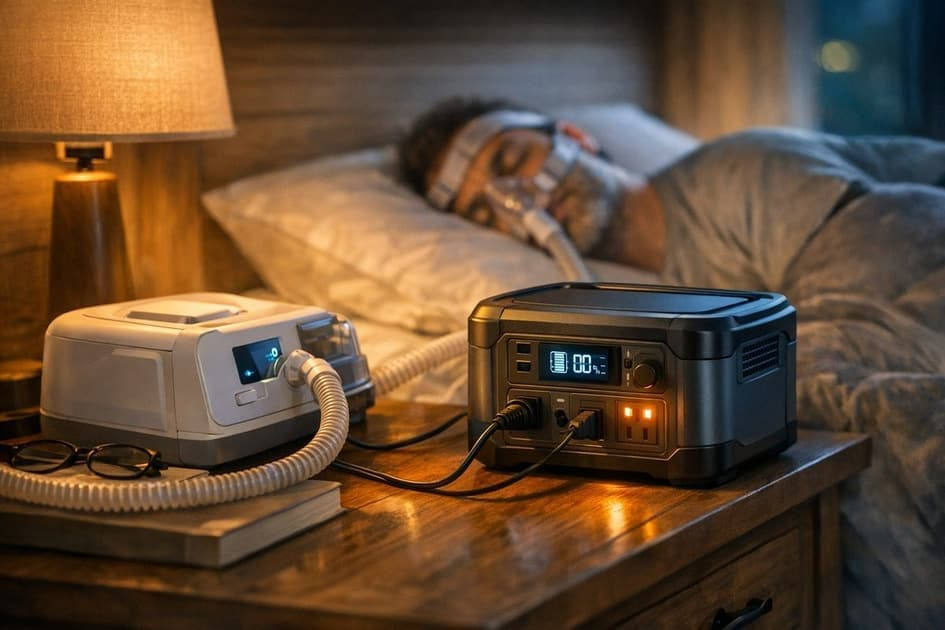
A portable power station can run a CPAP machine easily, including one with a heated humidifier, for a full night on a comparatively small amount of stored energy. A CPAP with no humidification averages roughly 7 to 20W. Add a heated humidifier and average draw rises to about 20 to 30W. Add heated tubing on top of that and it typically reaches 30 to 45W. Even at the high end, a 300Wh power station covers a full night with margin to spare, and a 500Wh to 1000Wh unit covers multiple nights.
The specification that actually determines compatibility is not battery capacity. It is waveform. A CPAP machine, particularly one with a heated humidifier, needs pure sine wave AC output. Nearly every mainstream portable power station sold today produces pure sine wave power, but a cheap standalone inverter or an off-brand power bank with an AC outlet sometimes does not, and that is the detail worth checking before an outage, not the Wh rating printed on the box.
How Much Power Does a CPAP Machine Actually Use?
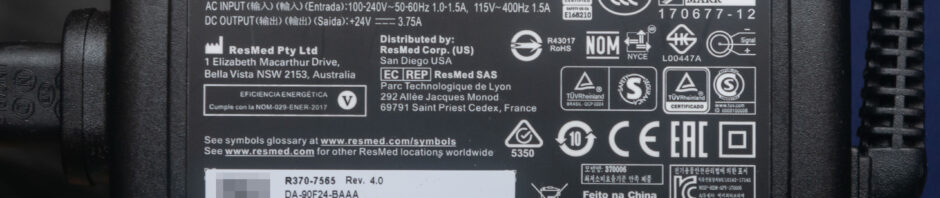
Marketing material and CPAP power supply labels tend to describe a maximum capacity, not typical operation, which has left a wide and somewhat inconsistent set of numbers circulating online. The most reliable figures come directly from ResMed’s own published power consumption data for its Air10 platform (AirSense 10, AirCurve 10), measured with a calibrated power meter under a standardized breathing simulation rather than estimated from the power supply’s rating.
| Configuration | Measured Energy | Average Power |
| AirSense 10 AutoSet, standby | 5 Wh over the standby period | Low, non-continuous |
| AirSense 10 AutoSet, device only | 7 Wh per hour of use | ≈ 7 W |
| AirSense 10 AutoSet, device + heated humidifier | 22 Wh per hour of use | ≈ 22 W |
| AirSense 10 AutoSet, device + humidifier + ClimateLineAir heated tube | 34 Wh per hour of use | ≈ 34 W |
| AirCurve 10 bilevel and ASV variants, full heat | 41–44 Wh per hour of use | ≈ 41–44 W |
Table 1. Manufacturer-measured energy consumption for ResMed Air10-platform devices, from ResMed’s published Air10 power consumption datasheet.
Independent verification points the same direction. One documented case of overnight logging on a mains-connected CPAP recorded an average of 173.6 Wh consumed over a full night, with a low of 136.1 Wh and a high of 228.2 Wh depending on settings; averaged across an 8-hour night, that lands at roughly 17 to 29W, consistent with the manufacturer’s device-plus-humidifier figures above. Travel CPAP machines without any heating components draw less still, typically 5 to 20W, since they have no humidifier or heated tube to power.
The commonly cited “30 to 60W, or up to 100W with a humidifier” figures found across many CPAP retailer blogs are not necessarily wrong, but they tend to describe a broader range of machines and settings, including higher humidity levels, colder ambient temperatures that force the heater to work harder, and older or bilevel devices that draw more than a basic AutoSet unit. Treat 7 to 20W as a realistic floor for device-only operation, 20 to 30W as a realistic middle for humidifier use, and 30 to 45W as a reasonable planning ceiling for humidifier-plus-heated-tube operation, and size accordingly rather than defaulting to the highest number seen online.
Why the Power Supply’s Wattage Rating Overstates What the Machine Draws
The ResMed AirSense 10 and AirCurve 10 series ship with a 90W AC power supply. That number describes the adapter’s maximum rated output, sized to cover the worst case of full heater output on both the humidifier plate and the heated tube running simultaneously at the highest temperature and humidity settings. It is not what the machine draws during a typical night, and using it as the load figure in a runtime calculation would understate real-world runtime by a factor of two to four, the same nameplate-versus-actual-draw error covered in more general terms in Watts vs Watt-Hours: What Is the Difference?.
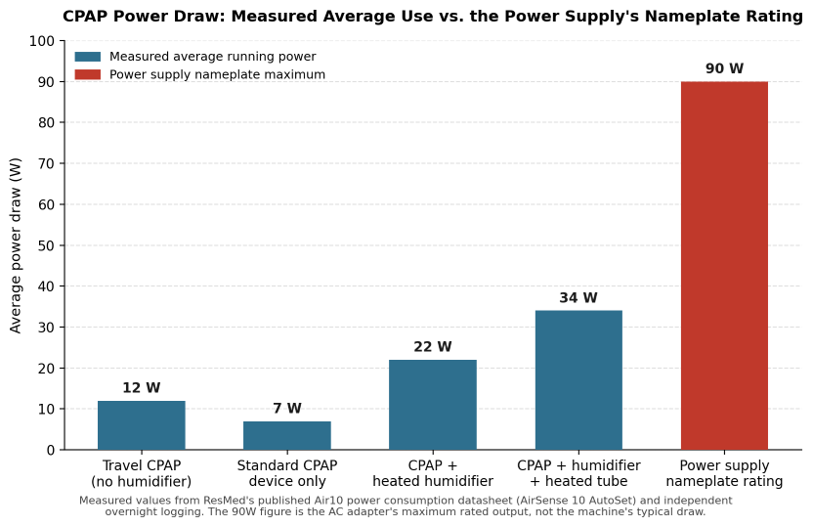
Figure 1. Measured average CPAP power draw across common configurations, compared with the power supply’s 90W nameplate rating. The nameplate figure is a maximum capacity rating, not a typical load.
This distinction matters directly for sizing. A reader who assumes their CPAP draws 90W and sizes a power station around that figure will buy roughly three to four times more battery capacity than the machine actually needs, adding unnecessary weight and cost. A reader who assumes the opposite, that the low end of the range always applies, risks undersizing for a machine that genuinely runs its humidifier and heated tube at a high setting through a full winter night.
Calculating CPAP Runtime on a Portable Power Station
CPAP runtime follows the same usable-energy method used across every Sielectronix runtime guide, detailed fully in How to Calculate Portable Power Station Runtime. A CPAP machine is a useful case study for that method because it is a light, steady, all-night load, which makes the standby-draw correction that guide describes for loads under roughly 50W proportionally significant rather than a rounding error.
The formula
Usable AC Energy (Wh) = Nominal Capacity (Wh) × 0.80
Runtime (h) = Usable AC Energy (Wh) ÷ (CPAP Average Load (W) + Standby Draw (W))
The 0.80 factor combines roughly 95 percent usable depth of discharge with roughly 85 percent inverter efficiency for a typical modern LiFePO4 power station, the same planning figure used throughout the Sielectronix runtime and capacity guides. Standby draw is the inverter’s own continuous consumption just to keep the AC outlet live, typically 5 to 15W depending on the model; this article uses 8W as a representative mid-range figure. For a 20 to 45W CPAP load, that 8W is not a rounding error. It is 15 to 35 percent of the total draw, and skipping it is one of the most common reasons a simple online calculator overstates CPAP runtime.
Worked Examples
Case 1: A travel night with no humidifier on a compact power station
A basic CPAP with the humidifier switched off averages about 15W.
Usable AC energy = 256 Wh × 0.80 = 204.8 Wh
Runtime = 204.8 Wh ÷ (15 W + 8 W) = 204.8 ÷ 23 ≈ 8.9 hours
A single overnight of 7 to 8 hours fits comfortably within a small, travel-sized power station, with roughly an hour of margin for a longer night or a slightly higher pressure setting.
Case 2: A full night with the heated humidifier running, mid-size station
A standard CPAP with the heated humidifier on, no heated tube, averages about 30W.
Usable AC energy = 500 Wh × 0.80 = 400 Wh
Runtime = 400 Wh ÷ (30 W + 8 W) = 400 ÷ 38 ≈ 10.5 hours
This case matches the same 300Wh humidifier scenario already used as the illustrative CPAP example in the Sielectronix runtime guide, which divides 240Wh by a flat 30W to get 8.0 hours. The 10.5-hour figure here uses a larger 500Wh unit and additionally folds in the 8W standby draw that guide’s simplified example skips for clarity; both are correct within their stated assumptions, and the difference simply shows why the standby-draw refinement matters more as the load gets lighter.
Case 3: Heated humidifier and heated tube on a larger station, multi-night backup
A CPAP running full comfort settings, humidifier and heated tube both active, averages about 45W.
Usable AC energy = 1000 Wh × 0.80 = 800 Wh
Runtime = 800 Wh ÷ (45 W + 8 W) = 800 ÷ 53 ≈ 15.1 hours
Fifteen hours covers close to two full nights on the highest realistic comfort setting, which is a reasonable target for a household planning around a multi-day outage rather than a single interrupted night.
Runtime by Power Station Capacity and CPAP Setting
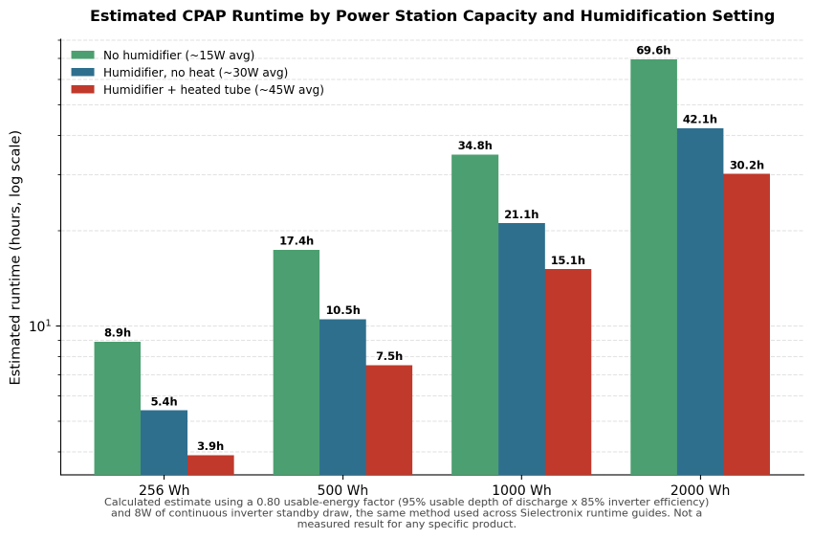
Figure 2. CPAP runtime across four common power station capacities and three humidification settings, calculated using the method above.
| Nominal Capacity | No Humidifier (≈15W) | Humidifier Only (≈30W) | Humidifier + Heated Tube (≈45W) |
| 256 Wh | 8.9 h | 5.4 h | 3.9 h |
| 500 Wh | 17.4 h | 10.5 h | 7.5 h |
| 1000 Wh | 34.8 h | 21.1 h | 15.1 h |
| 2000 Wh | 69.6 h | 42.1 h | 30.2 h |
Table 2. Calculated runtime estimates, not measured results for any specific product. Uses the 0.80 usable-energy factor and 8W standby draw described above.
AC Outlet vs. Direct DC Connection: Getting More Nights per Charge
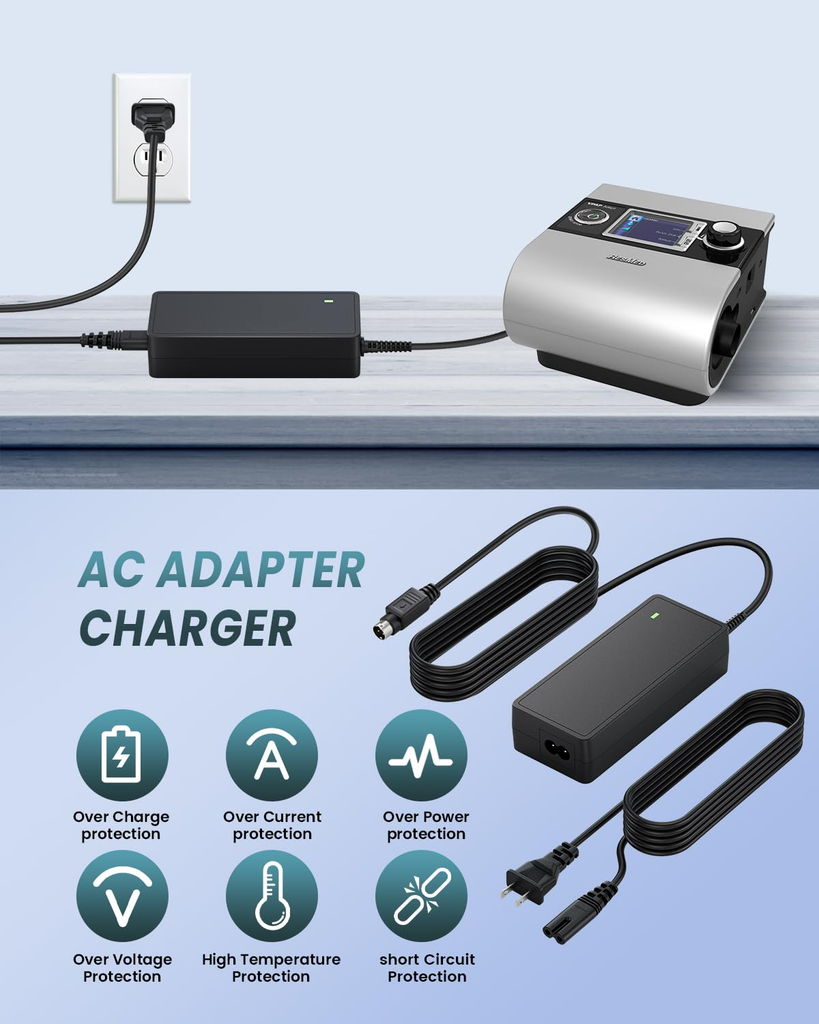
Every watt-hour that passes through a power station’s inverter loses roughly 15 percent to conversion, which is already baked into the 0.80 factor used above. A CPAP machine offers a way to avoid that loss entirely, because ResMed’s AirSense 10 and AirCurve 10 series run on 24V DC internally and simply use an AC adapter to create that voltage from a wall outlet.
Connecting the machine to a power station’s DC output instead, using ResMed’s own DC/DC converter (sold as part number 37344 for the AirSense 10 platform and as the Air11 DC/DC Converter for the AirSense 11 and AirCurve 11), skips the inverter stage altogether. The converter accepts a 12V or 24V source and regulates it to the 24V the machine needs.
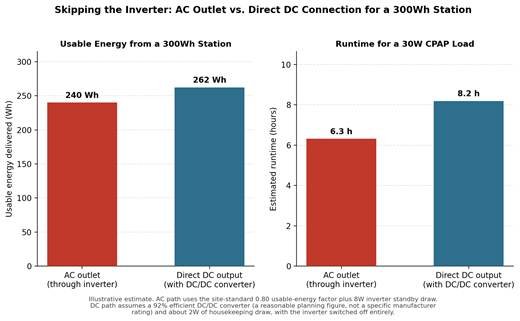
Figure 3. Comparison of usable energy and runtime for a 300Wh station powering a 30W CPAP load through the AC inverter versus a direct DC connection. Converter efficiency is a planning estimate, not a specific manufacturer figure.
The exact improvement depends on the specific DC/DC converter’s efficiency, which manufacturers do not always publish, so treat the roughly 30 percent runtime gain shown above as directionally correct rather than a precise universal figure. The practical requirement is a converter or cable rated for the correct output voltage and current for the specific CPAP model. A mismatched aftermarket DC cable is a genuine risk here, not a minor inconvenience: connecting the wrong voltage to a CPAP machine’s DC input can damage the device, so this path is worth pursuing only with a cable or converter explicitly rated for the exact model in use, ideally the manufacturer’s own accessory.
Pure Sine Wave: The Compatibility Requirement That Actually Matters
A CPAP’s blower motor and, more importantly, its heating elements respond poorly to the stepped, approximated AC waveform that a modified sine wave inverter produces. Reported symptoms include error codes, unusual humming, inconsistent pressure delivery, and machines that shut down mid-cycle. Some CPAP machines with simple switching power supplies tolerate modified sine wave power without obvious problems, but this varies by model and is not something to assume without checking the label on the power supply or the machine’s manual.
The practical resolution is straightforward: nearly every portable power station marketed for home backup, camping, or general household use today specifies pure sine wave output as a standard feature, unlike some older or bargain standalone inverters. Before relying on a specific unit for CPAP backup, confirm “pure sine wave” appears explicitly in its specifications rather than assuming it based on brand reputation or price point alone, a general point covered further in How Portable Power Stations Work.
Peak Draw and Power Factor: Why Inverter Sizing Needs More Headroom Than the Average Suggests
Average power tells you how much energy a night requires, but it is not the same as the power an inverter must be able to deliver at any given instant. In an independent, professionally instrumented case study, an owner logged a ResMed AirSense 10 Elite (8cmH2O prescription, heated humidifier and heated tube) over 11 consecutive nights using a Tektronix PA1000 power analyzer. The results averaged 173.6Wh per night, ranging from 136.1 to 228.2Wh, which corresponds to an average running power around 17.7W.
The peak power drawn at any point during a night, however, averaged 43.2W and reached as high as 57.6W across the logged nights, well above the nightly average even though it remained comfortably under the 90W adapter rating.
This peaking behavior also matters for apparent power (VA), not just real power (W). A CPAP’s switch-mode power supply has a fairly low power factor, meaning the ratio of real to apparent power sits well below 1.0, particularly near idle; the same measurements found a power factor around 0.38 at idle, rising to roughly 0.58 to 0.8 as load increased.
Since inverters are ultimately limited by VA capability as well as wattage, a purely watts-based calculation can understate what the inverter actually has to handle for a moment.
A practical margin is to size a power station’s continuous AC rating at roughly double the CPAP’s peak wall-power figure; for a machine peaking around 45 to 60W, that calls for a 150 to 200W continuous rating, which is well within what nearly every portable power station on the market already provides, including the compact units discussed earlier in this article.
This same data set is useful for a more conservative sizing approach than the tiered estimates above, worth considering for anyone treating CPAP backup as a genuine necessity rather than an occasional convenience. Take the worst recorded or expected night’s energy use, add roughly 10 percent as a margin against an even worse night, apply the usable-energy factor as before, and add a further 10 to 20 percent so the battery is not routinely run close to empty, since repeated full discharge shortens LiFePO4 cycle life faster than partial cycling does.
Applied to the 228.2Wh worst-night figure above, that reasoning points toward roughly 360 to 400Wh for dependable single-night coverage, noticeably more than a straightforward average-load calculation would suggest, and a useful reminder that averages alone can understate what a truly dependable backup setup needs.
What Does It Cost to Run a CPAP Overnight?
A related and frequently asked question, separate from backup power, is simply what a CPAP costs to run on grid electricity, since it uses the same nightly Wh figures from a different angle. Applying the 173.6Wh average nightly consumption measured above to typical residential electricity pricing puts the running cost at a small fraction of most home appliances, generally a few cents per night.
To estimate a specific figure, multiply the nightly Wh consumption appropriate to the machine’s configuration (see the measured figures earlier in this article) by the local price per kWh, then divide by 1000; even at the higher end of the measured range, a heated humidifier and heated tube running nightly typically remains a minor addition to a household’s overall electricity bill compared with major appliances like refrigeration or water heating.
Sizing a Power Station for CPAP Backup
Match the power station to how the CPAP is actually configured and how many nights of backup are the realistic planning target, not the worst theoretical case.
- Single night, no humidifier, minimal margin: a 150 to 250Wh unit is generally sufficient, based on the roughly 8 to 9 hour result at 15W shown in Case 1 above.
- Single night with a heated humidifier, comfortable margin: 300 to 500Wh covers the 20 to 30W range with room for a longer or colder night.
- Heated humidifier and heated tube, or planning for a multi-night outage: 500 to 1000Wh or larger, depending on how many nights of backup are the actual target.
- Running other essential loads from the same unit, a router, a lamp, phone charging, alongside the CPAP: add each additional load’s average power to the CPAP figure before applying the runtime formula, rather than sizing for the CPAP alone and assuming the rest is free.
For a full sizing walkthrough that accounts for multiple simultaneous loads and a defined outage duration, see What Size Portable Power Station Do I Need? and How to Calculate the Battery Capacity for a Portable Power Station.
Common Mistakes When Powering a CPAP from a Power Station
Using the power supply’s 90W rating as the load
This overstates real consumption by roughly a factor of two to four for most nights, leading to an oversized and unnecessarily expensive power station purchase.
Ignoring standby draw because the CPAP load looks small
An 8 to 15W inverter standby draw is easy to dismiss next to a 500W appliance, but next to a 20 to 30W CPAP it can represent a quarter or more of total consumption. Skipping it in the calculation produces an optimistic runtime that a real night of use will not match.
Assuming any AC outlet will work
A modified sine wave inverter or budget power bank with an AC outlet is not guaranteed to run a CPAP’s heating elements reliably. Confirm pure sine wave output before relying on any specific unit.
Using an unverified DC cable to chase efficiency gains
The DC-direct connection described above genuinely improves runtime, but only with a cable or converter rated for the CPAP’s exact voltage and current requirements. A mismatched cable risks damaging the machine rather than simply failing to work.
Never testing the setup before an actual outage
A power station that has never been connected to the CPAP before the night it is actually needed is a gamble. Confirming compatibility, cable fit, and one full night of real runtime ahead of time removes the two most common failure points: the wrong cable and an assumption about waveform compatibility that turns out to be wrong.
Practical Notes
CPAP therapy is prescribed medical equipment for many users, and this article addresses electrical compatibility and runtime, not medical guidance. Anyone who depends on CPAP therapy nightly and is planning backup power should also raise the plan with their durable medical equipment provider or physician, particularly if a chronic power reliability issue, rather than an occasional outage, is the underlying concern.
A portable power station used for CPAP backup functions differently from a true UPS: most power stations require manually plugging the CPAP into the unit rather than switching over automatically when mains power fails. For an automatic, no-interruption transition, see the comparison in Portable Power Station vs UPS. Cold ambient temperature also reduces both usable battery capacity and, to a lesser extent, inverter efficiency, so a runtime calculated at room temperature should be treated as an upper bound during a winter outage, not a guaranteed result.
Frequently Asked Questions
Can a small USB power bank run a CPAP machine?
Not directly in most cases. A standard phone power bank outputs 5V, 9V, or 12V over USB, which does not match a CPAP’s AC or 24V DC input without a compatible adapter cable. A handful of CPAP-specific battery packs exist with the correct voltage output and connector, but a generic phone power bank is not a substitute for a portable power station or a dedicated CPAP battery.
Does a CPAP require a pure sine wave power station?
Most CPAP machines, especially those with a heated humidifier or heated tubing, are designed around clean AC power and can behave unpredictably on modified sine wave output. Since nearly all mainstream portable power stations now ship with pure sine wave inverters as standard, this is rarely a limiting factor in practice, but it is worth confirming on the specification sheet rather than assuming.
Do CPAP power banks or power stations count as medical equipment for air travel?
No. The FAA and TSA apply the same lithium battery watt-hour rules regardless of what the battery is intended to power: batteries up to 100Wh travel in carry-on without restriction, batteries from 101 to 160Wh require airline approval and are limited to two spares per passenger, and batteries above 160Wh are not permitted on passenger aircraft. A CPAP prescription does not change these limits, though airlines commonly allow the CPAP machine itself as an additional item beyond standard carry-on allowances.
How many nights will a 1000Wh power station run a CPAP?
Based on the calculations above, roughly two nights with the heated humidifier and heated tube both running (about 15 hours total), or four to five nights with the humidifier off (nearly 35 hours total). Actual results vary with the specific machine’s settings and the power station’s age and ambient temperature.
Will nightly CPAP use wear out a power station faster than other loads?
Not meaningfully more than any other appropriate load. What matters for battery longevity is total energy cycled and depth of discharge per cycle, not the specific appliance connected. A CPAP’s steady, moderate, predictable draw is, if anything, an easier load for a battery management system to handle than a high-surge appliance.
Conclusion
A portable power station is well suited to CPAP backup precisely because a CPAP’s real average draw, 7 to 45W depending on humidification, is far below what the machine’s 90W power supply rating suggests. Even a compact 300 to 500Wh unit covers a full night with margin, and the two decisions that actually determine a good outcome are choosing a power station with confirmed pure sine wave output and sizing capacity to the humidifier and heated-tube settings actually in use rather than to the power supply’s worst-case rating. Where the power station supports it, a correctly rated direct DC connection removes the inverter’s conversion loss entirely and extends runtime further on the same battery.
For the underlying calculation method applied here, see How to Calculate Portable Power Station Runtime. To size a power station around a CPAP plus other essential devices for a planned outage duration, see What Size Portable Power Station Do I Need?.
Sources
Technical assumptions and figures in this article were checked against the following published sources.
- ResMed, “Power consumption of Air10™ devices” (manufacturer-measured Wh-per-hour energy consumption by device and configuration).
- ResMed, “CPAP batteries and adaptors” (official guidance on external battery and DC/DC converter use).
- The CPAP Shop, ResMed AirSense 10 90W AC Power Supply listing (OEM power supply wattage rating and compatible models).
- Gough’s Tech Zone, independent overnight CPAP power logging (measured full-night AC energy consumption for cross-validation).
- Federal Aviation Administration, “Airline Passengers and Batteries” (lithium battery watt-hour travel limits).
- Sielectronix, “How to Calculate Portable Power Station Runtime” (site-standard usable-energy factor and runtime methodology).