How Much Power Does a Refrigerator Use?
A refrigerator is one of the few household loads that never truly switches off, which makes it the single most important appliance to size correctly before choosing a generator, portable power station, or home backup system. The nameplate rating printed on the unit is not the number that matters for that decision. This guide explains running watts, starting watts, duty cycle, and the calculation that converts a refrigerator’s power draw into a usable energy budget.
Quick Answer
Most residential refrigerators draw between 100 and 400 running watts while the compressor is active, with a brief starting surge of 2 to 3 times that figure, commonly 350 to 1,200 watts, lasting a few seconds. Because the compressor cycles on and off rather than running continuously, actual average consumption is far lower than either figure, typically 40 to 100 watts averaged over a full day. An independent analysis of 2,450 ENERGY STAR-certified refrigerators put average annual consumption at 493 kWh per year, equivalent to a continuous average draw of about 56 watts.
Daily energy (Wh) = Average continuous watts × 24 hours
The average continuous figure, not the running watts printed on the compressor plate, is what determines a refrigerator’s electricity bill. The running watts and starting watts figures are what determine whether a generator, inverter, or portable power station can start and sustain the appliance. Both numbers matter, and they answer different questions, a distinction covered in more depth in Sielectronix’s guide to watts versus watt-hours.
Running Watts vs. Starting Watts
A refrigerator’s compressor is an induction motor, and induction motors draw substantially more current the instant they start than they do once spinning at operating speed. This creates two distinct wattage figures that are frequently confused.
Running Watts
Running watts, also called steady-state or continuous watts, is the power the compressor draws once it has started and is actively cooling. For most household refrigerators this falls between 100 and 400 watts, with larger side-by-side and French-door units reaching 400 to 800 watts under some conditions.
Starting Watts
Starting watts, also called surge watts or locked-rotor watts, is the brief spike the compressor motor draws at the instant of startup, before it reaches operating speed. This surge is typically 2 to 3 times the running wattage and lasts only a few seconds, but it is the figure that determines whether a generator or portable power station can start the refrigerator at all. A power source that comfortably covers the running watts but not the starting watts will fail to start the compressor, even though its continuous rating looks adequate on paper.
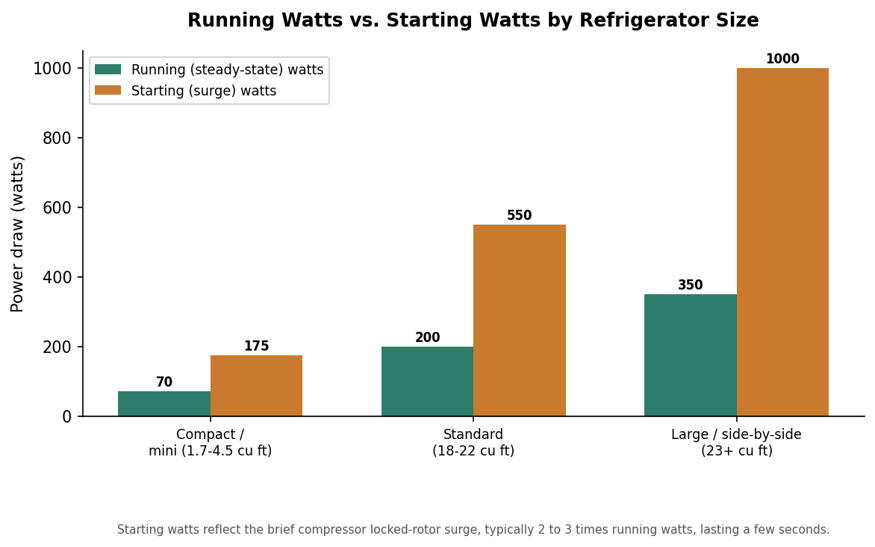
Figure 1. Running watts versus starting watts by refrigerator size class. Starting watts is a brief surge, not a sustained load, but backup equipment must still be rated to cover it.
Typical Wattage by Refrigerator Type
| Refrigerator Type | Running Watts | Starting Watts | Typical Duty Cycle |
| Compact / mini (1.7-4.5 cu ft) | 40-100 W | 100-250 W | 30-45% |
| Top-freezer, standard (18-22 cu ft) | 100-250 W | 250-700 W | 30-40% |
| French-door / counter-depth | 150-400 W | 400-1,000 W | 30-45% |
| Side-by-side, large | 200-400 W | 500-1,200 W | 35-50% |
| Older unit (15+ years, any type) | 300-800 W | 700-2,000 W | 40-55% |
Table 1. Approximate ranges compiled from manufacturer Energy Guide data and typical compressor sizing. A specific unit’s nameplate will state its own rated current and voltage.
Why the Compressor Does Not Run Continuously
A refrigerator’s compressor is controlled by a thermostat. Once the interior reaches its set temperature, the compressor shuts off; once the interior warms past a threshold, it restarts. This on-and-off pattern is called the duty cycle, and it is the reason a refrigerator’s actual energy consumption is far lower than its running wattage would suggest if it ran continuously.
Duty cycle is not fixed. It depends on the thermostat setting, insulation quality, ambient room temperature, how often the door opens, and how much warm food is placed inside. A refrigerator in a hot garage or one that has its door opened frequently during a power outage, when occupants are checking on food, will run a higher duty cycle than the same unit under normal conditions.
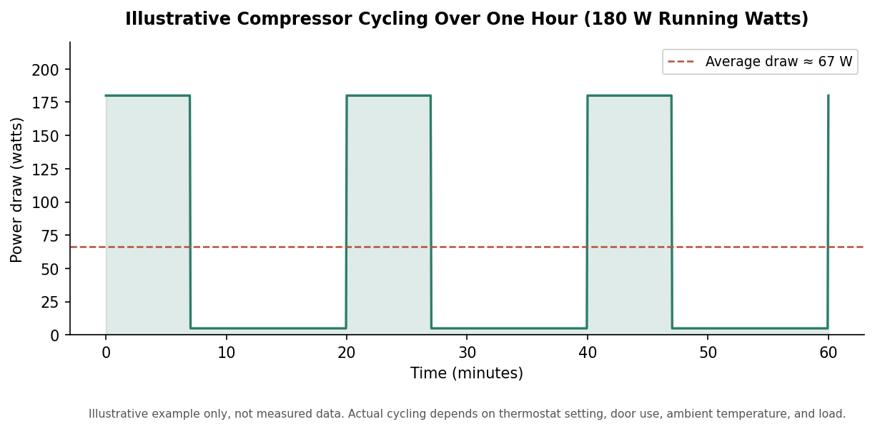
Figure 2. Compressor cycling pattern over one hour for a 180 W running-watts refrigerator. This is a simplified example, not a measurement of any specific unit.
Converting Running Watts to Daily and Annual Energy Use
Once running watts and duty cycle are known, or estimated, the average continuous draw and the resulting energy consumption can be calculated directly.
Average continuous watts = Running watts × Duty cycle
Daily energy (Wh) = Average continuous watts × 24
Annual energy (kWh) = Daily energy (Wh) × 365 / 1,000
Worked Example
Consider a standard top-freezer refrigerator with a compressor rated at 150 running watts and a duty cycle of 35 percent, a realistic figure for a unit in normal household use.
| Step | Calculation | Result |
| Average continuous draw | 150 W × 0.35 | 52.5 W |
| Daily energy | 52.5 W × 24 h | 1,260 Wh (1.26 kWh) |
| Annual energy | 1.26 kWh × 365 | 459.9 kWh/year |
This result, roughly 460 kWh per year, lands close to the 493 kWh per year average measured across 2,450 ENERGY STAR-certified refrigerators, which is a useful cross-check on the assumptions used. It also falls squarely inside the 381 to 650 kWh per year range reported for top-freezer and French-door units, confirming that a 150 W running-watts, 35 percent duty-cycle model is a reasonable planning assumption for a standard-size refrigerator, not just a theoretical exercise.
Two assumptions do most of the work in this calculation: running watts and duty cycle. Neither can be read directly off a nameplate. The nameplate current rating reflects the maximum the circuit must safely handle, including motor-starting current, and it commonly overstates actual running watts. Treating the nameplate amperage as the running wattage is one of the most common sizing errors, addressed further below.
Annual Energy Use and Cost by Refrigerator Type
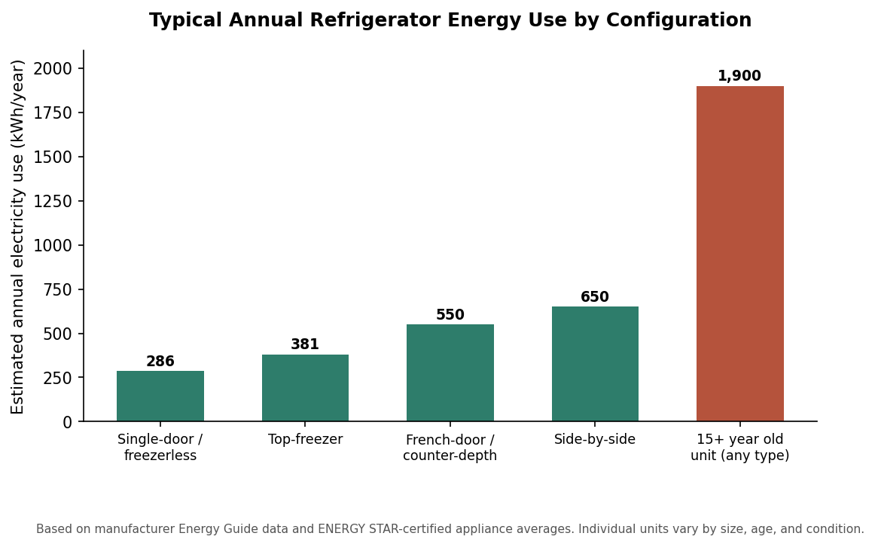
Figure 3. Typical annual electricity use by refrigerator configuration. Older units, particularly those over 15 years old, commonly use two to four times the energy of a comparable new ENERGY STAR-certified model.
| Refrigerator Type | Typical Annual Use | Approx. Cost at $0.16/kWh |
| Single-door / freezerless | 286 kWh/yr | ≈ $46/yr |
| Top-freezer, standard | 381 kWh/yr | ≈ $61/yr |
| French-door / counter-depth | 500-600 kWh/yr | ≈ $80-96/yr |
| Side-by-side, large | 600-700 kWh/yr | ≈ $96-112/yr |
| Older unit (15+ years) | 1,800-2,000 kWh/yr | ≈ $288-320/yr |
Table 2. Cost estimates use a representative U.S. average residential rate. Local utility rates vary significantly and should replace this figure for an accurate cost projection.
What Changes a Refrigerator’s Actual Power Use
The calculation above assumes typical conditions. Several factors push actual consumption meaningfully above or below the estimate.
- Age. Units built before roughly 2010 commonly lack modern variable-speed compressors and improved insulation, and can use two to four times the energy of a new ENERGY STAR model rated at a similar capacity.
- Ambient temperature. A refrigerator placed in a garage, sunroom, or near an oven works harder to maintain its setpoint, which increases duty cycle. Manufacturers typically rate performance for a 70 to 90°F ambient range; operation outside that range increases consumption and can shorten compressor life.
- Door openings and warm food. Each door opening lets warm, humid air in, and the compressor must remove that added heat load. Frequent openings or loading warm leftovers increases duty cycle for a period afterward.
- Condenser coil condition. Dust and debris on the condenser coils reduce heat rejection efficiency. Manufacturer guidance commonly cites meaningful efficiency loss from neglected coils, and periodic cleaning is a low-cost way to keep consumption near its rated value.
- Thermostat setting. Refrigerator and freezer compartments set colder than necessary increase run time without a meaningful food-safety benefit. A common recommendation is approximately 37°F (3°C) for the refrigerator compartment and 0°F (-18°C) for the freezer.
- Seal condition. A degraded door gasket allows continuous air infiltration, which can keep the compressor cycling far more often than the unit’s rated duty cycle.
Finding the Actual Number for a Specific Refrigerator
Generic ranges are useful for early planning, but any decision involving backup power sizing, circuit loading, or a purchase comparison benefits from the actual figures for the unit in question.
Read the Nameplate
The nameplate, usually located inside the refrigerator on a side wall or door frame, or on the back of the unit, lists rated voltage and rated current. Multiplying the two gives a maximum wattage figure, not the typical running wattage. This number should be treated as a ceiling for circuit and inverter surge sizing, not as the value to use in an energy calculation.
Check the Energy Guide Label
In the United States, the yellow EnergyGuide label required under the Federal Trade Commission’s Energy Labeling Rule states estimated annual kWh consumption based on standardized test conditions. This figure is the most reliable manufacturer-provided estimate for annual energy use and cost, and it already accounts for typical duty cycle. The ENERGY STAR refrigerator program provides an additional reference point, since certified models are independently verified against a consistent efficiency standard.
Measure It Directly
A plug-in power meter or a clamp meter placed on the refrigerator’s supply conductor gives the most accurate figure, capturing both running watts and the actual duty cycle in the appliance’s real operating environment. This is the preferred method when sizing a backup system for a specific refrigerator rather than working from published averages. A true-RMS clamp meter capable of resolving inrush current is useful for confirming the starting-current surge as well as the steady running current.
Using This Figure to Size Backup Power
Refrigerator power draw is one of the most common inputs into a home backup or portable power station sizing calculation, because it is one of the few loads that must run continuously through an outage. Two figures from this guide feed directly into that calculation: the energy requirement, driven by average continuous watts, and the surge requirement, driven by starting watts.
Case Study: Sizing for a 10-Hour Outage
Consider the same standard top-freezer refrigerator used in the worked example above, with 150 running watts and a 375 W starting surge. During an outage, occupants are more likely to open the door to check on food, and ambient conditions in the kitchen may be less controlled, so a higher duty cycle of 50 percent is used as a conservative planning assumption rather than the 35 percent baseline used for the annual estimate.
| Step | Calculation | Result |
| Average draw during outage (conservative) | 150 W × 0.50 | 75 W |
| Energy required for 10 hours | 75 W × 10 h | 750 Wh |
| Recommended usable capacity margin | 750 Wh × 1.2 | ≈ 900 Wh |
| Required inverter surge rating | Starting watts | ≥ 375 W |
The 900 Wh figure represents usable energy, not the rated capacity of a battery or power station. Because usable capacity is typically lower than rated capacity once depth-of-discharge limits and inverter conversion losses are accounted for, the power station selected should have rated capacity comfortably above this figure, and its inverter’s continuous and surge output ratings should both exceed 375 W. Sizing by Wh capacity alone, while ignoring the inverter’s continuous and surge wattage ratings, is a frequent and avoidable sizing mistake.
A refrigerator is rarely the only load that must be supported during an outage. Router equipment, lighting, a television, and other communication devices typically run alongside it, and each adds to both the energy total and, if running simultaneously, the continuous power requirement.
Once the Wh and surge figures above are established, they carry directly into a full capacity calculation. Sielectronix’s guides to battery capacity for a portable power station and what size portable power station you need both build on this same running watts, starting watts, and duty cycle framework. For households sizing a fixed battery-based backup system rather than a portable unit, the Sielectronix guide to the best 100Ah lithium batteries for home backup in Nigeria evaluates specific products against these same Wh and surge requirements.
Common Mistakes When Estimating Refrigerator Power Use
Using Nameplate Amperage as Running Watts
The nameplate current rating is a maximum safety figure the circuit must accommodate, not the appliance’s typical draw. Multiplying nameplate volts by nameplate amps routinely overstates real running watts by a significant margin, which leads to an oversized and unnecessarily expensive backup power estimate.
Ignoring Starting Watts Entirely
A power source sized only for running watts can fail to start the compressor. The compressor will not damage the power source in most modern designs with overload protection, but it will simply fail to start, defeating the purpose of the backup system. Starting watts must be checked against the power source’s surge rating independently of the energy calculation.
Assuming Continuous Operation
Multiplying running watts by 24 hours without applying a duty cycle produces an energy estimate that is roughly two to three times too high for most refrigerators under normal conditions. This error leads to consistently oversized, more expensive backup recommendations.
Applying an Arbitrary Safety Margin Without Basis
A margin is appropriate, since real-world duty cycle rises during outages and battery capacity degrades with age and temperature. An unexplained round-number margin, however, is not a substitute for identifying what the margin is meant to cover. The 20 percent margin used in the case study above is applied specifically to account for higher outage-condition duty cycle and battery aging, not as an arbitrary buffer.
Frequently Asked Questions
How many watts does a refrigerator use to start?
Most residential refrigerators require 350 to 1,200 starting watts, roughly 2 to 3 times their running watts, for a few seconds while the compressor motor reaches operating speed. Larger side-by-side units can require up to 2,000 starting watts.
How many kWh does a refrigerator use per day?
A typical ENERGY STAR-certified refrigerator uses approximately 1.35 kWh per day, based on the 493 kWh per year average measured across 2,450 certified units. Older or larger units can use 3 to 5 times that amount.
Can a 500 W inverter run a refrigerator?
A 500 W continuous inverter rating can sustain the running watts of most standard refrigerators, but it will not necessarily cover the starting surge, which can reach 700 to 1,200 watts for a standard-size unit. The inverter’s surge or peak rating, not its continuous rating, determines whether the compressor will actually start.
Does an old refrigerator use significantly more power than a new one?
Yes. A refrigerator built before roughly 2010 commonly uses 1,800 to 2,000 kWh per year, compared with 300 to 650 kWh per year for a comparable new ENERGY STAR-certified model, a difference of two to six times depending on size and condition.
Is running wattage the same as the number on the nameplate?
No. The nameplate states the maximum rated current the circuit must handle, which is higher than the appliance’s typical running watts. Nameplate volts multiplied by nameplate amps should be treated as an upper bound for circuit and surge sizing, not as the figure for an energy calculation.
Conclusion
A refrigerator’s power use cannot be reduced to a single number, because the figure that matters changes depending on the question being asked. Running watts and starting watts determine whether a generator, inverter, or portable power station can start and sustain the appliance. Average continuous watts, derived from running watts and duty cycle, determines the actual energy consumed and the resulting electricity cost. Conflating these figures, particularly by treating nameplate amperage as running wattage or by ignoring duty cycle entirely, is the most common source of both underpowered and needlessly oversized backup power decisions.
For most planning purposes, 100 to 400 running watts, 2 to 3 times that in starting watts, and a duty cycle of roughly one-third to one-half of the time are reasonable starting assumptions for a standard residential refrigerator. Reading the unit’s own Energy Guide label or measuring it directly with a clamp meter or plug-in power meter replaces assumption with an actual figure, and is the recommended step before finalizing any backup power purchase.
Key Sources Used
• ENERGY STAR refrigerator program – certified refrigerator program information and efficiency standards
• Independent analysis of 2,450 ENERGY STAR-certified refrigerator models, height 60 inches or greater, average 493 kWh/year
- EnergySage – refrigerator wattage and typical operating cost ranges
• U.S. Federal Trade Commission EnergyGuide Labels / Energy Labeling Rule
All figures presented as ranges in the article are cross-checked against at least two independent sources. The worked-example calculation was independently verified against the ENERGY STAR dataset average as an engineering sanity check rather than presented as a standalone estimate