How to Calculate Battery Capacity in Watt-Hours
A practical guide to the Wh = V x Ah calculation, why voltage changes the answer, and where the nameplate number and the usable number stop being the same thing.
Quick Answer Watt-hours (Wh) measure stored energy. The formula is: Wh = V x Ah V is the battery's nominal voltage and Ah is its rated amp-hour capacity. A 12V, 100Ah battery stores 1,200 Wh (12 x 100). If capacity is listed in milliamp-hours, divide by 1,000 to get Ah first. Important: this gives the rated capacity, not what a device will actually deliver. Depth of discharge, inverter or converter losses, and the difference between nominal and measured voltage all reduce the usable figure below.
A battery label rarely states energy directly. It states voltage, and separately it states amp-hours or milliamp-hours. Two batteries can share the same Ah number and store very different amounts of energy, because Ah measures charge, not energy, and charge only becomes energy once voltage is factored in. That gap causes real confusion when comparing a power bank, a car battery, and a home backup battery side by side using only the number printed on the case.
The calculation itself is short: multiply voltage by amp-hours. The part that actually matters for making a good decision is what happens after that multiplication, specifically which voltage to use, why a rated Wh figure overstates what a device will deliver, and how battery packs built from multiple cells change the numbers on the label without changing the underlying physics. This guide works through the formula, the assumptions hiding inside it, and where it breaks down in practice.
What a Watt-Hour Actually Measures
A watt-hour is a unit of energy: the amount of energy delivered by one watt of power sustained for one hour. Ten watt-hours could come from a 10W load running for one hour, a 1W load running for ten hours, or a 100W load running for six minutes. Watt-hours are the unit that answers “how much total energy is stored,” which is a different question from “how fast can it deliver that energy,” answered by watts, or “how much charge can it hold,” answered by amp-hours.
Amp-hours (Ah) describe electric charge, not energy. A 100Ah rating means the battery can theoretically supply 100 amps for one hour, or 1 amp for 100 hours, before the charge is depleted. Charge alone says nothing about energy until voltage enters the calculation, because the same current pushed through a higher voltage does more electrical work per unit time. This is why comparing two batteries by amp-hours alone, without checking voltage, is one of the most common ways buyers misjudge how much energy they are actually getting.
The Watt-Hour Formula
The relationship follows directly from the definition of electrical power:
P = V x I
where P is power in watts, V is voltage in volts, and I is current in amperes. Multiplying both sides by time in hours (t) gives energy:
P x t = V x I x t = V x (I x t) = V x Ah
which reduces to the working formula:
Wh = V x Ah
Variables:
- Wh – energy stored, in watt-hours
- V – the battery’s nominal voltage, in volts
- Ah – the rated capacity, in amp-hours (divide mAh by 1,000 first)
Worked Example: A Standard 12V Battery
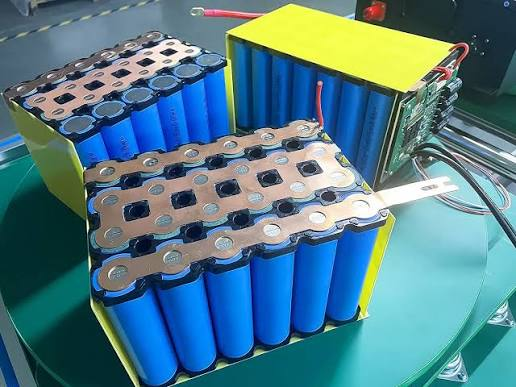
A sealed lead-acid or 12V LiFePO4 battery rated at 100Ah:
- Known values: V = 12, Ah = 100
- Substitution: Wh = 12 x 100
- Result: Wh = 1,200
This 1,200 Wh figure is the rated energy content at the manufacturer’s stated voltage and discharge conditions. It is the number printed on a spec sheet, not necessarily the number a connected device will receive, which is addressed later in this guide.
Which Voltage Actually Belongs in the Formula
“12V” and “3.7V” batteries are nominal labels, not measurements taken at a single instant. A battery’s terminal voltage moves through a range as it charges and discharges: higher near full charge, lower near the cutoff point. Manufacturers publish a nominal voltage, an approximate average across the usable discharge curve, and that nominal figure is what belongs in the Wh = V x Ah calculation unless a datasheet explicitly states otherwise.
The nominal voltage depends on chemistry, and mixing this up is a frequent source of miscalculated capacity, particularly at the individual cell level:
| Chemistry | Nominal Voltage per Cell | Typical Full-Charge Voltage | Typical Cutoff Voltage |
| Lead-acid (flooded or AGM) | 2.0 V | 2.15 to 2.4 V | 1.75 to 1.8 V |
| LiFePO4 (LFP) | 3.2 V | 3.6 to 3.65 V | 2.5 to 2.8 V |
| Li-ion (NMC / NCA / Li-poly) | 3.6 to 3.7 V | 4.2 V | 2.8 to 3.0 V |
| Alkaline | 1.5 V | 1.5 to 1.6 V | 0.8 to 1.0 V |
Nominal cell voltages above are the values commonly specified across manufacturer datasheets for each chemistry, consistent with the chemistry comparison published in Battery University BU-205: Types of Lithium-ion; individual cell models vary within these ranges and the datasheet for the specific cell should be used when precision matters.
A common 12V “lead-acid replacement” LiFePO4 pack is not built from a single 12V cell. It is built from four LiFePO4 cells wired in series, 4 x 3.2V = 12.8V nominal, close enough to a 12V lead-acid battery’s voltage that it drops into the same equipment, but the underlying cell chemistry and nominal voltage differ. A 12.8V, 100Ah LiFePO4 pack stores 1,280 Wh, slightly more than the 1,200 Wh implied by treating it as a flat 12V system.
Series and Parallel Packs: Same Energy, Different Numbers on the Label
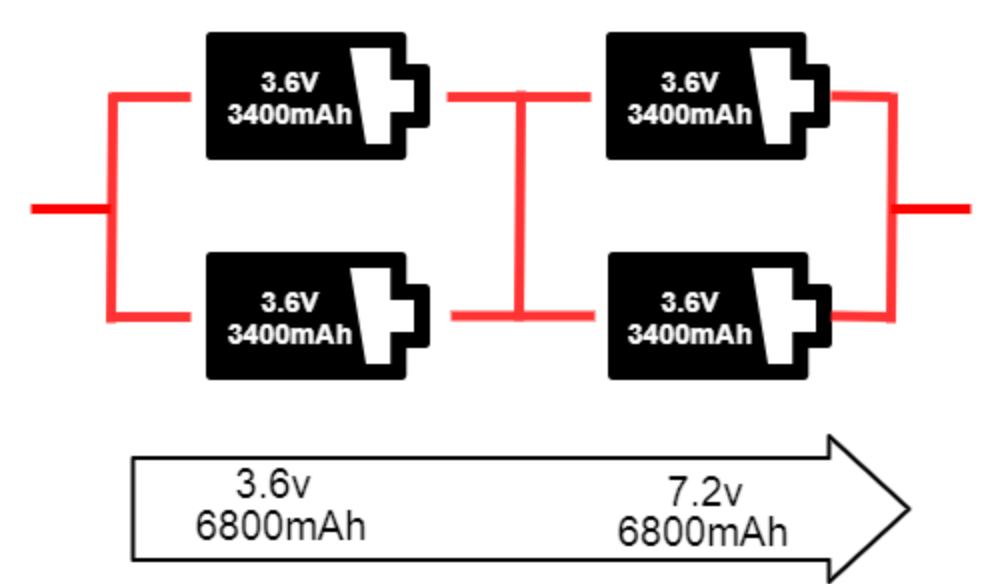
Battery packs are rarely a single cell. Multiple cells are wired in series to raise voltage, in parallel to raise amp-hour capacity, or both. Wiring changes what the voltage and Ah figures printed on the pack look like, but it does not change the total stored energy, because energy is conserved regardless of how the same set of cells is arranged.
Two identical 12V, 100Ah batteries wired together illustrate the point:
- Wired in series: 24V, 100Ah -> Wh = 24 x 100 = 2,400 Wh
- Wired in parallel: 12V, 200Ah -> Wh = 12 x 200 = 2,400 Wh
The total energy is identical. What changes is the voltage and current the pack presents to connected equipment, which is why battery bank wiring should be selected for the load and system voltage a device requires, not for whichever configuration produces a more impressive-looking Ah number on the label.
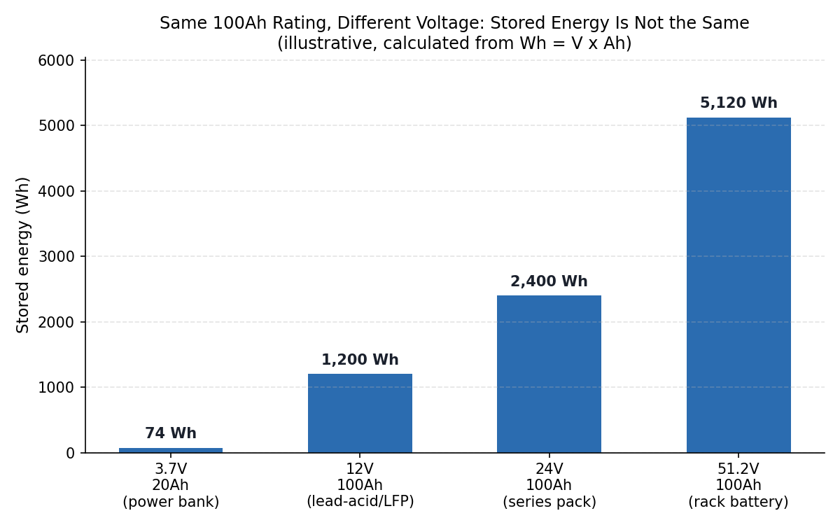
Figure 1. The same 100Ah rating stores very different amounts of energy depending on system voltage. Values are calculated using Wh = V x Ah, not measured.
Rated Capacity vs. Usable Capacity
The Wh = V x Ah result is the rated, or nameplate, capacity. It assumes the battery is discharged from completely full to completely empty and that every watt-hour leaving the battery terminals reaches the connected load with no losses. Neither assumption holds in a real system.
Two factors typically separate rated capacity from usable capacity:
- Depth of discharge (DOD): most lithium battery management systems reserve a small margin at both ends of the charge range to protect cell life, so the full rated Ah is rarely available. Manufacturers commonly define and rate capacity against a stated DOD rather than a full 0 to 100 percent window, as described in Battery University BU-501: Basics about Discharging. A conservative planning assumption is roughly 95 percent of rated capacity for a well-managed lithium pack.
- Conversion efficiency: energy leaving the battery through an inverter to power AC equipment loses a portion to heat during DC-to-AC conversion, commonly on the order of 85 percent efficiency for a compact inverter under typical load, in line with the representative round-trip efficiency figures used in NREL’s Annual Technology Baseline for lithium-ion battery storage. Energy delivered through a DC-to-DC path, such as a USB or 12V output, loses less, typically around 95 percent efficiency.
Combining a 95 percent depth-of-discharge assumption with an 85 percent inverter efficiency gives a combined usable-energy factor of roughly 0.80 for AC output. Applied to a 1,000 Wh rated battery, the AC-usable energy is approximately 800 Wh, while the same battery’s DC output, without inverter losses, delivers closer to 950 Wh. These are planning estimates built from stated assumptions, not laboratory measurements of a specific product, and they should be adjusted using a product’s own documented specifications when available.
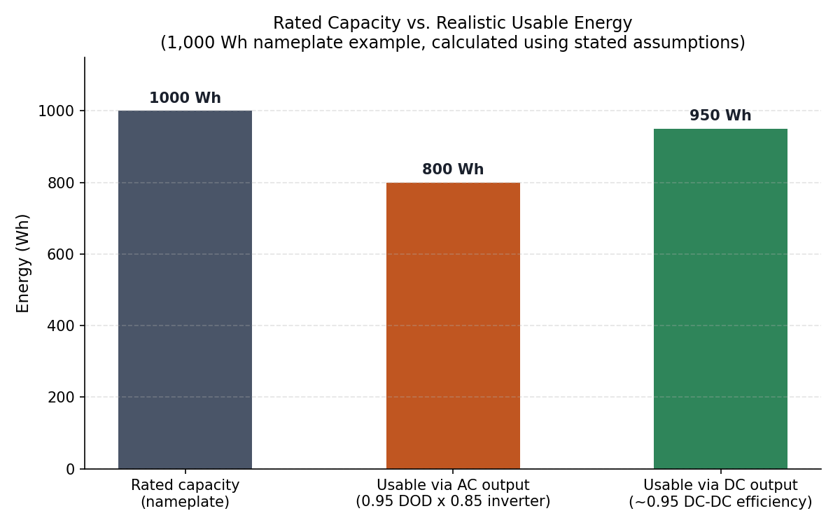
Figure 2. Rated capacity is a ceiling, not a delivery promise. Usable energy depends on the output path and the assumptions applied. Calculated using the stated 0.95 DOD, 0.85 inverter efficiency, and 0.95 DC-DC efficiency assumptions.
Worked Example: From Rated Wh to Usable Wh
A power station rated at 1,000 Wh, discharged through its AC inverter output:
- Known values: rated Wh = 1,000, DOD factor = 0.95, inverter efficiency = 0.85
- Substitution: Usable Wh = 1,000 x 0.95 x 0.85
- Result: Usable Wh = 807.5, approximately 800 Wh
- Interpretation: a device drawing 80W continuously would run for roughly 10 hours on the usable figure, not the 12.5 hours a naive 1,000 Wh / 80W calculation would suggest
Converting Milliamp-Hours to Watt-Hours
Small consumer electronics, phone batteries, and power banks are almost always labeled in milliamp-hours (mAh) rather than amp-hours or watt-hours, because the numbers look larger and more marketable. The same formula applies after converting mAh to Ah by dividing by 1,000.
Worked Example: A 20,000mAh Power Bank
A typical USB power bank cell is rated at 20,000mAh with a 3.7V nominal lithium-ion cell voltage:
- Known values: mAh = 20,000, V = 3.7
- Convert: Ah = 20,000 / 1,000 = 20
- Substitution: Wh = 3.7 x 20
- Result: Wh = 74
That 74 Wh figure is the internal cell energy, not what reaches a connected phone. The power bank steps 3.7V up to 5V (or higher, for USB-PD) through a DC-to-DC converter before it reaches the USB port, and that conversion carries a typical efficiency loss on the order of 5 percent. At roughly 95 percent conversion efficiency, the phone receives closer to 70 Wh. This is also why a phone with a smaller mAh-rated battery than the power bank does not necessarily receive a full “number of charges” equal to a simple mAh ratio; the two devices commonly operate at different nominal voltages, so the comparison has to run through watt-hours, not mAh, to be meaningful.
Common Mistakes When Calculating Battery Capacity
Comparing mAh or Ah Across Different Voltages
A 20,000mAh power bank at 3.7V and a 20,000mAh power bank at 3.7V made by a different brand are genuinely comparable. A 20,000mAh power bank and a 10,000mAh laptop battery are not directly comparable by that number alone, because the laptop pack commonly runs at a higher nominal voltage, often 11.1V or higher for a multi-cell pack, meaning its watt-hour total can exceed the power bank’s despite the smaller mAh figure. Convert to watt-hours before comparing.
Treating Rated Capacity as Delivered Capacity
The Wh = V x Ah result is a ceiling. Depth-of-discharge limits and conversion losses reduce what a connected load actually receives, sometimes by 15 to 25 percent for an AC-coupled system. Sizing a backup power system on the rated number alone is a common way to end up with a system that falls short of the runtime a buyer expected.
Using Full-Charge or Cutoff Voltage Instead of Nominal Voltage
A LiFePO4 cell reads roughly 3.65V fresh off the charger and roughly 2.5V near empty. Using either of those instantaneous readings instead of the 3.2V nominal figure in the Wh formula introduces a meaningful error at both ends of the discharge curve. The nominal voltage from the manufacturer datasheet is the correct input for a capacity calculation.
Assuming Series and Parallel Wiring Changes Total Energy
As shown above, wiring the same cells in series or parallel changes the voltage and Ah figures printed on the resulting pack, but not the total watt-hours available from those cells. A buyer comparing a 24V, 50Ah system to a 12V, 100Ah system built from the same underlying cell count should expect the same approximate total energy, 1,200 Wh either way, not treat the higher-voltage system as inherently storing more.
Ignoring Manufacturer-Stated Test Conditions
Ah and Wh ratings are typically measured at a specific discharge rate, and capacity can measurably decrease at higher discharge currents due to internal resistance losses, an effect described by the Peukert relationship for lead-acid chemistries in particular and explained in Battery University BU-402: What Is C-rate?. A battery rated at 100Ah at a slow, 20-hour discharge rate will not necessarily deliver the full 100Ah when discharged in under an hour. Where the discharge rate materially differs from the rated test condition, treat the nameplate Wh as an upper bound rather than an exact figure.
Frequently Asked Questions
Is a higher watt-hour rating always better?
Higher watt-hours means more stored energy, which generally supports longer runtime, but the right amount depends on the load being powered and the required runtime, not the largest available number. An oversized battery adds cost and weight without a corresponding benefit if the load never approaches the battery’s capacity.
Why do two batteries with the same Ah rating have different Wh?
Because Ah measures charge, not energy, and the two batteries have different voltages. Multiply each by its own nominal voltage to compare them on an energy basis.
Can Wh be calculated without knowing the exact voltage?
Not accurately. Voltage is one of the two required inputs. If a manufacturer publishes only an Ah or mAh figure with no stated voltage, that specification is incomplete for capacity purposes and the nominal voltage should be requested or found in the cell’s own datasheet.
Does temperature affect the Wh calculation?
Temperature affects a battery’s actual deliverable capacity, particularly for lithium chemistries in cold conditions, but it does not change the rated Wh = V x Ah figure printed on the label. Cold-weather performance is a separate, real-world adjustment on top of the nameplate calculation, not a correction to the formula itself.
Is watt-hours the same as the capacity shown on a power station’s specification sheet?
Usually yes for the headline number, since most portable power station manufacturers publish a Wh figure directly rather than requiring a V x Ah conversion. That published Wh figure is still a rated, nameplate value, and the depth-of-discharge and conversion-efficiency adjustments described above still apply to determine what the unit will actually deliver to a connected load.
Sources
- Battery University, BU-205: Types of Lithium-ion – chemistry nominal voltage ranges
- Battery University, BU-501: Basics about Discharging – depth-of-discharge definition and rating conventions
- Battery University, BU-402: What Is C-rate? – discharge-rate effects on delivered capacity
- NREL, Annual Technology Baseline: Residential Battery Storage – representative round-trip conversion efficiency for lithium-ion battery storage
Manufacturer cell and pack datasheets should be consulted directly for the exact nominal, full-charge, and cutoff voltages of any specific product referenced in a follow-up article.
Related Sielectronix Guides
For the difference between instantaneous power and stored energy, see Watts vs. Watt-Hours: What Is the Difference?. For sizing a battery specifically for a portable power station purchase decision, see Battery Capacity for a Portable Power Station. For converting a rated Wh figure into an expected runtime under a specific load, see How to Calculate Portable Power Station Runtime.