How to Calculate the Battery Capacity for Portable Power Station
Buying a portable power station without doing this calculation first is how people end up with a unit that either runs out halfway through an outage or costs far more than they actually needed. The good news is that the underlying math is simple. The part most guides skip is what happens to that number once depth of discharge and inverter efficiency are applied to it.
This guide walks through the exact formula, shows a full worked example with a real device list, and explains why a 1,000 Wh battery rarely delivers 1,000 Wh of usable energy to your appliances.
Quick Answer
| Required battery capacity (Wh) = Total daily energy demand (Wh) ÷ Usable fraction of rated capacity Usable fraction = depth of discharge (DoD) x inverter efficiency. For a typical LiFePO4 portable power station, that fraction is commonly around 0.72 to 0.81 (roughly 80 to 90% DoD multiplied by roughly 85 to 92% inverter efficiency), not 1.0. So a household that needs 1,000 Wh of real, deliverable energy per day should look for a unit rated closer to 1,300 to 1,400 Wh, not exactly 1,000 Wh. |
Why Battery Capacity Is Different From Battery Runtime
Battery capacity, expressed in watt-hours (Wh), describes how much energy a battery can store. Runtime describes how long that stored energy will actually power a specific load. The two are related but not interchangeable, and conflating them is the single most common sizing mistake.
Capacity answers the question “how big is the tank.” Runtime answers “how long will the tank last with this specific appliance running.” You need capacity to calculate runtime, but capacity alone does not tell you whether a power station is big enough for your situation.
The Core Formula: From Devices to Watt-Hours
Before sizing anything, you need to know how much energy your devices actually consume in a day. This is where sizing starts, and it is also where most errors are introduced, usually by underestimating how many hours a device runs.
Step 1: List your devices and their running watts
Use the nameplate wattage on the device or its power adapter, not the voltage and current ratings multiplied together carelessly. If only amps are listed, multiply amps by the operating voltage (W = V x A) to get watts.
Step 2: Estimate hours of use per day
Be realistic. A router that stays on around the clock needs 24 hours entered, not the number of hours you are awake. A fan you run for sleep only needs 8 hours.
Step 3: Calculate energy demand per device
Energy (Wh) = Power (W) x Time (h)
Sum the Wh values across every device you intend to run to get your total daily energy demand. This number is the target your usable battery capacity has to meet or exceed.
Why Rated Capacity Is Not the Same as Usable Capacity
A power station’s nameplate rating, the number printed on the box, describes the battery’s total stored energy under laboratory conditions. Two things stand between that number and the energy your appliances actually receive: depth of discharge and inverter conversion loss.
Also Read: How to Calculate the Battery Capacity for Portable Power Station
Depth of discharge (DoD)
Depth of discharge is the percentage of a battery’s rated capacity that can safely be drawn before the battery management system (BMS) cuts off the load to protect the cells. LiFePO4 cells, used in most current portable power stations, tolerate deep discharge well, but manufacturers commonly set a warranted DoD of 80 to 90% to preserve cycle life, even though the chemistry itself can often handle more.
| Battery chemistry | Typical warranted DoD | Usable capacity from 100Ah | Common in |
| Flooded lead-acid | 40 to 50% | 40 to 50 Ah | Older generators, budget inverters |
| AGM / sealed lead-acid | 50% | 50 Ah | Mid-range inverter systems |
| LiFePO4 (lithium iron phosphate) | 80 to 90% (occasionally to 100%) | 80 to 90 Ah | Most current portable power stations |
| NMC lithium-ion | 80 to 90% | 80 to 90 Ah | Some lighter, higher energy-density units |
Table 1. Typical depth of discharge ranges by battery chemistry. Always confirm the exact figure on the manufacturer’s datasheet for the specific model.
Inverter efficiency
A portable power station stores energy as direct current (DC) but most household appliances need alternating current (AC). The internal inverter that performs this conversion is never 100% efficient. Independent product data and manufacturer documentation place typical AC inverter efficiency for portable power stations in the 80 to 92% range, with pure sine wave units generally at the higher end and older or budget modified sine wave inverters at the lower end.
Devices powered directly from a DC or USB-C port skip this conversion step and lose noticeably less energy, which is why charging a laptop from a power station’s USB-C PD port is measurably more efficient than charging it through the AC outlet.
Combining the two loss factors
Usable energy is not the rated capacity minus one flat number. It is the rated capacity reduced twice, once by the DoD limit and again by inverter conversion loss:
Usable energy (Wh) = Rated capacity (Wh) x DoD fraction x Inverter efficiency
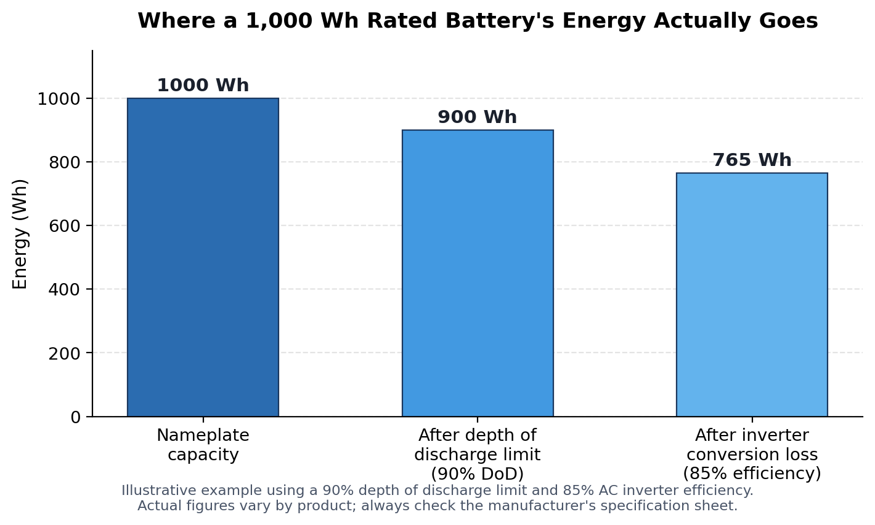
Figure 1. Illustrative breakdown of a 1,000 Wh rated battery using a 90% DoD limit and 85% inverter efficiency, two figures within the commonly published ranges. Your unit’s actual numbers will differ; check the datasheet.
Worked Example: Sizing a Battery for a Home Backup Setup
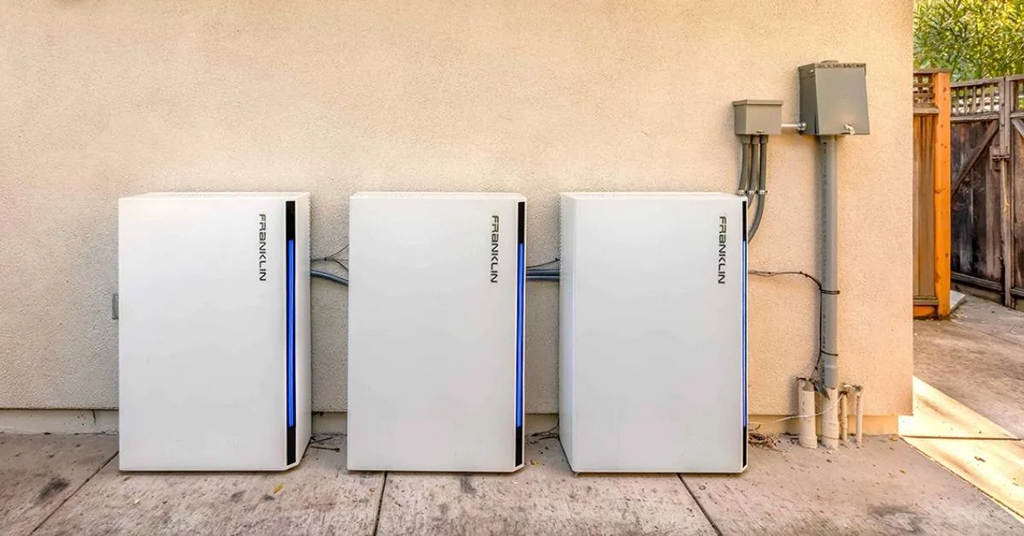
Consider a household in an area with frequent grid outages that wants to keep a router, a laptop, a desk lamp, two phones, and a standing fan running through a typical outage day.
| Device | Running watts | Hours per day | Daily energy (Wh) |
| Wi-Fi router and modem | 15 W | 24 h | 360 Wh |
| Laptop (charging + light use) | 60 W | 6 h | 360 Wh |
| LED desk lamp | 10 W | 5 h | 50 Wh |
| Phone charging (2 phones) | 18 W | 2 h | 36 Wh |
| Standing fan | 55 W | 8 h | 440 Wh |
| Total daily energy demand | 1,246 Wh |
Table 2. Example daily device list and calculated energy demand.
With a total daily demand of 1,246 Wh, apply the usable fraction to find the required rated capacity, using this example’s 90% DoD and 85% inverter efficiency (a combined usable fraction of 0.765):
- Required rated capacity = Daily demand ÷ Usable fraction
- Required rated capacity = 1,246 Wh ÷ 0.765
- Required rated capacity ≈ 1,629 Wh
A power station rated at exactly 1,246 Wh would fall well short of covering this load list for a full day once real-world losses are accounted for. The household should look at units rated in the 1,600 to 2,000 Wh range, leaving some margin above the bare calculated minimum.
Runtime by Load: What Different Capacities Actually Deliver
Once you understand the usable fraction, you can estimate runtime for any single continuous load using the same logic applied in reverse:
Runtime (hours) = Usable energy (Wh) ÷ Load (W)
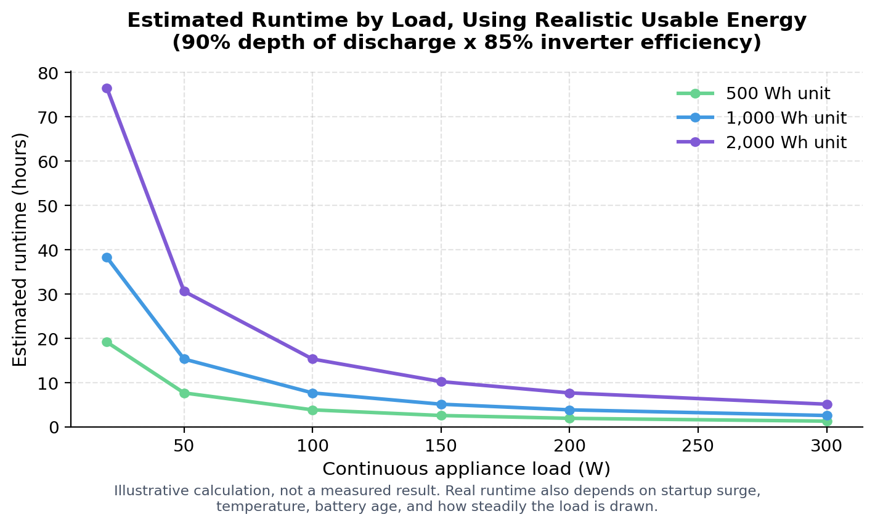
Figure 2. Estimated runtime at different continuous loads for three common capacity sizes, using a 90% DoD and 85% inverter efficiency (0.765 usable fraction). Illustrative calculation, not a measured result.
| Continuous load | 500 Wh unit | 1,000 Wh unit | 2,000 Wh unit |
| 20 W (router, lamp) | ~19 h | ~38 h | ~77 h |
| 50 W (laptop, TV) | ~7.7 h | ~15.3 h | ~30.6 h |
| 100 W (multiple devices) | ~3.8 h | ~7.7 h | ~15.3 h |
| 200 W (small fridge, fan + lights) | ~1.9 h | ~3.8 h | ~7.7 h |
Table 3. Quick-reference estimated runtimes rounded to one decimal place, based on the same 0.765 usable fraction used above.
Real-World Adjustments Beyond DoD and Efficiency
The DoD-and-efficiency formula gets you close, but several additional factors can shift real-world results further:
- Startup surge: appliances with motors or compressors, such as refrigerators, fans, and pumps, briefly draw several times their running wattage at startup. The power station’s surge rating, not just its continuous rating, must cover this spike or the unit may shut down.
- Standby and parasitic draw: the station’s own display, cooling fan, and Bluetooth or Wi-Fi module consume a small amount of power continuously, which reduces the energy actually available to your devices.
- Temperature: cold conditions reduce a lithium battery’s effective usable capacity, sometimes significantly. Heat can also reduce charging and discharging efficiency.
- Battery aging: capacity gradually declines over hundreds of charge cycles. A three-year-old unit will not deliver the same usable Wh as it did new, even at the same DoD setting.
- Load variability: a load that cycles on and off, like a refrigerator compressor, uses less total energy over a day than its running wattage multiplied by 24 hours would suggest, because it is not drawing full power the entire time.
Common Mistakes When Sizing Battery Capacity
Using rated capacity as if it were usable capacity
This is the most frequent error. Buying a 1,000 Wh unit for a calculated 1,000 Wh daily need leaves no margin for DoD limits, inverter loss, or aging, and the household will run short before the day is over.
Ignoring startup surge for motor-driven appliances
A power station may show a continuous wattage rating well above a refrigerator’s running wattage, yet still fail to start it if the surge rating is too low. Both figures matter.
Confusing watts and watt-hours
Watts (W) measure the rate of power draw at any instant. Watt-hours (Wh) measure total energy over time. A 60 W device left on for 10 hours consumes 600 Wh, not 60 Wh.
Assuming every LiFePO4 unit uses the same DoD and efficiency figures
These figures vary by model and manufacturer. Always check the specific product’s documentation rather than applying a single number across every brand.
How Much Margin Should You Add?
Beyond the DoD and efficiency adjustment already built into the formula, most practical sizing guidance adds a further buffer of roughly 15 to 25% above the calculated requirement. This buffer absorbs battery aging over the unit’s lifespan, colder-than-expected conditions, and days when device usage runs higher than planned. For safety-critical or medical equipment, err toward the higher end of that range and confirm the manufacturer’s specifications directly rather than relying on general estimates.
Portable Power Station vs Home Backup Battery: Does This Formula Still Apply?
The same core formula, daily energy demand divided by usable fraction, applies whether you are sizing a small portable unit for a few electronics or a larger home backup battery bank for appliances and circuits. What changes at larger scale is the complexity of the load list and the importance of accounting for simultaneous surge loads from multiple motor-driven appliances, which is a more detailed calculation than a single portable unit typically requires.
Frequently Asked Questions
Is a 1,000 Wh power station enough for a laptop and phone overnight?
Yes, comfortably. A laptop drawing 60 W for 4 hours and two phones drawing a combined 18 W for 2 hours totals well under 300 Wh of demand, far inside what a 1,000 Wh unit can deliver even after DoD and inverter losses are applied.
Does a higher DoD always mean a better battery?
Not automatically. A high warranted DoD gives more usable capacity per charge, but manufacturers set the warranted figure as a balance between usable energy and long-term cycle life. Check the cycle life rating alongside the DoD figure rather than treating DoD in isolation.
Why does my power station’s app or display show a lower Wh number than the box advertises?
Displays often show remaining usable energy after the BMS applies its DoD limit, while the box states the full rated capacity. This is expected behavior, not a defect.
Should I size for average daily use or worst-case use?
For backup power during outages, size for your realistic worst-case day, since that is precisely when the battery needs to perform. For everyday portable use such as camping, average use with a modest margin is usually sufficient.
Conclusion
Sizing a portable power station correctly comes down to two calculations done in sequence: total daily energy demand in watt-hours, then dividing that figure by the realistic usable fraction of the battery’s rated capacity, not the rated capacity itself. Depth of discharge and inverter efficiency together typically leave you with somewhere between 72% and 81% of the number printed on the box. Build your device list carefully, apply that usable fraction honestly, add a reasonable margin for aging and surge loads, and the resulting capacity figure will hold up in a real outage rather than only on paper.