What Size Portable Power Station Do I Need?
A portable power station rated at 1,000Wh sounds like a straightforward specification until it has to keep a router, a laptop, a fan, and a CPAP machine running through an actual overnight outage. The rated capacity on the box is a starting point, not the answer. The real answer depends on which devices need power, how long they need it, how much of the rated capacity actually reaches the appliances after inverter losses and battery management reserves, and whether the unit’s continuous and surge output can handle the load at all.
Undersizing leads to a unit that runs out of energy before the outage ends or a job is finished. Oversizing means paying for capacity that never gets used. Both mistakes come from skipping the calculation and buying based on the Wh number alone.
| Quick Answer Add the watt-hours (Wh) each device needs (device wattage multiplied by hours of use), divide by roughly 0.80 to account for inverter and battery reserve losses, then round up to the next commonly available capacity. Separately confirm the station’s continuous watt rating covers the highest simultaneous load, and its surge watt rating covers the largest startup spike, such as a compressor or motor. |
The remainder of this guide works through that calculation in detail, including a full worked example, a reference table of common appliance wattages, and the mistakes that most often produce an undersized or oversized purchase.
Why the Wh Number on the Box Is Not the Full Answer
Every portable power station lists a rated capacity in watt-hours, such as 500Wh, 1,000Wh, or 2,000Wh. That number describes how much energy the battery can store, not how much AC energy will actually reach a connected device.
Two losses stand between rated capacity and usable output:
- Battery reserve. The battery management system (BMS) keeps a small reserve near the bottom of the charge range to protect the LiFePO4 cells from over-discharge. Manufacturer guidance for LiFePO4 packs commonly limits regular depth of discharge to roughly 80 to 95 percent of rated capacity, though the exact figure depends on the pack and BMS design.
- Inverter conversion loss. The battery stores DC energy, and most appliances run on AC. The inverter that performs that conversion is not 100 percent efficient. Published efficiency figures for pure sine wave inverters used in portable power stations typically fall between 85 and 95 percent, with efficiency dropping somewhat at very light loads.
Combined, these two losses typically remove 15 to 25 percent of the rated Wh figure before it becomes usable AC energy. A 1,000Wh unit realistically delivers somewhere close to 750 to 850Wh to connected AC devices under normal operating conditions. This is why sizing a purchase directly off the rated Wh number, without any correction, tends to leave the reader short on real-world runtime.
The Five-Step Sizing Method
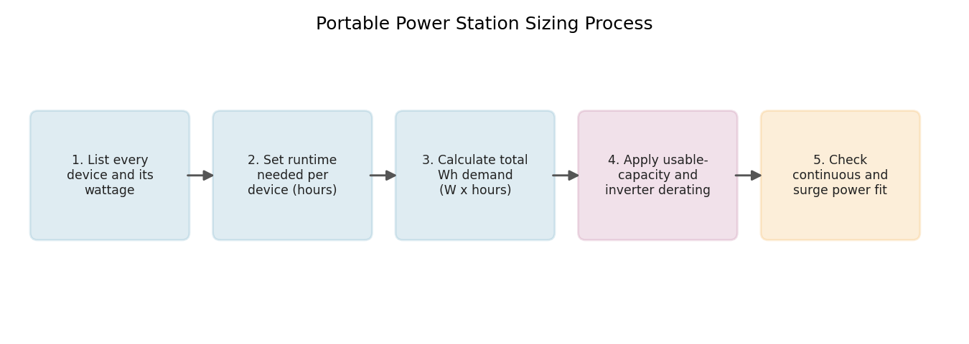
Figure 1. The five-step process for sizing a portable power station to an actual load, from listing devices through checking surge compatibility.
Step 1: List Every Device and Its Wattage
Write down every device that needs to run, along with its running wattage. Running wattage is usually printed on a label, in the manual, or on the manufacturer’s specification page. Where only current (amps) is listed, wattage can be found with:
P = V x I
P = power in watts
V = supply voltage (120V or 230V depending on region)
I = current in amps
Do not use amp-hour or plate ratings from unrelated equipment as a substitute; always use the specific device’s own rated or measured wattage.
Step 2: Set the Runtime Needed for Each Device
Different devices rarely need to run for the same number of hours. A router might need to stay on for the full duration of an outage, while a space heater might only run intermittently. Estimate realistic hours of use per device rather than assuming every device runs continuously for the entire backup period.
Step 3: Calculate Total Energy Demand in Watt-Hours
Wh_demand = P (W) x t (hours)
Total demand = sum of Wh_demand for every device
This produces the theoretical AC energy requirement, before accounting for the losses described earlier.
Step 4: Apply Usable-Capacity and Inverter Derating
Because the rated capacity is not fully usable as AC energy, the required rated capacity is higher than the raw AC energy demand:
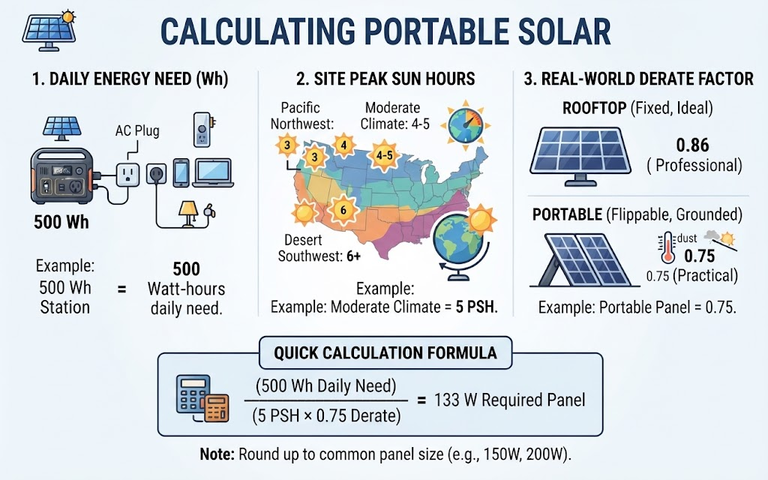
Required rated capacity (Wh) = Total AC demand (Wh) / derating factor
Typical derating factor = 0.75 to 0.85
(reflecting combined BMS reserve and inverter efficiency losses)
Using a derating factor of 0.80 is a reasonable general-purpose assumption for a quality LiFePO4 portable power station with a pure sine wave inverter. Units with published lower inverter efficiency or a larger reserved capacity will need a lower factor, which increases the required rated capacity.
Step 5: Check Continuous and Surge Power Fit
Capacity in Wh only answers how long a station can run a load. It does not answer whether the station can run that load at all. Two additional specifications matter:
- Continuous power rating (W): the maximum load the inverter can sustain. The combined wattage of every device running at the same time must stay below this figure, ideally with some margin.
- Surge power rating (W): the maximum brief spike the inverter can tolerate, needed for motors and compressors that draw several times their running wattage for a fraction of a second at startup.
A power station with ample Wh capacity but an undersized continuous or surge rating will trip its overload protection or fail to start the device, regardless of how much energy remains in the battery.
Worked Example: Sizing a Station for a 24-Hour Outage
Consider a household preparing for a 24-hour outage. The essential loads are a Wi-Fi router, a laptop, LED lighting, phone charging, a small fan, and a CPAP machine used overnight. No refrigerator or heating load is included in this example; those are addressed separately in the mistakes section below, since they introduce surge demands that change the analysis.
| Device | Running Watts | Hours Needed | Energy (Wh) |
| Wi-Fi router | 10 W | 24 h | 240 Wh |
| Laptop | 60 W | 6 h | 360 Wh |
| LED lighting (mixed fixtures) | 40 W | 6 h | 240 Wh |
| Phone charging (2 phones) | 15 W | 3 h | 45 Wh |
| Small fan | 50 W | 8 h | 400 Wh |
| CPAP machine | 30 W | 8 h | 240 Wh |
| Total AC energy demand | 1,525 Wh |
Applying the Step 4 derating factor of 0.80:
Required rated capacity = 1,525 Wh / 0.80 = 1,906 Wh
Rounding up to a commonly available capacity tier puts the practical requirement at approximately 2,000Wh. A 1,000Wh or 1,500Wh unit would leave this household short of energy before the 24-hour period ends, even though the raw AC demand of 1,525Wh might appear close to a 1,500Wh rating at first glance.
Checking Step 5: the highest simultaneous load in this scenario, if the fan, laptop, lighting, router, and CPAP all happened to run at once, totals 190W. That is well within the continuous rating of virtually any power station in the 1,500 to 2,000Wh class, so the binding constraint in this example is energy capacity, not power output.
Runtime vs. Load: Why Bigger Loads Drain Capacity Faster
Runtime is not fixed for a given power station. It depends directly on how much load is connected. The relationship is straightforward:
Runtime (h) = Usable AC energy (Wh) / Load (W)
Because usable AC energy is fixed for a given unit, doubling the connected load halves the runtime. This becomes important when comparing a manufacturer’s advertised runtime figure, which is usually based on a single light load such as a phone or small light, against the runtime a reader can actually expect for a heavier combined load.
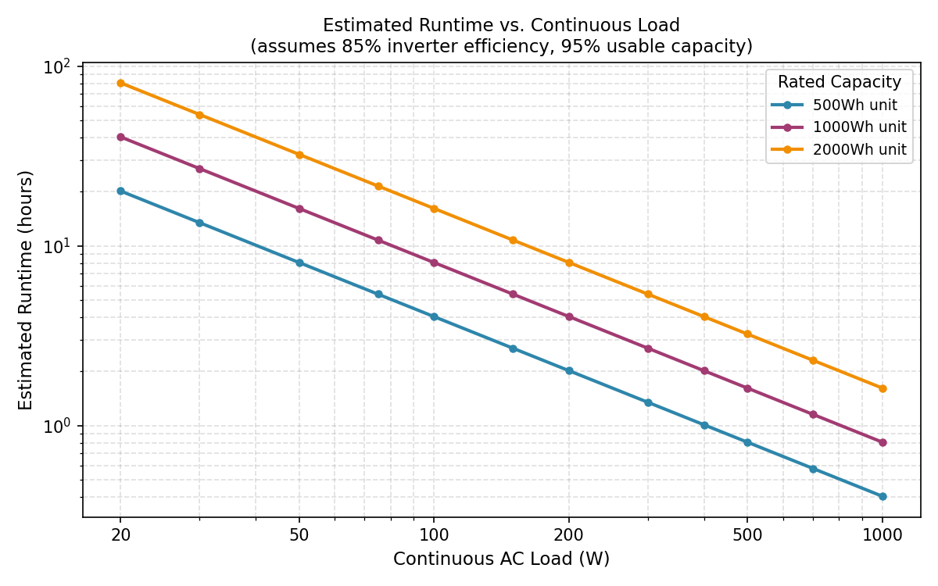
Figure 2. Estimated runtime versus continuous AC load for three common rated capacities, assuming 85 percent inverter efficiency and 95 percent usable capacity. Values are illustrative calculations, not manufacturer-measured results.
The chart illustrates why a 500Wh unit that comfortably runs a 20W router for over a day will run a 500W appliance for well under an hour. Sizing decisions should always be checked against the specific load in question, not against a manufacturer’s headline runtime figure for a different device.
Continuous Power vs. Surge Power
Continuous power is the wattage a device draws while running normally. Surge power (also called starting or peak power) is the brief, higher wattage draw that occurs when a motor or compressor first starts.
Devices with electric motors or compressors, including refrigerators, freezers, well pumps, air conditioners, and many power tools, can draw two to six times their running wattage for a fraction of a second at startup. A power station’s continuous watt rating does not describe its ability to handle that spike; the surge rating does.
| Device Type | Typical Running Watts | Typical Surge Watts |
| Mini refrigerator | 60 to 150 W | 400 to 800 W |
| Full-size refrigerator | 150 to 400 W | 800 to 2,000 W |
| Window air conditioner | 500 to 1,500 W | 1,500 to 4,500 W |
| Well pump (1/2 HP) | 750 to 1,000 W | 2,000 to 3,000 W |
| Power tool (circular saw) | 1,000 to 1,500 W | 2,000 to 3,000 W |
These figures vary by specific model and should be confirmed against the nameplate or manufacturer specification of the actual device before finalizing a purchase. When a compressor-driven appliance is part of the load, the power station’s surge rating, not just its Wh capacity, becomes the limiting specification.
Reference: Typical Household Appliance Wattages
| Device | Typical Running Watts |
| Wi-Fi router / modem | 8 to 15 W |
| LED light bulb | 8 to 12 W |
| Laptop | 40 to 65 W |
| Box or pedestal fan | 40 to 100 W |
| CPAP machine | 30 to 60 W |
| LCD/LED television (32 to 55 in) | 50 to 150 W |
| Desktop computer | 150 to 350 W |
| Microwave oven | 900 to 1,500 W |
| Space heater | 750 to 1,500 W |
| Coffee maker | 800 to 1,200 W |
| Hair dryer | 1,200 to 1,800 W |
These are general reference ranges rather than exact values for any specific model. Actual wattage should always be confirmed on the device’s own rating label before it is used in a sizing calculation, since even similar-looking devices can vary by a wide margin.
Power Station Size Tiers: What Each Range Can Realistically Run
| Capacity Tier | Realistic Use Case | Not Well Suited For |
| 200 to 300 Wh | Phones, small lights, a laptop for a few hours, short camping trips | Anything running many hours, appliances with motors |
| 500 to 700 Wh | Router and laptop backup, CPAP for one night, multiple device charging | Refrigerators for extended periods, space heaters, extended multi-day backup |
| 1,000 to 1,500 Wh | Router, laptop, lighting, and fan together for a full day; short-duration mini fridge backup | Whole-home backup, sustained heating or cooling loads |
| 2,000 to 3,000 Wh | Multi-device 24-hour backup as in the worked example, full-size refrigerator for part of a day | Central air conditioning, sustained high-draw heating |
| 3,000 Wh and above | Extended multi-day essential-circuit backup, refrigerator plus multiple devices, small workshop tools | Whole-home backup during extended multi-day outages without supplemental charging (solar or generator) |
These tiers describe general capability, not guarantees. The worked example above shows that even a 1,500Wh raw energy demand can require a unit rated closer to 2,000Wh once realistic derating is applied. Every purchase decision should still go through the five-step calculation rather than relying on tier tables alone.
Common Sizing Mistakes
Treating Rated Wh as Usable AC Energy
Using the full rated capacity as the usable AC energy figure overstates real-world runtime by roughly 15 to 25 percent. This is the single most common source of disappointment after purchase.
Ignoring Surge Power for Compressor-Driven Devices
A power station can have more than enough Wh capacity to run a refrigerator for hours and still fail to start it, because the compressor’s startup surge exceeds the inverter’s surge rating. Surge compatibility must be checked separately from energy capacity.
Adding an Arbitrary Safety Margin Without Identifying What It Covers
A round-number margin, such as adding 20 percent for no defined reason, is not a substitute for correctly modeling inverter losses, battery reserve, and realistic hours of use. The derating factor in Step 4 already accounts for the largest source of loss; an additional margin should be reserved for genuine uncertainty in runtime estimates or anticipated load growth, not used to paper over a skipped calculation.
Using Manufacturer Runtime Claims for a Different Load
A manufacturer’s advertised runtime figure, such as ‘charges a phone 80 times,’ describes a specific light load. It does not transfer to a heavier combined load. Runtime must be recalculated for the actual devices in question.
Overlooking Charge Time When Sizing for Repeated Cycles
A power station intended to be recharged during the day, such as with a portable solar panel, needs its recharge rate checked against available charging hours. A large-capacity unit that cannot recharge fully within the available window provides less real-world reliability than its Wh rating suggests.
Frequently Asked Questions
Does a bigger Wh rating always mean more usable power?
Yes, for a given inverter efficiency and reserve percentage, a higher rated Wh capacity produces more usable AC energy. However, two units with the same rated Wh can deliver different usable energy if their inverter efficiency or BMS reserve differs, so the rated Wh figure alone is not a complete comparison.
Can a 1,000Wh power station run a refrigerator?
A 1,000Wh unit can often run a mini or full-size refrigerator’s running wattage for several hours, but only if its surge rating covers the compressor’s startup spike. Cycling behavior (the compressor turning on and off) also affects real-world runtime more than the running wattage alone suggests.
Is it better to oversize a power station just to be safe?
Moderate oversizing is reasonable when future loads are uncertain or when the reader wants a genuine safety margin beyond the calculated requirement. Substantial oversizing mainly adds cost and weight without improving reliability, since the same result can usually be achieved by correctly running the five-step calculation instead of guessing high.
Do solar-charging plans change the required capacity?
Yes. A power station that can be recharged during daylight hours through a solar panel may need less total stored capacity than one that must survive an entire outage on a single charge, provided the solar input is reliable enough to meet the recharge requirement before the next high-demand period.
Conclusion
The correct portable power station is not the unit with the largest Wh number on the box. It is the unit whose usable AC energy, once inverter and reserve losses are accounted for, covers the actual calculated demand, and whose continuous and surge power ratings match the devices being connected. Skipping either half of that check, energy capacity or power delivery, is what typically produces a unit that disappoints in practice.
Before purchasing, list every device, estimate realistic hours of use, apply a derating factor of roughly 0.80 to the resulting Wh demand, and separately confirm the continuous and surge ratings against the largest and most demanding loads, particularly any compressor or motor-driven appliance.
For a closer look at how rated capacity translates into watt-hours and how depth of discharge affects usable energy, see our guide on how to calculate battery capacity for a portable power station.
Sources
Technical assumptions used in this article, including inverter efficiency ranges and LiFePO4 usable-capacity guidance, were checked against the following published sources:
- Unbound Solar, “What Is an Inverter: Inverter Ratings, Efficiency & More” (inverter efficiency definition and typical ranges).
- EcoFlow, “Pure Sine Wave Inverters: Complete Guide” (typical pure sine wave inverter efficiency, 90 to 95 percent).
- LiPower, “How Long Will a Portable Power Station Run“
- Anern, “LiFePO4 DoD Guide: Maximize Usable Battery Capacity” (manufacturer-cited 90 to 95 percent recommended depth of discharge for LiFePO4 cells).
Appliance wattage ranges reflect commonly published general reference figures and should be confirmed against the nameplate rating of the specific device before finalizing a sizing decision.