Portable Power Station vs UPS: What Is the Difference?
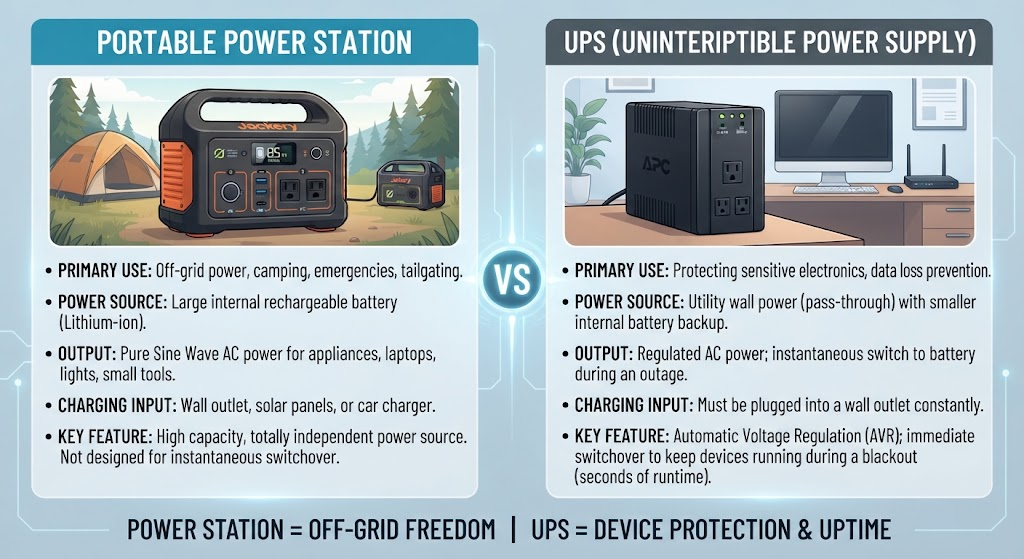
A UPS and a portable power station both sit between a wall outlet and a piece of equipment, and both switch to battery power when the mains supply fails. That surface similarity is where the resemblance mostly ends. One is engineered around switching speed, the other around energy capacity, and a purchase decision that ignores that distinction tends to produce either an underprotected server or an oversized, underused battery.
The confusion has grown as manufacturers add “UPS mode” to portable power stations, since the marketing language borrows directly from a product category built on a different set of priorities. This guide compares the two on the specifications that actually determine whether either one solves a specific problem: transfer time, runtime, output rating, and the kind of load each is designed to protect.
| Quick Answer A UPS is built to bridge an instantaneous power loss, typically switching to battery in 0 to 12 milliseconds so that a computer, server, or router never sees an interruption, then running that load for roughly 5 to 20 minutes so equipment can shut down safely or a generator can start. A portable power station is built for sustained runtime instead: hours rather than minutes, at the cost of a transfer time that independent testing has measured at roughly 14 to 40 milliseconds, well above what a dedicated UPS achieves. Some portable power stations now include a “UPS mode” that narrows this gap, but the underlying design goal, instant protection versus sustained capacity, remains different, and the two are not interchangeable for protecting sensitive computing equipment without checking the specific transfer time first. |
What a UPS Is Actually Built to Do
A UPS (uninterruptible power supply) exists to solve one narrow problem: keeping sensitive electronic equipment powered through the instant a mains supply fails, long enough for an orderly shutdown or for backup generation to take over. It is not sized for hours of runtime. A typical consumer or small-office UPS supports its full rated load for somewhere in the range of 5 to 20 minutes, and considerably longer at a partial load, because the internal battery is small relative to the inverter’s power rating.
Three technologies dominate the category, and they differ mainly in how fast they respond to a mains failure and how much they condition the incoming power before an outage even happens.
| Topology | How It Works | Typical Transfer Time | Best Suited For |
| Standby (offline) | Passes mains power through directly during normal operation and switches to the inverter only when mains fails or drifts outside a safe voltage range | 5 to 12 ms (avg. ~8 ms) | Home PCs, basic POS terminals, non-critical desktops |
| Line-interactive | Adds an autotransformer that corrects under-voltage and over-voltage conditions without switching to battery, preserving battery life for genuine outages | 3 to 8 ms (avg. ~5 ms) | Small office servers, network switches, NAS units |
| Online (double-conversion) | Continuously converts incoming AC to DC and back to AC, so the inverter is always powering the load and mains failure requires no switching at all | 0 ms | Data centers, medical equipment, loads that cannot tolerate any interruption |
Table 1. UPS topology comparison. Transfer time ranges per Power Sonic’s Line-Interactive UPS vs Online UPS white paper.
For context on how a computer power supply tolerates these gaps: most desktop and server power supplies have a “hold-up time,” the interval they can keep running after AC input is lost, of roughly 5 to 20 milliseconds depending on the design and how heavily loaded the supply is at the moment of the interruption. A standby UPS with an 8 ms average transfer time fits inside that window for most equipment, though it can occasionally miss it under unfavorable conditions, which is why sensitive workloads are usually paired with a line-interactive or online unit instead.
What a Portable Power Station Is Actually Built to Do
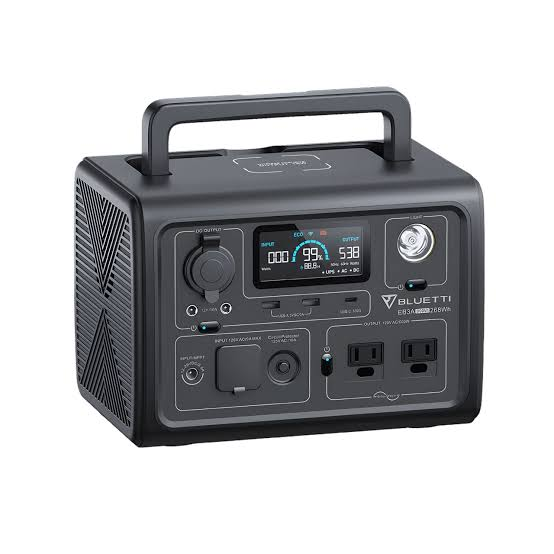
A portable power station is a large lithium battery pack with a built-in inverter, charge controller, and multiple output ports, designed to run appliances for hours rather than minutes and to be carried between locations. Its defining constraint is not switching speed but stored energy, expressed in watt-hours (Wh), and the practical relationship between that stored energy and how long it can run a given load is covered in detail in Watts vs Watt-Hours: What Is the Difference?.
Because a portable power station was not originally designed around instantaneous mains switching, its transfer behavior depends on whether it includes a dedicated pass-through or UPS mode. Independent transfer-time testing of several current models found actual measured switching times in the 14 to 40 millisecond range, with results varying meaningfully between manufacturers and even between two products from the same manufacturer. That is longer than any of the three UPS topologies above, including the slowest one.
The internal components responsible for this behavior, the battery management system, inverter, and charge controller, work the same way regardless of whether the unit is being used for backup power or general portable use, and are explained in more depth in How Portable Power Stations Work.
Transfer Time Compared Directly
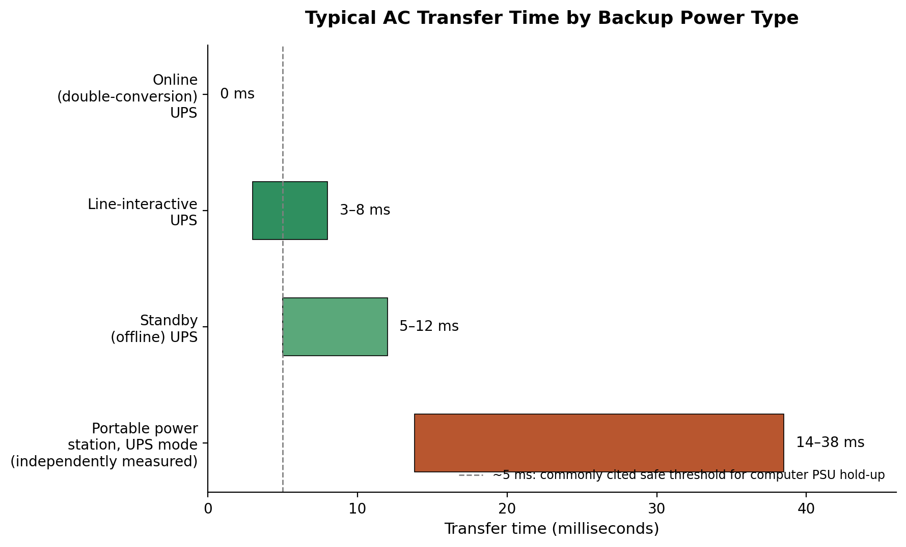
Figure 1. Typical AC transfer time by backup power type, comparing published topology ranges for dedicated UPS units against independently measured transfer times for portable power stations operating in UPS mode. Portable power station figures reflect third-party lab measurements, not manufacturer marketing claims, which are often listed lower.
The gap matters because transfer time and hold-up time are the two halves of the same equation. If a UPS or power station’s transfer time exceeds the connected equipment’s hold-up time, the equipment briefly loses power, which can cause a reboot, a dropped connection, or in the worst case, data corruption on equipment that was mid-write when the interruption occurred.
Manufacturer-listed portable power station transfer times, often quoted as “less than 20 ms” or “less than 30 ms,” describe a best case; independent measurement by Storage Review found some units taking closer to 40 ms in practice, which exceeds the hold-up time of a meaningful share of desktop and workstation power supplies.
This does not mean a portable power station’s UPS mode is useless. For loads that tolerate a brief interruption, a Wi-Fi router, a modem, a lamp, a security camera with local buffering, the difference between 8 ms and 30 ms is irrelevant. For a desktop computer, network-attached storage actively writing data, or a server, it can be the difference between an uninterrupted session and an unplanned reboot.
Why UPS Power Ratings Look Different From Portable Power Station Ratings
UPS output capacity is usually listed in volt-amperes (VA), not watts, which confuses buyers comparing it against a portable power station’s watt rating. As Schneider Electric (APC) explains, the two are related by the power factor:
W = VA × PF
Where:
W = real power, the figure that actually determines heat output and what the connected equipment draws
VA = apparent power, the product of voltage and current, used for sizing the UPS’s internal wiring and circuit protection
PF = power factor, a ratio between 0 and 1 describing how much of the apparent power is converted into real, usable power
A UPS rated at 1,500 VA with a power factor of 0.6, a common rating for older or budget consumer units, delivers only 900 W of real power (1,500 × 0.6 = 900). A modern unit with a 0.9 power factor rated at the same 1,500 VA delivers 1,350 W (1,500 × 0.9 = 1,350) for the same apparent-power sizing. Reading only the VA number and assuming it equals watts can lead to a UPS that trips its overload protection well before its VA rating is reached.
Manufacturer guidance on typical consumer power factors and VA-to-watt conversion is detailed further in APC’s Watt Ratings Differs From Volt Amp Ratings knowledge base article.
Portable power stations skip this ambiguity. Their continuous output is specified directly in watts, and their stored energy directly in watt-hours, so there is no power-factor conversion for a buyer to account for. This is one area where portable power station specifications are, if anything, easier to interpret correctly than UPS specifications.
Runtime: Minutes vs Hours
| Specification | Typical UPS | Typical Portable Power Station |
| Design goal for runtime | Bridge power until safe shutdown or generator start | Sustain a load for an extended period |
| Typical runtime at full rated load | Roughly 5 to 20 minutes | Multiple hours, depending on Wh capacity and load |
| Typical runtime at half load | Often 15 to 45 minutes | Roughly double the full-load runtime |
| Energy storage disclosed as | VA-hours or minutes at stated loads (varies by model) | Watt-hours (Wh), a directly comparable unit |
| Expandable capacity | Rare on consumer units; external packs exist on some enterprise models | Common; many models accept extra battery modules or solar input |
Table 2. Runtime and capacity comparison. Figures are general planning ranges, not a guarantee for any specific product.
Runtime figures for both categories vary significantly by specific model and stated load, and the ranges above are general planning figures rather than a guarantee for any particular product. For a portable power station, the actual runtime for a specific appliance is best worked out directly rather than assumed; the method is covered step by step in How to Calculate Portable Power Station Runtime, and the underlying capacity math is covered in How to Calculate the Battery Capacity for Portable Power Station.
The practical consequence of this runtime gap is that the two devices are usually sized for different outage lengths. A UPS is sized to survive the interruption itself, not the outage. A portable power station is sized to survive the outage.
Feature Comparison at a Glance
| Feature | UPS | Portable Power Station |
| Primary purpose | Instant protection for sensitive electronics during brief interruptions | Sustained power for appliances during extended outages or off-grid use |
| Transfer time | 0 to 12 ms depending on topology | Roughly 14 to 40 ms in UPS mode, when the feature exists |
| Runtime at rated load | Minutes | Hours |
| Output rating disclosed in | VA and watts (power factor applies) | Watts directly |
| Portability | Designed to stay in one location; often rack-mounted or floor-standing | Designed to be carried; typically has an integrated handle |
| Charging inputs | AC mains only, on most consumer units | AC, 12V/car port, and solar on many current models |
| DC and USB outputs | Rare on consumer UPS units | Standard on nearly all current portable power stations |
| Typical protected equipment | Desktops, servers, network gear, medical devices | Refrigerators, routers, laptops, CPAP machines, lighting, tools |
| Battery chemistry | Sealed lead-acid on most consumer units; lithium on premium models | Almost universally lithium (LiFePO4 or NMC) |
Table 3. Side-by-side feature comparison.
Can a Portable Power Station Replace a UPS?
Sometimes, and the answer depends almost entirely on what is connected to it and how sensitive that equipment is to a brief interruption.
A portable power station with a dedicated, tested UPS mode is a reasonable substitute for a router, a modem, a lamp, a fan, small kitchen appliances, or a security system with its own local buffering. None of these are meaningfully affected by a 15 to 40 millisecond gap in power.
A dedicated UPS remains the safer choice for a desktop computer actively in use, a NAS performing a write operation, a server, networking equipment supporting a business-critical connection, or any medical device where the manufacturer specifies UPS protection. For these loads, the gap between a UPS’s sub-10 ms transfer time and a portable power station’s measured 14 to 40 ms range is not a rounding error; it is the difference between staying online and rebooting.
A household planning backup for a full outage rather than a brief interruption, a refrigerator, lighting, a CPAP machine overnight, general device charging, is generally better served by a portable power station’s runtime advantage than by a UPS’s speed advantage, since the outage itself, not the switching moment, is the larger risk to that kind of load. For guidance on matching a station’s watt-hour capacity to that kind of load list, see What Size Portable Power Station Do I Need?.
Some households reasonably use both: a dedicated UPS for the modem, router, and any desktop or NAS equipment that cannot tolerate a reboot, and a portable power station sized for refrigeration, lighting, and device charging during a longer outage.
Common Mistakes
Assuming Marketed Transfer Time Equals Measured Transfer Time
A portable power station listed as “less than 20 ms” is describing a best-case or typical figure under specific test conditions. Independent measurement across several current models found actual results as high as 38.5 ms on some units, well above the listed specification. Do not treat a manufacturer’s transfer-time claim as a guarantee for a specific sensitive load without checking independent test data or a manufacturer statement that covers the specific equipment in question.
Reading a UPS’s VA Rating as Its Watt Rating
Because VA is always equal to or greater than watts, sizing a load against the VA number alone can overload the UPS well before its stated capacity appears to be reached. Always check the watt rating and, where only VA is published, the stated or typical power factor.
Buying a UPS for Whole-Home Backup
A UPS’s runtime, typically minutes rather than hours, makes it the wrong tool for keeping a refrigerator or a house full of lighting running through an extended outage. That is a capacity problem, which a portable power station or a larger battery backup system is built to solve.
Buying a Portable Power Station Expecting UPS-Grade Switching
Not every portable power station includes a UPS mode, and among those that do, transfer time varies meaningfully between models. A unit purchased specifically to protect a desktop computer or NAS should have its transfer time confirmed, ideally against independent test data, before it is relied on for that purpose.
Common Misconceptions
“UPS mode” on a portable power station means it behaves like a UPS
UPS mode indicates the unit can detect a mains failure and switch to battery output automatically. It does not mean the transfer time matches a dedicated UPS. The underlying hardware, an inverter and battery management system originally designed around sustained runtime rather than sub-10 ms switching, still determines the actual response time.
A higher VA rating always means more usable power
A higher VA rating only means more usable watts if the power factor is known and reasonably high. A 3,000 VA UPS with a 0.6 power factor delivers less real power than a 2,000 VA unit with a 0.9 power factor.
Portable power stations and UPS units serve the same market
They overlap at the edges, particularly for light loads like routers, but a UPS is fundamentally a bridge for an instant, and a portable power station is fundamentally a reservoir for an extended period. Treating them as interchangeable for every load ignores the reason each category exists.
Frequently Asked Questions
Can I plug a UPS into a portable power station to extend its runtime?
Yes, in most cases, since a UPS’s input is standard AC and a portable power station’s AC output is standard AC as well. This effectively uses the portable power station as an extended-runtime source behind the UPS’s fast switching, combining the transfer-time advantage of the UPS with the capacity advantage of the power station. The UPS’s own internal battery capacity becomes largely irrelevant once the power station is supplying it continuously; the UPS mainly continues to provide the fast switching and any power conditioning it offers.
Do all portable power stations have a UPS mode?
No. UPS mode, sometimes called pass-through charging or automatic switchover, is a specific feature that not every model includes. It should be confirmed in the product specification rather than assumed, particularly on older or budget models.
Is a line-interactive UPS good enough for a home server?
For most home servers and NAS units, yes. A line-interactive UPS’s 3 to 8 ms transfer time comfortably fits within the hold-up time of most modern power supplies. An online (double-conversion) UPS is a further step up for equipment that cannot tolerate any interruption at all, but it costs meaningfully more for the same runtime.
Why does my portable power station’s UPS mode still cause my computer to restart sometimes?
This usually means the unit’s actual transfer time exceeds the hold-up time of the computer’s power supply for that specific load condition. Because measured transfer times for portable power stations vary by model and can reach the higher end of the 14 to 40 ms range under certain conditions, a desktop with a lower hold-up time margin can occasionally see a brief enough gap to trigger a restart even when the average transfer time looks acceptable on paper.
Conclusion
A UPS and a portable power station are solving different problems even when they look similar on a store shelf. A UPS is an instant-response device, engineered around a transfer time measured in single-digit to low double-digit milliseconds and a runtime measured in minutes, built to protect equipment that cannot tolerate even a brief interruption. A portable power station is a capacity device, engineered around watt-hours and hours of runtime, with a transfer time that independent testing places well behind even the slowest UPS topology.
The right choice follows from the load, not from which product looks more capable on a spec sheet. Sensitive computing and networking equipment that cannot tolerate a reboot belongs behind a dedicated UPS. Refrigeration, lighting, medical devices intended for extended use, and general device charging through a longer outage are better served by a portable power station’s runtime. Many households reasonably use both, applied to the equipment each one actually protects well.
For readers sizing a portable power station for the runtime side of that decision, What Size Portable Power Station Do I Need? walks through the full calculation.
Sources
1. Storage Review, “Portable Power Stations Actually Work Pretty Well as a UPS” (independently measured transfer times for EcoFlow, Bluetti, and Ugreen portable power stations against an Eaton 5PX G2 UPS baseline).
2. Power Sonic, “Line-Interactive UPS vs Online UPS” white paper (transfer time ranges by UPS topology).
3. Schneider Electric (APC), “Watts vs VA: What’s the Difference Anyway?” (VA, watts, and power factor definitions and UPS sizing guidance).
4. Schneider Electric (APC), “Watt Ratings Differs From Volt Amp Ratings” knowledge base article (VA-to-watt conversion and typical consumer power factor guidance).