What Is a LiFePO4 Battery?
Quick Answer
A LiFePO4 battery, short for lithium iron phosphate and also called an LFP battery, is a rechargeable lithium-ion battery that uses lithium iron phosphate as its cathode material instead of the cobalt or nickel oxides found in most other lithium-ion chemistries. That single change in cathode material is responsible for most of what makes LiFePO4 attractive for off-grid, solar, and portable power applications: a substantially higher resistance to thermal runaway, a longer usable cycle life at deep discharge, and stable voltage delivery through most of the discharge curve, traded off against lower energy density than nickel or cobalt based lithium chemistries.
The Chemistry Behind LiFePO4
Every lithium-ion cell, regardless of chemistry, works the same basic way: lithium ions move between a cathode and an anode through an electrolyte, while electrons take the external circuit path and do the actual work of powering a load. What differs between chemistries is the cathode material, and that material determines voltage, energy density, and, critically, how the battery behaves under stress.
In a LiFePO4 cell, the cathode is lithium iron phosphate arranged in an olivine crystal structure. The anode is graphitic carbon, the same anode material used in most other lithium-ion batteries. During discharge, lithium ions release from the anode, travel through the electrolyte and a porous separator, and insert into the cathode structure, while electrons flow through the external circuit to the load. Charging reverses the process, with an external charger forcing ions back from the cathode to the anode.
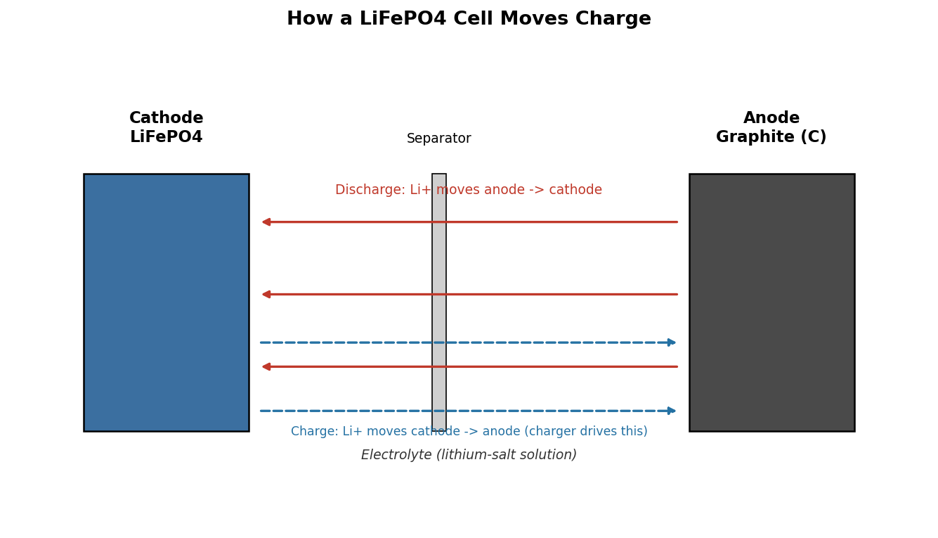
Figure 1. Lithium-ion movement between the LiFePO4 cathode and graphite anode during charge and discharge.
Why LiFePO4 Is Considered Safer
The safety reputation attached to LiFePO4 is real, but it comes from a specific mechanism, not just marketing language. In cobalt or nickel based cathodes such as NMC, NCA, and LCO, the layered oxide structure can break down under heat or overcharge stress and release oxygen. That released oxygen feeds the electrolyte fire, which is what drives thermal runaway from a contained failure into a rapidly escalating one.
The phosphate group in LiFePO4’s olivine structure forms strong covalent phosphorus-oxygen bonds. Breaking that bond and releasing oxygen takes substantially more energy than breaking down a layered oxide cathode, so LiFePO4 resists the self-feeding oxygen-release reaction that makes other lithium chemistries dangerous when damaged, overcharged, or overheated.
In controlled thermal-runaway testing on commercial 18650 cells, researchers found that LiFePO4 cathode cells reached thermal runaway at meaningfully higher temperatures than metal-oxide cathode cells of equivalent format, consistent with the pattern reported across independent industry testing of roughly 220 C to 300 C for LFP versus roughly 150 C to 210 C for NMC. Exact figures vary by test method, cell format, and state of charge, so treat these as representative ranges rather than fixed thresholds.
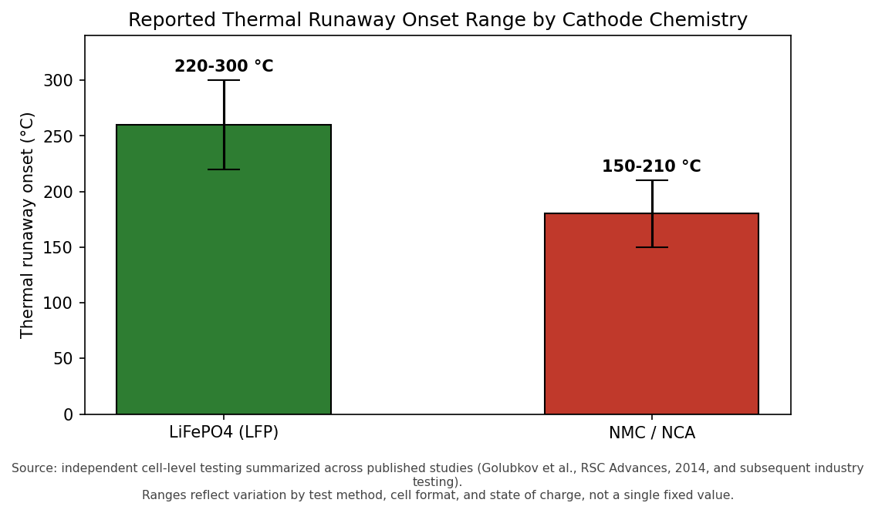
Figure 2. Reported thermal runaway onset ranges for LiFePO4 versus NMC/NCA cathodes, drawn from independent cell-level testing.
Correcting a Common Misconception: Depth of Discharge
A claim that circulates in LiFePO4 marketing material is that the battery has 100 percent discharge capacity and the user never has to worry about over-discharging. That is not accurate. LiFePO4 cells still degrade faster when routinely discharged to very low states of charge, and every well-designed system relies on the battery management system’s low-voltage cutoff specifically because unmanaged over-discharge damages the cells. LiFePO4’s real advantage is that it tolerates a deeper usable depth of discharge than lead-acid or many other lithium chemistries before cycle life drops off sharply, not that discharge depth stops mattering. For the full mechanics of how discharge depth affects lifespan, see Battery Depth of Discharge Explained.
Nominal Voltage: Cell vs. Pack
LiFePO4 has a nominal voltage of 3.2 V per cell, noticeably lower than the 3.6 to 3.7 V nominal voltage of NMC or NCA cells. That lower per-cell voltage is one reason LiFePO4’s energy density trails nickel and cobalt based chemistries, but it becomes largely irrelevant once cells are assembled into a pack, because off-grid and solar systems are built around standardized pack voltages, not individual cell voltage.
| Cell Count | Nominal Pack Voltage | Typical Use Case |
| 1S | 3.2 V | Small electronics, individual cell replacement |
| 4S | 12.8 V (“12V”) | RV, marine, small solar battery banks, portable power stations |
| 8S | 25.6 V (“24V”) | Mid-size off-grid systems, larger inverters |
| 16S | 51.2 V (“48V”) | Whole-home solar/battery systems, high-current inverters |
A “12V” LiFePO4 battery is a 4S pack, not a single 12V cell. A “24V” system is 8S, and a “48V” system is 16S. This is the detail most general explainers skip, and it matters directly when matching a battery to an inverter or charge controller’s input voltage window.
Discharge Curve: Why Voltage Doesn’t Tell You State of Charge
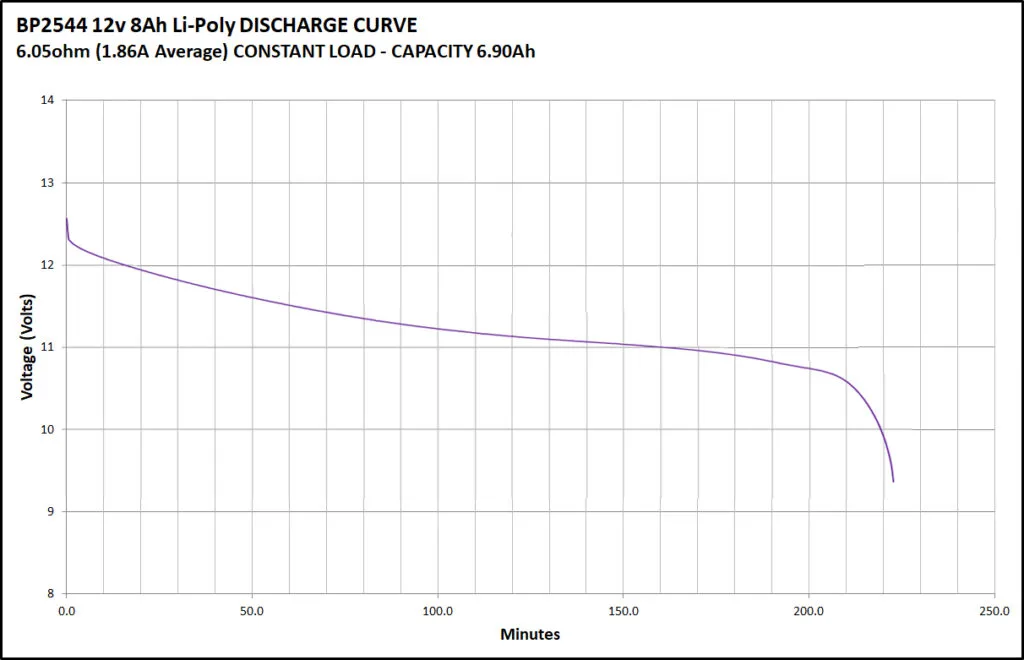
LiFePO4 has an unusually flat discharge curve. Once past the initial drop from full charge, pack voltage stays close to nominal across most of the usable capacity range, then falls sharply near empty. Lead-acid and most other lithium chemistries sag more steadily and predictably as they discharge, which is exactly why a simple voltmeter reading works reasonably well as a rough state-of-charge indicator on those chemistries.
On LiFePO4, that same approach is unreliable. A pack reading 13.2 V could be at 80 percent charge or 30 percent charge, because most of the discharge curve sits in a narrow voltage band. This is a genuine practical consequence, not just a technical curiosity: it is why LiFePO4 systems depend on a battery management system with coulomb counting, current-based state-of-charge tracking, rather than voltage alone, to give an accurate percentage reading. A buyer troubleshooting an inconsistent state-of-charge display on a LiFePO4 system is very often looking at this behavior, not a fault.
Cycle Life and Depth of Discharge
LiFePO4’s cycle life is consistently reported in the thousands of cycles, but the exact number depends heavily on depth of discharge and charge/discharge rate, not a single fixed figure. A cell cycled to 100 percent depth of discharge every time shows a materially shorter cycle life than the same cell cycled to a shallower depth. Battery Cycle Life Explained and Battery C-Rate Explained cover the full mechanics of that relationship; this section exists only to establish that LiFePO4’s longevity claims are conditional on usage pattern, not a fixed warranty-style number.
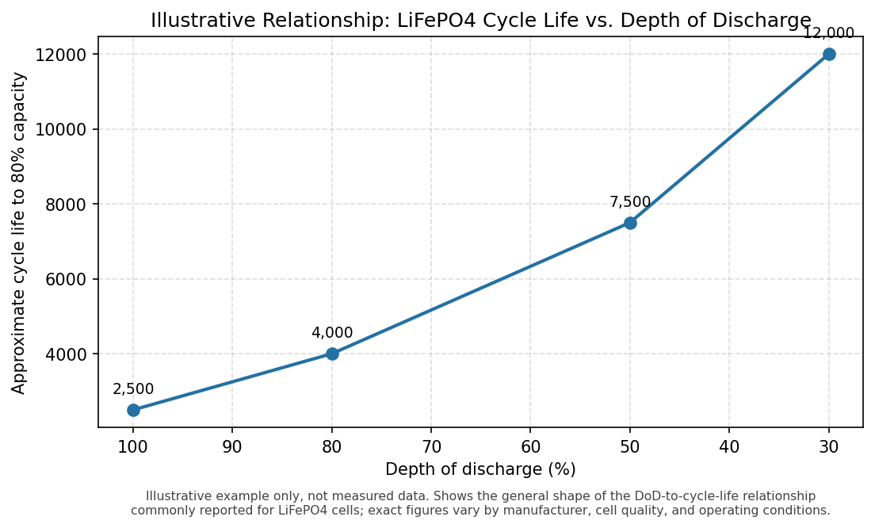
Figure 3. shape of the cycle-life-to-depth-of-discharge relationship commonly reported for LiFePO4 cells. Not measured data; consult a specific manufacturer’s datasheet for actual figures.
The Trade-Off: Energy Density
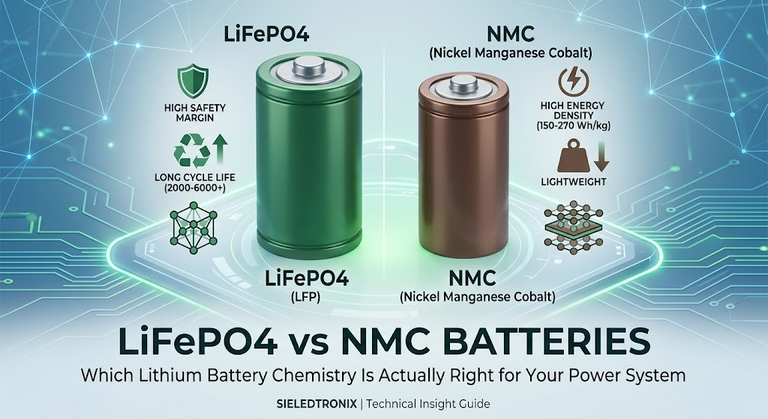
LiFePO4 is not the best lithium chemistry on every axis. Independent testing summarized in a California Air Resources Board funded battery evaluation placed iron phosphate cells in the roughly 80 to 110 Wh/kg range against roughly 100 to 170 Wh/kg for nickelate chemistries of the same era, and current commercial cells reported on Wikipedia’s lithium iron phosphate battery reference page now reach roughly 95 to 172 Wh/kg for LFP against 150 Wh/kg or higher for NMC. The gap is a direct consequence of the lower nominal cell voltage and the weight of the iron phosphate cathode structure relative to layered oxide cathodes.
For weight-critical applications, drones, slim consumer electronics, and long-range electric vehicles, that difference matters enough that manufacturers often choose NMC or NCA despite the safety trade-off. For stationary and semi-portable applications, home battery banks, portable power stations, telecom backup, and marine or RV house batteries, the weight penalty is far less important than cycle life and safety margin, which is why LiFePO4 dominates those categories.
LiFePO4 vs Lead-Acid: The More Common Real Decision
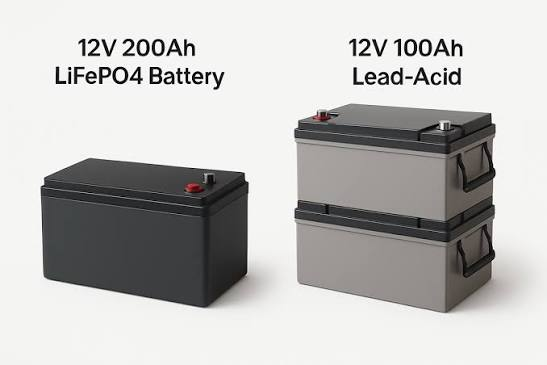
For most off-grid and backup buyers, the practical comparison is not LiFePO4 against NMC, it is LiFePO4 against lead-acid or AGM, since those are the two options actually competing for the same installation. Three differences dominate that decision. First, usable depth of discharge: lead-acid is generally limited to roughly 50 percent depth of discharge before cycle life degrades sharply, while LiFePO4 tolerates a substantially deeper usable discharge, so a lead-acid bank needs roughly double the rated capacity to deliver the same usable energy as a LiFePO4 bank.
Second, cycle life: manufacturer datasheets for common 100Ah LiFePO4 packs report cycle life in the range of 2,000 to 4,000-plus cycles at 80 percent depth of discharge, for example the Wattstunde NovaBase 100Ah LiFePO4 datasheet specifies 4,000-plus cycles at 80 percent DoD, against roughly 300 to 500 cycles typically reported for flooded or AGM lead-acid at comparable discharge depth. Third, self-discharge: LiFePO4 packs typically self-discharge at roughly 1 to 3 percent per month according to manufacturer specifications, versus a commonly cited 20 to 30 percent per month for lead-acid left unmaintained, which matters directly for a battery bank that sits idle between outages.
The upfront cost per amp-hour of LiFePO4 remains higher than lead-acid, and that gap is real. But it has to be weighed against replacement frequency: a lead-acid bank cycled deeply on a daily off-grid load is a consumable that gets replaced every one to three years, while a correctly sized LiFePO4 bank under the same load can reasonably be expected to outlast several lead-acid replacement cycles. Whether that trade favors LiFePO4 depends on usage pattern, upfront budget, and how deeply the bank is cycled, not a universal answer, but the comparison should be run on total cost over the expected service life, not sticker price alone.
Operating Temperature Limits and Installation Considerations
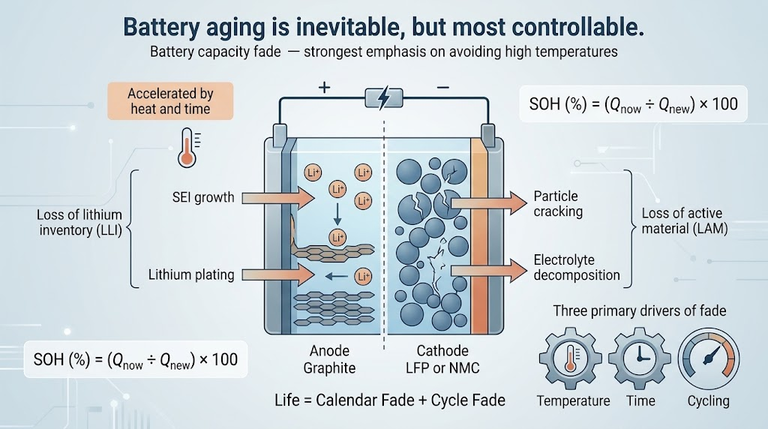
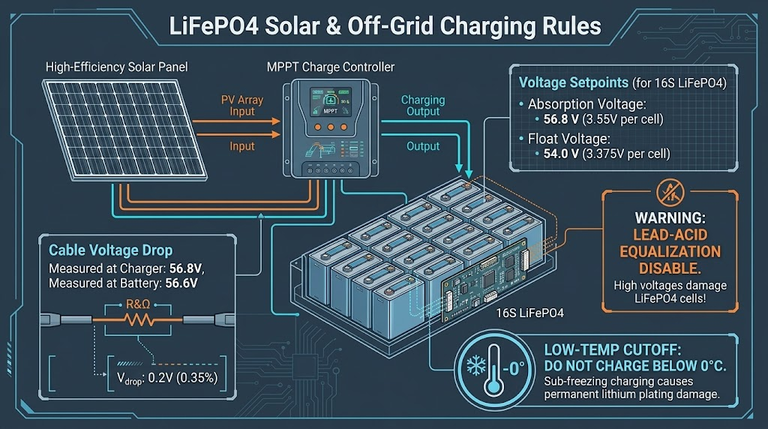
LiFePO4 batteries generally should not be charged below 0 C without a heating element or built-in low-temperature charge protection. Research from the National Renewable Energy Laboratory on lithium-ion fast charging confirms the underlying mechanism: charging a lithium-ion cell in cold conditions causes lithium metal to plate onto the anode surface instead of intercalating normally, which permanently reduces capacity and can create an internal short-circuit risk over repeated cold-charge cycles. This limitation is frequently omitted from general LiFePO4 explainers, but it is one of the more consequential details for buyers in cold climates or unheated installation locations, since discharge in cold conditions is far less restricted than charging.
Installation ventilation requirements also differ meaningfully from lead-acid. Flooded lead-acid batteries electrolyze water during charging and release hydrogen gas, which is why they require dedicated venting to the outside in an enclosed compartment. LiFePO4 cells do not produce hydrogen through that mechanism and do not off-gas during normal charge and discharge, so they generally do not require the same external gas venting.
That is not the same as needing no airflow at all: heat still builds up during charging and high-current discharge, multiple packs installed close together in a sealed compartment can accumulate that heat, and in an abnormal failure condition a cell can still vent gas internally. Manufacturer installation guidance on spacing and airflow should be followed even though the hydrogen-venting requirement that governs lead-acid installations does not apply in the same way.
Where LiFePO4 Is Actually Used
The chemistry’s combination of safety margin, cycle life, and stable voltage delivery has made it the default choice in three overlapping categories: portable power stations, where internal battery packs are sealed and safety margin matters more than raw weight, see How Portable Power Stations Work; stationary solar and off-grid battery banks, where daily cycling for years demands high cycle life; and backup power systems for telecom, medical, and home use, where the battery may sit at or near full charge for long periods and still needs to perform reliably when called on. Electric vehicles use LiFePO4 selectively, mainly in standard-range and cost-focused models, while weight-sensitive long-range EVs typically still favor NMC or NCA.
LiFePO4 vs Other Battery Chemistries
| Property | LiFePO4 (LFP) | NMC / Li-ion | Lead-Acid |
| Nominal cell voltage | 3.2 V | 3.6-3.7 V | 2.0 V |
| Typical cycle life (to 80%) | 2,000-6,000+ (DoD dependent) | 500-1,500 | 300-500 |
| Usable depth of discharge | 80-100% (design dependent) | 80-100% | ~50% |
| Energy density | ~90-172 Wh/kg | ~150-260 Wh/kg | ~30-50 Wh/kg |
| Reported thermal runaway onset* | Higher; roughly 220-300 C across published testing | Lower; roughly 150-210 C across published testing | Different failure mode; not applicable |
| Cold charging restriction | Generally not below 0 C without heating | Similar restriction, chemistry dependent | Less restrictive; capacity drops sharply in cold |
| Typical self-discharge | ~1-3% per month | ~2-5% per month | ~20-30% per month |
*Thermal runaway onset temperatures vary across published test methods, cell format, and state of charge; figures shown represent the range commonly reported in independent testing rather than a single fixed value.
Conclusion
LiFePO4 is a lithium-ion chemistry that trades some energy density for a meaningfully higher resistance to thermal runaway and a longer usable cycle life, driven by the strong phosphorus-oxygen bond in its olivine cathode structure. That trade-off is favorable for almost any stationary or semi-portable application, off-grid solar banks, portable power stations, and home backup, where weight is a secondary concern and daily cycling over years is the real demand placed on the battery.
It is a poor fit only where weight and maximum energy density outweigh cycle life and safety margin, a narrow set of use cases outside the off-grid and portable power space. For a reader evaluating an actual 100Ah LiFePO4 purchase for home backup in Nigeria, see Best 100Ah Lithium Battery for Home Backup in Nigeria.