LiFePO4 vs NMC Batteries
QUICK ANSWER
LiFePO4 (LFP) and NMC are both lithium-ion chemistries, but they trade the same underlying resource differently. LiFePO4 gives up energy density (roughly 90 to 160 Wh/kg at the cell level) in exchange for a much longer cycle life (commonly 2,000 to 6,000+ full cycles to 80% capacity), a higher thermal runaway threshold, and cobalt-free cathode material. NMC gives up some of that safety margin and cycle life (commonly 500 to 2,500 cycles, depending on grade) to pack more energy into less weight (roughly 150 to 270 Wh/kg).
For stationary or daily-cycling applications, such as a home backup battery or a portable power station used most days, LiFePO4 is the better engineering choice because cycle life dominates the lifetime cost. For weight- or space-constrained applications, such as a lightweight EV or a handheld device, NMC’s density advantage still matters more than its shorter service life.
Two Cathodes, One Underlying Trade-Off
A household choosing between a LiFePO4 power station and an older NMC-based unit is really choosing between two different cathode chemistries built on the same lithium-ion foundation. The cathode material is the single biggest factor separating the two: it determines how much energy the cell can pack in, how many times it can be charged and discharged before it wears out, and how it behaves when something goes wrong.
The practical stakes are not abstract. A buyer who prioritizes energy density without understanding the cycle-life trade-off can end up replacing a battery pack in two to three years instead of eight to twelve. A buyer who assumes LiFePO4 is simply “the safe one” without understanding its weight and voltage implications can end up with an oversized, overweight system for an application where density actually mattered.
This guide explains what physically separates the two chemistries, compares them on the specifications that actually affect a purchasing or engineering decision, and works through the calculation that most comparison articles skip: what each chemistry actually costs per delivered cycle.
What Actually Separates LiFePO4 from NMC
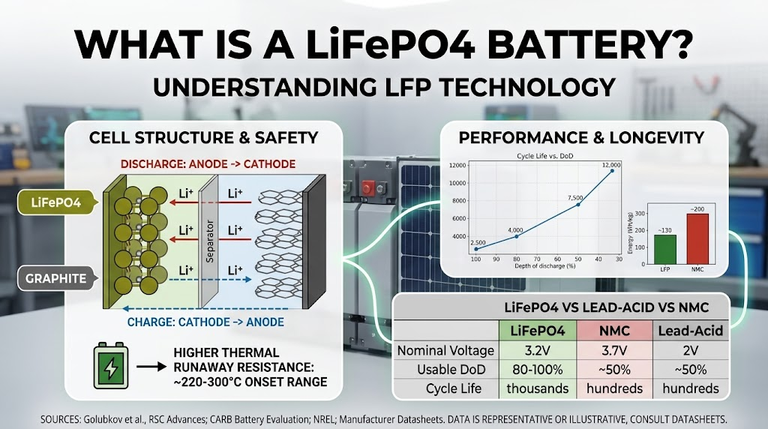
Both chemistries are lithium-ion batteries: lithium ions move between a cathode and a graphite anode during charge and discharge. The difference is the cathode material itself.
LiFePO4 (LFP)
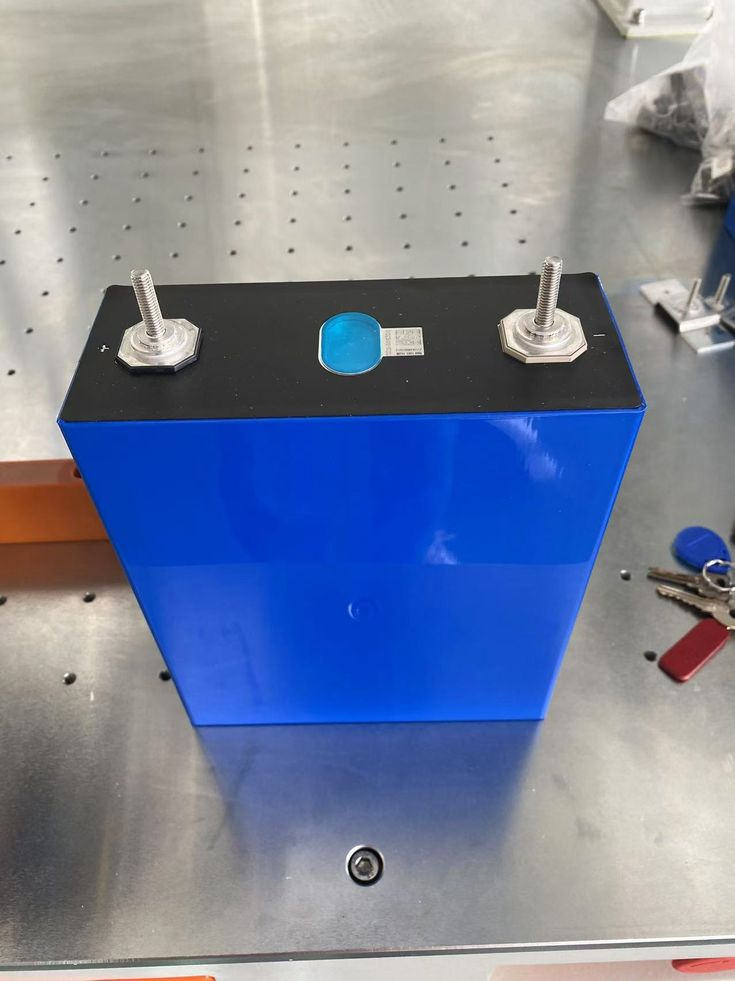
LiFePO4 uses an olivine crystal structure built around an iron-phosphate cathode (LiFePO4). The phosphorus-oxygen bond within the phosphate group is a strong covalent bond, and it stays intact across a wide temperature and state-of-charge range. That structural stability is the root cause of nearly every practical advantage LiFePO4 has: it is why the chemistry tolerates full discharge cycles, high heat, and physical abuse better than most other lithium-ion cathodes, and why its cycle life is so much longer.
The trade-off comes from the same structure. Iron and phosphate simply cannot pack as much lithium per unit of weight as the layered oxide structures used in NMC, so LiFePO4 cells store less energy for a given weight and occupy more space for a given capacity.
NMC (Nickel Manganese Cobalt Oxide)
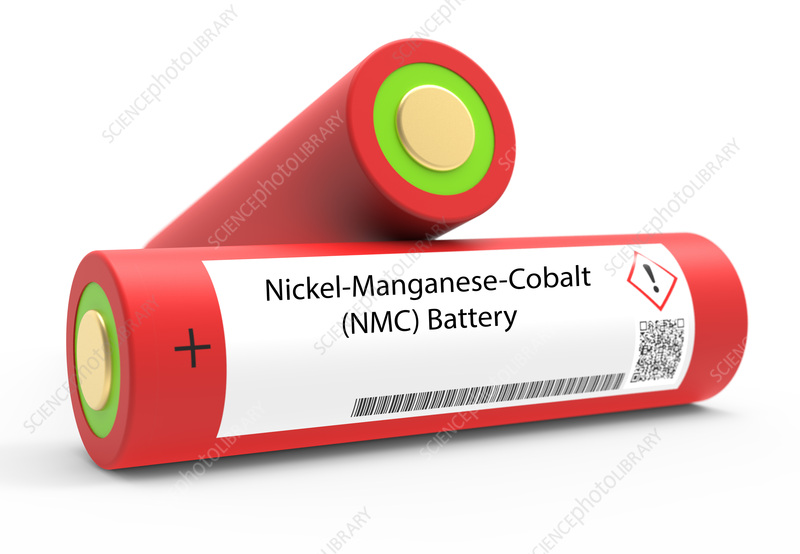
NMC uses a layered oxide cathode combining nickel, manganese, and cobalt, typically written as ratios such as NMC 111, NMC 622, or NMC 811 (the numbers describe the relative nickel:manganese:cobalt content). Higher nickel content increases how much energy the cathode can store, which is why nickel-rich formulations such as NMC 811 dominate long-range electric vehicles and space-constrained consumer electronics.
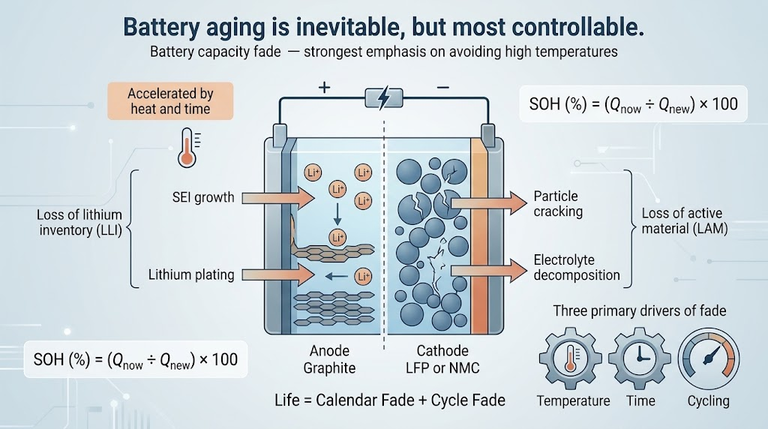
The layered structure that allows this higher energy density is inherently less stable than LiFePO4’s olivine structure. Under overcharging, physical damage, or sustained high heat, the layered oxide can begin to break down and release oxygen, which is what allows thermal runaway to propagate more easily than it does in a LiFePO4 cell. Higher nickel content generally raises energy density further while lowering thermal stability and cycle life.
Specification Comparison
The table below compares the two chemistries on the specifications that matter most for a purchasing or system-design decision. Ranges reflect published manufacturer and industry data; individual cells vary by manufacturer, grade, and test conditions, so treat these as planning ranges rather than a specific cell’s rating.
| Characteristic | LiFePO4 (LFP) | NMC |
| Nominal cell voltage | 3.2 V (typical range 3.0-3.65 V) | 3.6-3.7 V (typical range 3.0-4.2 V) |
| Specific energy (cell level) | ~90-160 Wh/kg; premium cells to ~205 Wh/kg | ~150-270 Wh/kg depending on nickel content |
| Cycle life to 80% capacity | ~2,000-6,000 cycles; premium cells higher | ~500-2,500 cycles depending on grade and DOD |
| Thermal runaway onset* | Higher (approx. 60-120C higher than NMC in comparable tests) | Lower; layered oxide begins breaking down at lower temperatures |
| Cobalt content | None | Present (proportion varies by formulation) |
| Cold-weather discharge | Usable, though capacity drops in cold; charging below 0C needs protection | Slightly better low-temperature discharge in most published comparisons |
| Typical application | Home/portable backup power, solar storage, RVs, telecom, daily-cycling use | EVs, drones, handheld electronics, weight- or space-constrained systems |
Reported thermal runaway onset temperatures vary across test methods and sources; treat the figures as a relative comparison rather than a precise threshold for any specific cell. See External Sources.
Cycle Life: The Difference That Dominates Lifetime Cost
Cycle life is the number of full charge/discharge cycles a cell can complete before its capacity falls to a defined threshold, almost always 80% of its original rated capacity. It is the single specification that most affects how long a battery-powered system lasts and what it actually costs to own.
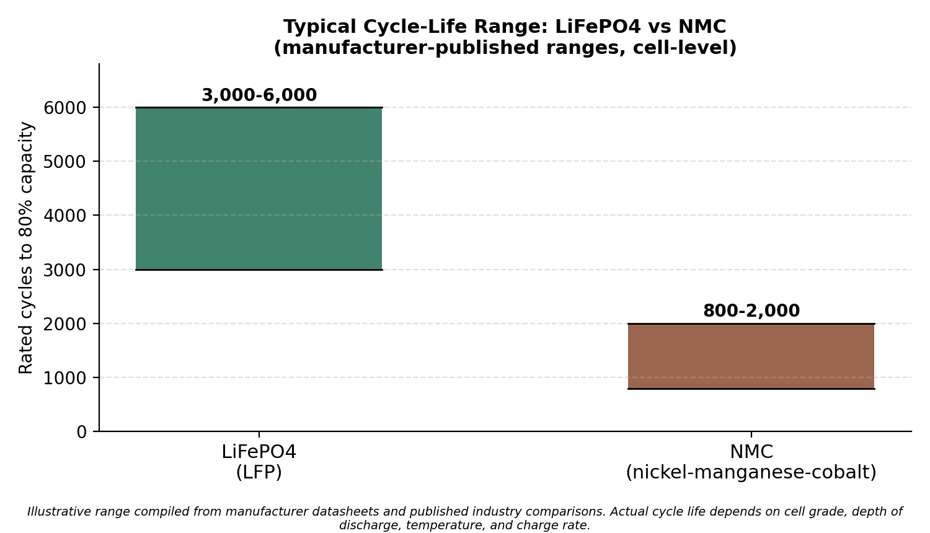
Figure 1. Typical rated cycle life ranges for LiFePO4 and NMC cells at the manufacturer datasheet level. Actual results depend on depth of discharge, charge rate, and operating temperature.
The practical consequence: a LiFePO4 pack cycled once per day typically reaches its rated cycle life in roughly 6 to 16 years. An NMC pack cycled at the same rate, using the lower end of its typical range, can reach its rated cycle life in under 2 to 4 years. Elevated ambient temperature makes the gap worse for NMC specifically. Sustained operation above about 35C accelerates NMC degradation meaningfully faster than it does LiFePO4, which matters for a power station stored in a hot garage, vehicle, or uncooled enclosure.
Worked Example: Cost per Delivered Cycle
A lower purchase price is not the same as a lower cost of ownership. The calculation that actually matters for a daily-cycling application is cost per delivered cycle: the purchase price divided by the number of cycles the pack is rated to deliver before it needs replacing.
Formula Cost per cycle = Purchase price / Rated cycle life (to 80% capacity)
Scenario
Two 1,000Wh-class portable power stations are being compared for daily home backup use:
- LiFePO4 unit: $700, rated for 3,000 cycles to 80% capacity, 1,024Wh
- NMC unit: $600, rated for 800 cycles to 80% capacity, 1,000Wh
Calculation
LiFePO4: $700 / 3,000 cycles = $0.233 per cycle
NMC: $600 / 800 cycles = $0.750 per cycle
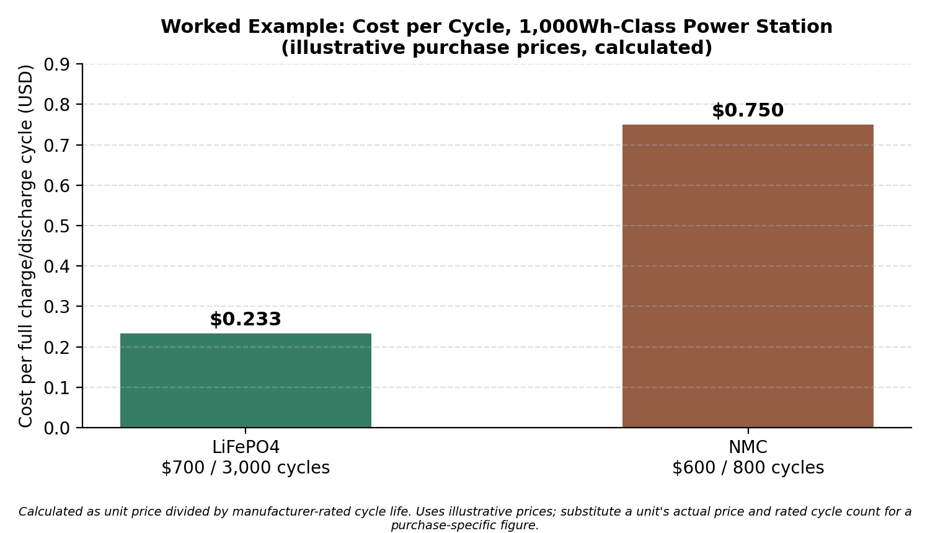
Figure 2. Calculated cost per full cycle for the worked example above.
Interpretation
Despite costing about 17% more to buy, the LiFePO4 unit in this example delivers each cycle at roughly one-third the cost of the NMC unit. Over a decade of daily cycling, that difference compounds: the NMC pack would need to be replaced two to four times to match the LiFePO4 pack’s service life, and each replacement carries the full purchase price again. This is why LiFePO4 has become the default chemistry for stationary and daily-cycling applications even though its purchase price per Wh is usually higher.
Real-world adjustment: this calculation assumes both packs are actually cycled to their rated depth of discharge daily and reach their full rated cycle count before failing. Partial cycling, high temperatures, fast charging, and BMS behavior all shift the real result. Treat the figure as a planning estimate, not a guaranteed lifetime cost, and substitute a specific product’s real price and rated cycle count for a purchase-specific comparison.
Safety and Thermal Stability
LiFePO4’s phosphate cathode structure is chemically more resistant to thermal runaway than NMC’s layered oxide structure. Under stress from overcharging, physical damage, or sustained high heat, an NMC cathode’s structure can begin to break down and release oxygen, which can feed a fire once one starts. LiFePO4’s stronger phosphorus-oxygen bond makes that breakdown pathway much harder to trigger, which is the main reason it has become the preferred chemistry for stationary home battery storage, where a thermal event has to be contained inside an occupied structure.
This does not make NMC unsafe by design. A properly engineered NMC pack with a well-designed battery management system (BMS), adequate cell spacing, and correct thermal management operates safely within its intended application, which is why it remains the dominant chemistry in electric vehicles. The comparison is one of relative safety margin, not of one chemistry being safe and the other being dangerous. Avoid absolute claims such as “NMC cannot be made safe” or “LiFePO4 cannot fail”: neither is accurate, and the real differentiator is the size of the engineering margin each chemistry provides before a fault becomes a fire.
Cold-Weather Performance
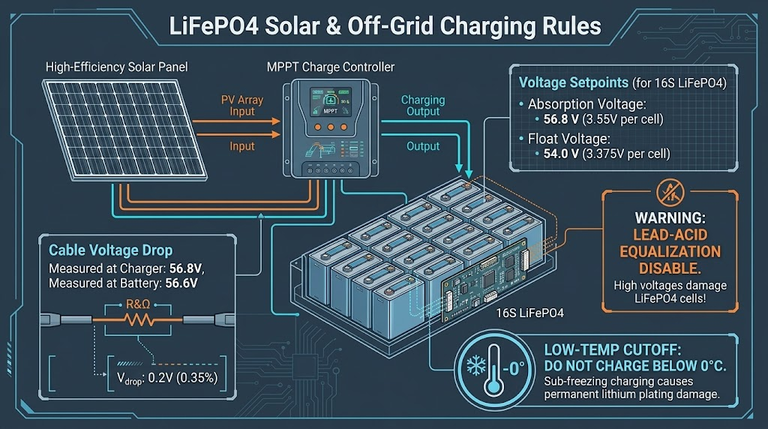
Both chemistries lose usable capacity in cold conditions, and neither should be charged below 0C without low-temperature protection or a self-heating design; charging a lithium-ion cell below freezing can cause lithium plating on the anode, which permanently reduces capacity and can create an internal short-circuit risk. This is one of several mechanisms behind portable power station battery degradation over time. Most published comparisons give NMC a slight edge in low-temperature discharge performance, though the difference is usually secondary to whether the product’s BMS includes proper low-temperature charge protection in the first place.
Which Chemistry Actually Fits the Application
Start from the constraint that matters most for the specific system, not from a general preference for one chemistry over the other.
Choose LiFePO4 when:
- The system cycles daily or near-daily (home backup, solar storage, a portable power station used regularly)
- The unit will sit charged through hot weather or an uncooled enclosure
- Long service life and low cost per cycle matter more than weight or size
- Cobalt-free sourcing is a priority
- There is enough physical space and weight budget to accept a lower Wh/kg pack
Choose NMC when:
- Weight or volume is the binding constraint (a lightweight EV, a drone, a handheld device)
- The system is cycled infrequently, so shorter cycle life matters less over its service life
- Cold-weather discharge performance is a meaningful factor
- The manufacturer’s BMS and thermal design are well proven for the application
For most portable power station buyers specifically, the daily-cycling and safety-margin advantages of LiFePO4 outweigh its density disadvantage, which is the main reason essentially every current-generation flagship portable power station on the market, across EcoFlow, Bluetti, Anker SOLIX, and Jackery’s newer LFP-based lines, has moved to LiFePO4. Older or budget-tier units still sold with NMC or generic “lithium-ion” chemistry typically carry a materially shorter rated cycle life, commonly in the 500 to 1,000 cycle range, and that figure should be checked explicitly before buying rather than assumed from the brand name alone.
Common Misconceptions
“NMC batteries are dangerous and LiFePO4 batteries are completely safe.”
Both chemistries can fail if abused, overcharged, physically damaged, or poorly managed by the BMS. LiFePO4 has a wider safety margin before a fault propagates into thermal runaway, which is a real and important difference, but it is a difference of degree, not a difference between an unsafe chemistry and a risk-free one.
“Higher voltage means a more powerful battery.”
NMC’s higher nominal cell voltage (3.6-3.7V vs LiFePO4’s 3.2V) affects how many cells are needed in series to reach a target pack voltage; it does not by itself mean more stored energy. Total stored energy is a function of capacity and voltage together (Wh = V x Ah), not voltage alone.
“Cycle life ratings are directly comparable across datasheets.”
A cycle life figure is only meaningful alongside the depth of discharge, charge rate, and temperature it was tested at. Comparing an LFP cell rated at 100% depth of discharge against an NMC cell rated at 80% depth of discharge makes the NMC figure look artificially closer than it actually is in equivalent daily use.
Common Mistakes
Choosing chemistry by price per watt-hour alone
An NMC pack is frequently cheaper per Wh at purchase, which makes it look like the better deal. As the worked example above shows, cost per delivered cycle, not purchase price per Wh, is the number that determines lifetime cost for a daily-cycling application. The same logic applies to sizing a power station’s battery capacity in the first place: getting the capacity right matters more than chasing the lowest price per watt-hour.
Charging any lithium-ion cell below freezing without protection
This applies to both chemistries, not just NMC. A BMS that lacks low-temperature charge cutoff is a real risk regardless of cathode material; check for this feature rather than assuming chemistry alone determines cold-weather safety.
Assuming a brand’s older and newer product lines share the same chemistry
Several major portable power station brands transitioned from NMC to LiFePO4 across their own product lines within the last few years. The same brand name does not guarantee the same chemistry; the datasheet or product listing needs to be checked for the specific model.
Frequently Asked Questions
Is LiFePO4 always better than NMC?
No. LiFePO4 is the better choice for most stationary and daily-cycling applications because of its cycle life and safety margin, but NMC remains the better choice where weight or volume is the binding constraint, such as in long-range electric vehicles or handheld devices.
Can I replace an NMC battery pack with a LiFePO4 pack of the same Wh rating?
Not automatically. LiFePO4’s lower nominal voltage (3.2V per cell vs 3.6-3.7V for NMC) means a pack built for the same total voltage needs a different cell count in series, and the physical size and weight will differ for the same Wh capacity. This is a system-level compatibility question, not a simple capacity swap.
Why do some cheaper power stations still use NMC?
NMC cells are generally cheaper to manufacture per Wh, so some budget-tier and older-generation products still use NMC or unspecified “lithium-ion” chemistry to hit a lower price point. That cost saving typically comes with a shorter rated cycle life, which should be weighed against the lower purchase price.
Does LiFePO4 really last 10 years?
A LiFePO4 pack rated for roughly 3,000 to 6,000 cycles can reach that figure in 8 to 16 years at one cycle per day, but real-world service life depends on actual cycling frequency, depth of discharge, temperature, and BMS quality. Treat manufacturer cycle ratings as a planning figure, not a guarantee.
Conclusion
LiFePO4 and NMC are not competing for the same job. LiFePO4 trades energy density for cycle life, thermal stability, and a lower cost per delivered cycle, which is why it has become the default chemistry for home backup power, portable power stations, and solar storage. NMC trades some of that safety and longevity margin for higher energy density, which keeps it the preferred choice wherever weight and space are the binding constraint, most visibly in long-range electric vehicles.
The practical decision rule: check the actual rated cycle life and chemistry of the specific product being considered, not the brand or the chemistry name alone, and weigh that figure against how often the system will actually be cycled. For anything charged and discharged on a near-daily basis, LiFePO4’s lower cost per cycle will almost always outweigh NMC’s lower sticker price within the first few years of ownership.