1000Wh Power Station: What It Means and How Long It Lasts
A portable power station listing “1000Wh” on the box does not, by itself, say how long it will run a refrigerator, how many times it will charge a phone, or how it compares to a competitor’s unit rated “1000W” sitting on the shelf next to it. The number is a measurement of stored energy, not of speed, output, or capability in any single application. Reading it correctly is the difference between buying a power station that comfortably covers a blackout and buying one that runs out two hours in.
This article explains what 1000Wh actually represents, why so many portable power stations cluster around that figure, how much of it is realistically usable once battery reserve and inverter losses are accounted for, and what a 1000Wh unit can be expected to run in practice.
| Quick Answer 1000Wh means the battery stores enough energy to deliver 1000 watts of continuous power for one hour, or any other combination of power and time that multiplies out to 1000 watt-hours: 500W for two hours, 100W for ten hours, 10W for one hundred hours. After the usual battery reserve and AC inverter conversion losses, a 1000Wh power station typically delivers around 750 to 850Wh of real, usable AC energy, which is roughly enough to run a 100W device for about 8 hours, recharge a smartphone 35 to 40 times, or keep a small compressor refrigerator running for around 13 hours. |
The Literal Definition, in Brief
Energy, in watt-hours, is power multiplied by time: E (Wh) = P (W) × t (h). A 1000Wh rating simply means the number that results from multiplying some power level by some duration equals 1000. The full distinction between watts and watt-hours, including why the two are frequently confused on product listings, is covered in Watts vs Watt-Hours: What Is the Difference?. This article picks up from that definition and focuses specifically on what the 1000Wh figure means in practice.
The table below shows a few of the power-and-time combinations that all equal 1000Wh. A power station does not “choose” one of these; it simply keeps delivering energy until the total reaches its usable limit, at whatever combination of power and time the connected load happens to draw.
| Power delivered | Duration to reach 1000Wh |
| 1000 W | 1 hour |
| 500 W | 2 hours |
| 200 W | 5 hours |
| 100 W | 10 hours |
| 50 W | 20 hours |
| 10 W | 100 hours |
Table 1. Power and time combinations that all equal 1000Wh of nominal energy. Real power stations lose a portion of this total to conversion losses before it reaches a load, explained below.
Why 1000Wh Became an Entire Product Class
“1000Wh” functions as shorthand for an entire tier of portable power stations, roughly one kilowatt-hour of storage, positioned as a step up from small camping batteries and a step below whole-home backup units. Very few products in this tier are rated at exactly 1000Wh. The EcoFlow DELTA 2 is rated at 1024Wh with 1800W of continuous AC output. The Jackery Explorer 1000 v2 is rated at 1070Wh with 1500W AC output.
The BLUETTI Elite 100 V2 is rated at 1024Wh with 1800W AC output. None of these lands on a round number, because a battery pack’s actual capacity is determined by cell count and nominal voltage, not by marketing convenience. “1000Wh” is the tier name; the datasheet number is what actually ships.
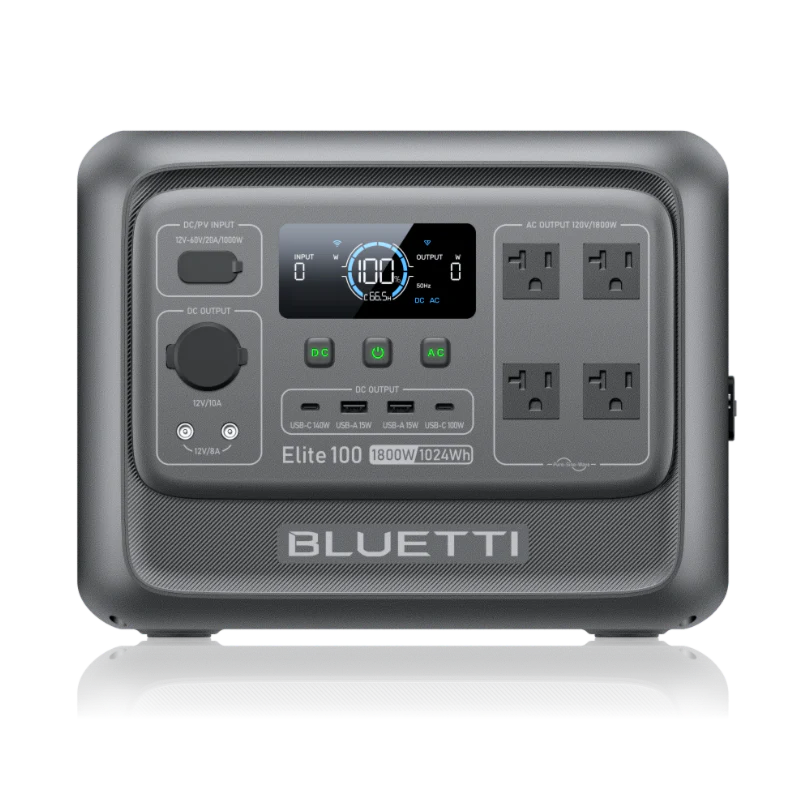
This matters for comparison shopping. Two products both marketed in the “1000Wh class” can differ in nominal capacity by 5 to 10 percent before any real-world losses are even considered, and their continuous AC output ratings, a separate specification entirely, can differ far more than that. A unit with a smaller nominal Wh figure but a stronger inverter and better real-world efficiency can outperform a nominally larger competitor on the loads that matter for a specific use case.
What the 1000Wh Number Does Not Tell You
It does not say how fast the unit can deliver energy
A power station’s continuous and surge wattage ratings are separate specifications from its Wh rating, and they determine whether the unit can start and run a given appliance at all. A 1000Wh power station with a 300W inverter cannot run a 1500W space heater regardless of how much energy is stored inside it. This distinction is explained fully in Watts vs Watt-Hours: What Is the Difference?.
It does not say how much of that 1000Wh actually reaches a device
The nameplate Wh figure is measured at the battery, not at the AC outlet. Depth-of-discharge reserve and inverter conversion losses both reduce the energy that reaches a connected load. The complete methodology for calculating usable energy and runtime is covered in How to Calculate Portable Power Station Runtime; the next section summarizes the result as it applies specifically to a 1000Wh unit.
It does not say how efficiency changes with the load
Inverter efficiency is not a single fixed percentage. Independent testing of a 1024Wh EcoFlow DELTA 2 by Outdoor Life measured the unit delivering approximately 67 percent of its stated watt-hour capacity at a light, consistent 34W draw, but approximately 88 percent of its stated capacity at a heavier, consistent 380W draw. A lightly loaded inverter spends a larger share of the energy passing through it on its own standby and switching losses, which is why small loads run for disproportionately less time per watt-hour than the simple Wh-divided-by-watts math suggests.
This is one of the more consequential gaps in how 1000Wh specifications are typically read: the percentage of nameplate capacity actually delivered depends on what is plugged in, not just on the unit’s advertised efficiency figure.
From Nameplate Wh to Usable AC Energy
Sielectronix uses a planning factor of about 0.80 to estimate usable AC energy from nominal capacity for a modern LiFePO4 power station, combining roughly 95 percent usable depth of discharge with roughly 85 percent inverter efficiency (0.95 × 0.85 ≈ 0.80). This is the same factor used throughout the Sielectronix portable power station guides, including How to Calculate Portable Power Station Runtime, so figures stay consistent from one article to the next. Applied to a 1000Wh nominal rating, the factor gives approximately 800Wh of usable AC energy.
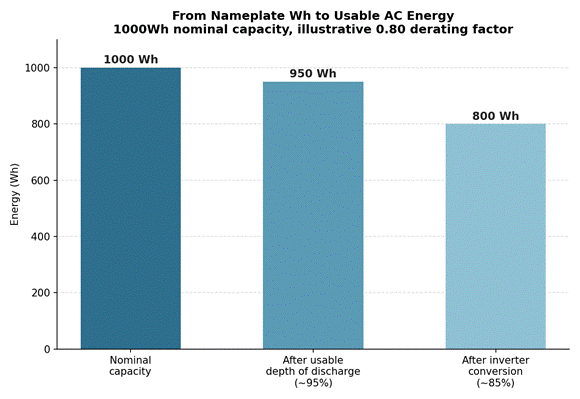
Figure 1. Two loss stages separate a 1000Wh nameplate rating from the energy that actually reaches an AC load.
This 800Wh figure is a planning estimate, not a guarantee for any individual unit. As the efficiency test data above shows, a unit running a very light load can deliver noticeably less than 80 percent of its nameplate rating, while a unit running closer to its efficient mid-range load can deliver somewhat more. A manufacturer-published usable-capacity or efficiency figure for a specific product should always be used in place of this general estimate when it is available.
What Can a 1000Wh Power Station Actually Run?
The table and chart below apply the 800Wh usable-energy estimate to a range of common loads. Figures are calculated, not measured, and assume a steady continuous draw except where noted; devices with a compressor or a heating element behave differently, as explained in the notes below the table.
| Device or load | Typical power | Estimated runtime |
| Wi-Fi router + modem | ~15 W | ~53 hours |
| CPAP machine (average draw) | ~30 W | ~27 hours (about 3 nights) |
| Box fan | ~50 W | ~16 hours |
| Small compressor fridge (average, duty-cycle adjusted) | ~60 W avg. | ~13 hours |
| Flat-screen TV | 65–100 W | 8–12 hours |
| Laptop + monitor + Wi-Fi router | ~110 W | ~7.3 hours |
| Countertop microwave | ~1500 W | ~0.5 hours |
Table 2. Estimated runtime on 800Wh of usable AC energy (a 1000Wh unit at the 0.80 planning factor). The refrigerator figure uses the same duty-cycle method as Case 3 in the Sielectronix runtime guide, scaled to a 1000Wh unit; the laptop-and-monitor figure matches Case 2 of that same guide directly.
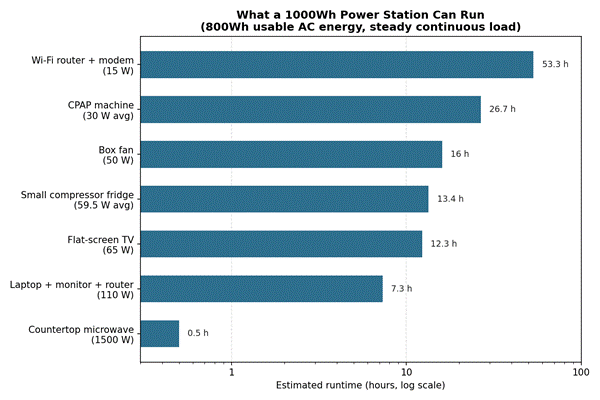
Figure 2. The same runtime estimates shown on a logarithmic scale, illustrating how much continuous power level, not battery size alone, changes the outcome.
Charging small devices tells a different story than running them continuously, because each charge only needs a fraction of the battery’s energy. A typical modern smartphone battery stores roughly 12 to 20 watt-hours; accounting for charging losses, 800Wh of usable energy is enough for approximately 35 to 40 full phone charges. A typical laptop battery stores roughly 40 to 70 watt-hours; at the same charging efficiency, 800Wh supports roughly 10 to 14 full laptop charges, depending on the specific battery and charger.
Is 1000Wh a Lot of Energy?
The answer depends entirely on what it is being compared against. According to U.S. Energy Information Administration data, the average American household consumes roughly 28 to 29 kilowatt-hours of electricity per day. A 1000Wh power station holds about 1 kilowatt-hour, or roughly 3.5 percent of a typical day’s whole-house electricity use. That comparison is not a criticism of the product; a portable power station in this class was never intended to replace whole-home electrical service, including central heating and cooling. It is intended to run a defined set of essential or convenient loads, which is exactly what the table above quantifies.
Against a smaller reference point, 1000Wh is a substantial amount of portable energy. A common 20,000mAh USB power bank built around a 3.7V lithium cell stores approximately 74Wh, so a 1000Wh power station holds roughly 13 times as much energy as one of those power banks, in a form factor that can output AC power rather than only USB charging.
Against a larger reference point, most current electric vehicles carry battery packs in the 60 to 100 kilowatt-hour range, meaning a 1000Wh power station holds somewhere around 1 to 1.5 percent of a typical EV battery’s capacity. These comparisons are useful for calibrating expectations, not for predicting exact performance; the runtime table above remains the more directly useful reference for planning a specific outage or trip.
Common Mistakes When Reading a 1000Wh Spec
Assuming the full 1000Wh is usable
Dividing 1000Wh directly by a device’s wattage produces a runtime the power station’s own battery management system and inverter will not actually deliver. The usable figure, after depth-of-discharge reserve and inverter losses, is meaningfully lower, typically around 750 to 850Wh rather than the full nameplate figure.
Treating “1000Wh” and “1000W” as the same kind of number
A 1000Wh rating describes total stored energy. A 1000W rating describes the maximum rate at which the unit can deliver power at any given moment. A power station can be strong on one figure and comparatively weak on the other, and checking only one of them before a purchase is one of the more common mistakes in this product category.
Assuming every 1000Wh-class unit performs identically
As the independent efficiency testing cited earlier shows, real-world delivered capacity varies by load level and by unit, sometimes by 20 percentage points or more between a light load and a moderate one. A specific product’s manufacturer-published efficiency or usable-capacity figure, where available, is a better planning input than a general industry assumption.
Ignoring the continuous and surge wattage ceiling separately
A generously sized 1000Wh battery paired with an undersized inverter will still fail to start a compressor-driven appliance if the startup surge exceeds the inverter’s rating, regardless of how much energy remains in the battery. Continuous wattage, surge wattage, and watt-hour capacity are three separate specifications that all need to be checked against the intended load.
Is 1000Wh Enough for a Given Use Case?
A 1000Wh power station is well matched to running a small set of essential or convenience loads for the better part of a day: a router, a few lamps, phone and laptop charging, a CPAP machine overnight, or a small refrigerator for roughly half a day to a full day depending on ambient temperature and insulation. It is not well matched to running whole-home HVAC, an electric water heater, or multiple high-draw appliances simultaneously for an extended outage.
A reader working from a specific list of devices and a specific required duration should use the step-by-step method in How to Calculate the Battery Capacity for Portable Power Station or the full sizing framework in What Size Portable Power Station Do I Need? to determine whether 1000Wh, or a different capacity entirely, is the right target.
Frequently Asked Questions
Is 1000Wh always exactly 1000Wh?
No. “1000Wh” is generally used as a tier name for products clustered around one kilowatt-hour of nominal capacity. Actual nameplate ratings in this tier commonly range from roughly 1000Wh to just over 1070Wh depending on the manufacturer and model, and the usable AC energy after conversion losses is lower than the nameplate figure in every case.
How many times will a 1000Wh power station charge my laptop?
Using the Sielectronix 0.80 usable-energy planning factor and a typical 40 to 70Wh laptop battery, a 1000Wh power station supports roughly 10 to 14 full laptop charges. The exact number depends on the laptop’s battery size and charger efficiency, and it drops if the laptop is also being used, rather than only charged, during that time.
Can a 1000Wh power station run a full-size refrigerator?
Not for an extended period. A full-size residential refrigerator typically has a much higher average daily energy consumption than a small compressor cooler, often in the range of 1 to 2 kilowatt-hours per day, which is comparable to or greater than a 1000Wh unit’s entire usable capacity. A 1000Wh power station is better matched to a small compact refrigerator or a well-insulated cooler; sizing for a full-size refrigerator generally requires a larger power station, addressed in “What Size Portable Power Station Do I Need?”
What is the difference between a 1000Wh power station and a 1000W power station?
They describe different specifications on the same or different products. “1000Wh” describes total stored energy, the reservoir. “1000W” describes maximum power output, the rate at which that reservoir can be drained. A single power station is rated for both figures independently, and neither one can be inferred from the other.
Does a bigger Wh number always mean a more capable power station?
Not for every use case. A larger Wh rating means more total stored energy and generally longer runtime for a given load, but it says nothing about the unit’s continuous or surge wattage ceiling, its inverter efficiency, its charging speed, or its physical weight and portability. A smaller-capacity unit with a stronger inverter can outperform a larger-capacity unit on loads that require high continuous or surge power.
Conclusion
1000Wh describes a fixed quantity of stored energy, roughly one kilowatt-hour, not a speed, a guarantee, or a single fixed runtime. In practice, a 1000Wh power station delivers somewhere around 750 to 850Wh of usable AC energy after battery reserve and inverter losses, enough to keep a handful of essential devices running for the better part of a day, recharge a phone several dozen times, or run a single higher-draw appliance for a much shorter window.
The number on the box is the correct starting point for a sizing decision, but the continuous wattage rating, the real-world efficiency at the intended load, and the specific devices being powered all have to be checked separately before assuming a 1000Wh unit is either plenty or not enough.
For a full sizing calculation based on a specific list of devices and a target backup duration, see How to Calculate the Battery Capacity for Portable Power Station and How to Calculate Portable Power Station Runtime.
Sources
Technical assumptions and figures used in this article were checked against the following sources:
- EcoFlow, “DELTA 2 Portable Power Station” product specifications (nominal capacity and continuous AC output rating).
- Outdoor Life, “Best Portable Power Stations 2026” (independent load-dependent efficiency testing of a 1024Wh unit).
- U.S. Energy Information Administration, residential electricity consumption data, as reported by industry summaries of EIA figures (average household daily kWh use).
Appliance wattage figures used in the runtime table are general reference estimates for illustration. Actual values vary by model and should be confirmed against a specific device’s nameplate rating before use in a real sizing decision.