How Portable Power Stations Work
A portable power station is a battery, a battery management system, an inverter, and a charge controller built into one case. The battery stores energy as direct current (DC). The battery management system (BMS) protects the cells and decides when charging or discharging is allowed. The charge controller manages energy coming in from a wall outlet, a car port, or a solar panel. The inverter converts stored DC energy into AC power that resembles ordinary wall electricity.
Every one of these components introduces a small, measurable energy loss, which is why a station rated at 1,000 Wh never delivers a full 1,000 Wh to a connected device, a gap explained in detail in Watts vs Watt-Hours: What Is the Difference?.
Quick Answer
A portable power station stores DC energy in a lithium battery, protects that battery with a BMS, accepts incoming power through a charge controller, and releases it either as DC (through USB-C or 12V ports, with minimal loss) or as AC (through the internal inverter, which typically wastes 5 to 15 percent of the energy as heat). The nameplate watt-hour rating describes stored energy, not delivered energy. Real-world usable output is lower once BMS reserve and conversion losses are accounted for.
The Core Components
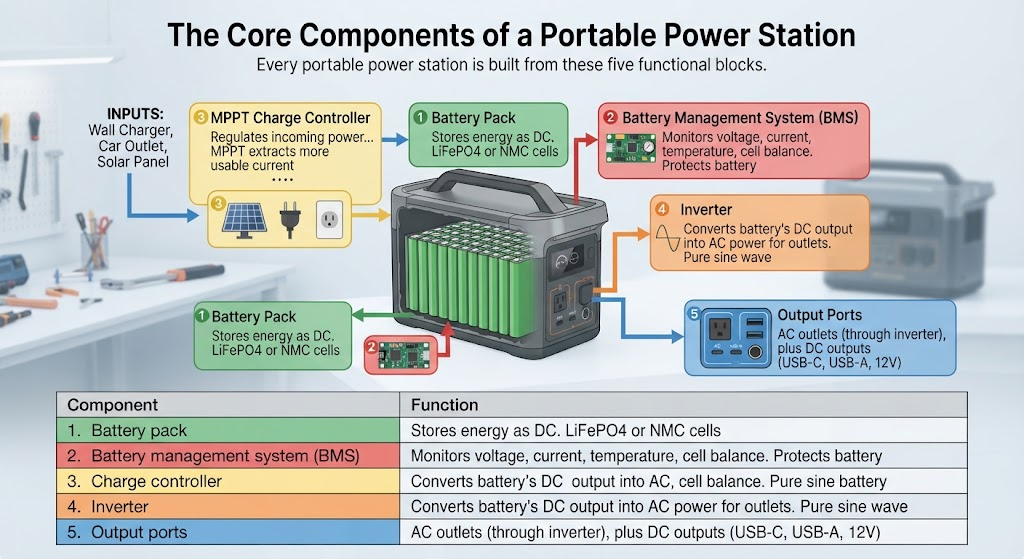
Every portable power station on the market, regardless of brand, is built from the same five functional blocks.
| Component | Function |
| Battery pack | Stores energy as DC. Almost all current models use lithium-ion cells, either LiFePO4 (lithium iron phosphate) or NMC (nickel manganese cobalt). |
| Battery management system (BMS) | Monitors voltage, current, temperature, and cell balance. Decides when charging or discharging must stop to protect the battery and the connected equipment. |
| Charge controller | Regulates incoming power from a wall charger, car outlet, or solar panel. Solar-capable units typically use an MPPT (maximum power point tracking) controller rather than a simpler PWM controller, because MPPT extracts more usable current from a variable solar input. |
| Inverter | Converts the battery’s DC output into AC power for the wall-style outlets. Nearly all current products use a pure sine wave inverter, which produces a waveform close to utility power and is compatible with sensitive electronics. |
| Output ports | AC outlets (through the inverter), plus DC outputs such as USB-C, USB-A, and 12V ports that draw directly from the battery with far less conversion loss. |
How Energy Actually Flows Through the Unit
The diagram below traces both directions: energy coming in during charging, and energy going out during use.
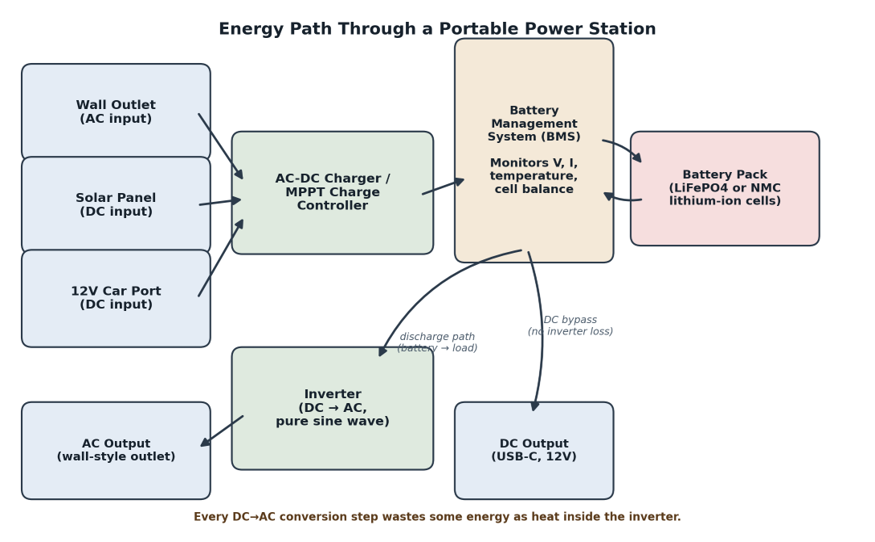
Figure 1. Energy path through a portable power station. The BMS sits between every input and output path and can interrupt either direction. The DC output bypasses the inverter entirely, which is why DC ports lose less energy than AC outlets.
During charging, power enters through one of three paths: a wall outlet (through an internal AC-DC charger), a solar panel (through an MPPT charge controller), or a 12V vehicle outlet. In every case, the BMS sits between the incoming power and the cells, and it can throttle or halt charging based on temperature, voltage, or cell balance. During discharge, the process reverses. The battery’s DC output goes either straight to a DC port with minimal additional loss, or through the inverter to become AC power. The inverter step is where most of the unavoidable energy loss occurs.
The Battery: LiFePO4 vs NMC
The two chemistries dominating current portable power stations behave differently enough that the choice affects safety margin, expected lifespan, and weight.
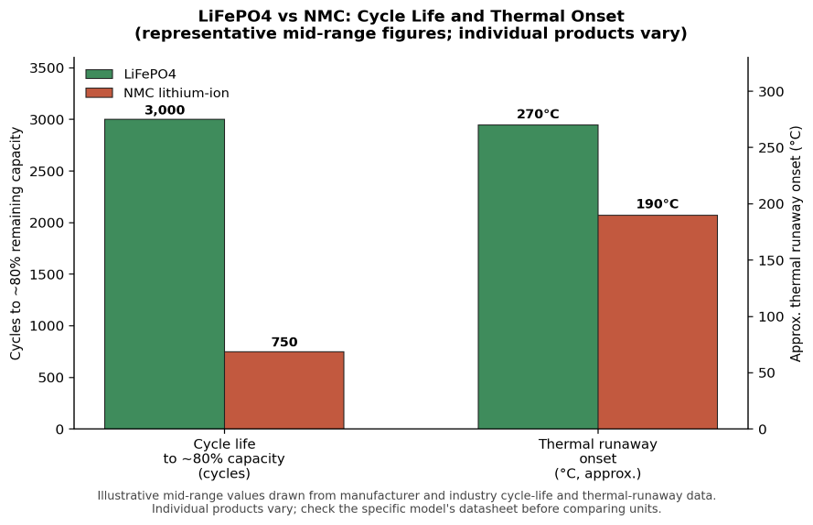
Figure 2. Representative mid-range cycle life and thermal runaway onset for LiFePO4 versus NMC cells. Individual products vary; the values shown are illustrative, not a specific product’s tested data.
LiFePO4 cells generally reach roughly 2,500 to 3,500 cycles, and in some manufacturer ratings well beyond that, before capacity falls to about 80 percent of original, and their thermal runaway threshold sits meaningfully higher than NMC, around 270 degrees Celsius versus roughly 150 to 210 degrees Celsius for NMC depending on the source and specific formulation.
That stability is the reason LiFePO4 has become the default chemistry in most home-backup-oriented portable power stations released in the last few years. NMC packs more energy into less weight, which is why it still appears in smaller, portability-focused units, but it typically lasts on the order of 500 to 1,000 cycles and carries a lower thermal runaway threshold. Neither figure should be read as an exact universal number. A specific product’s datasheet is the only source that describes that product’s actual cycle rating.
The Inverter: Where Energy Actually Gets Lost
The inverter is the component most responsible for the gap between a station’s rated capacity and what a connected device actually receives. Converting DC to AC is never a lossless process. Published efficiency figures for the pure sine wave inverters used in current portable power stations typically fall between 85 and 95 percent, with efficiency also varying by load; a lightly loaded inverter is usually less efficient than one running near its rated output.
Worked Example
Consider a power station with a 1,000 Wh nameplate rating. Two real-world adjustments apply before that number becomes usable energy. The figures below match the depth of discharge and inverter efficiency assumptions already used in How to Calculate the Battery Capacity for Portable Power Station, so a reader moving between the two articles works from the same numbers rather than a different assumption on each page.
- Depth of discharge (DoD): the BMS reserves headroom at the top and bottom of the charge range to protect the cells, so only a fraction of the nameplate rating is ever actually available. This example uses 90 percent, within the commonly published 80 to 90 percent range for LiFePO4 units.
- Inverter efficiency: this example uses 85 percent for the AC path, within the commonly published 80 to 92 percent range, and 95 percent for the DC path, which skips the inverter and only incurs minor port-level conversion loss.
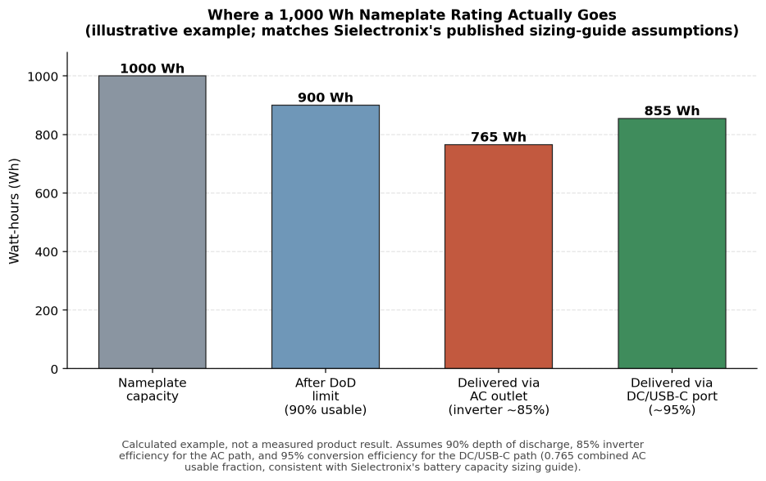
Figure 3. Calculated example showing how a 1,000 Wh nameplate rating is reduced by depth-of-discharge limits and, separately, by the inverter step. Values are calculated from the stated assumptions, not measured from a specific product.
Under these assumptions, roughly 900 Wh is actually available after the DoD limit. Drawing that energy through the AC outlet delivers approximately 765 Wh to the connected device, a combined usable fraction of 0.765, matching the figure used in the sizing guide’s own worked example. Drawing the same stored energy through a DC or USB-C port delivers approximately 855 Wh, because it bypasses the inverter step. The practical takeaway: charging a laptop from the DC port instead of the AC outlet, when the laptop supports it, recovers meaningfully more usable energy from the same battery. For the full runtime formula built on these same figures, see How to Calculate Portable Power Station Runtime.
What the BMS Actually Does in Practice
The battery management system is often described only as a protection circuit, but its behavior has direct, observable effects on runtime and on what a station will and will not power.
- Runtime is usually a little shorter than the simple math suggests. A 500 Wh station running a 60 W laptop, a 40 W monitor, and a 10 to 15 W router looks like it should run just over four hours; in practice three to three and a half hours is common, because the inverter and internal electronics draw power continuously and the BMS keeps a reserve at both ends of the charge range.
- A refrigerator or other compressor-driven appliance can trip an unexpected shutdown. The compressor’s running wattage might be well within the inverter’s continuous rating, but the brief startup surge can be several times higher, and its duty cycle, not its rated wattage, is what actually determines total energy use over a day, a point covered in more depth in How Much Power Does a Refrigerator Use?. If the BMS detects a current spike it interprets as a fault condition, it can cut the AC output even when the inverter’s surge rating looks adequate on paper.
- Heat changes behavior. A station sitting in direct sun or inside a warm bag can have its output quietly limited by the BMS to keep internal temperatures within a safe range, independent of how much charge remains.
Charging: Wall, Car, and Solar
The charge controller’s job differs depending on the input source. A wall charger or car adapter supplies a relatively stable voltage, so the controller’s main task is regulating current and cutting off at full charge. Solar input is inherently variable, changing with cloud cover, panel angle, and time of day, which is why solar-capable stations use an MPPT controller rather than a simpler design. MPPT continuously adjusts the electrical operating point of the connected panel to extract more usable current than a fixed-ratio controller would, particularly in partial-shade or low-light conditions.
Common Misconceptions
Watt-hours and watts are not the same measurement
Watt-hours (Wh) describe stored energy, the total amount available. Watts (W) describe power, the rate at which that energy is used or delivered right now. A 1,000 Wh station and a 100 W load do not simply divide to a guaranteed 10 hours of runtime, because that calculation ignores BMS reserve, inverter loss, and idle draw.
Nameplate capacity is not delivered capacity
As the worked example above shows, a portion of the rated watt-hours is never available to a connected device once BMS reserve and inverter conversion are factored in. This is a normal characteristic of every lithium-based system, not a defect specific to one product.
Running watts and surge watts measure different things
An inverter’s continuous, or running, wattage rating describes what it can sustain. Surge wattage describes the brief higher output available to start a motor or compressor. Sizing a station using running watts alone, while ignoring the surge demand of a refrigerator, pump, or power tool, is a common way to end up with a unit that shuts down the moment the appliance starts.
Common Mistakes
- Assuming the full nameplate Wh rating will be usable. Budget for roughly 80 to 90 percent of the rated capacity as a realistic planning figure, and less than that if the load runs exclusively through the AC inverter.
- Ignoring startup surge for compressor-based or motor-based appliances. Check the appliance’s surge or locked-rotor current, not just its running wattage, against the inverter’s surge rating.
- Charging and discharging exclusively through the AC path when the connected device supports DC input. This routes energy through the inverter unnecessarily and gives up several percentage points of usable capacity.
- Leaving a station in direct sun or an enclosed hot space during use, which can trigger BMS-driven output limiting independent of remaining charge.
Frequently Asked Questions
Why does my power station show less runtime than the math predicts?
The simple calculation of watt-hours divided by load watts assumes 100 percent efficiency and ignores BMS reserve, inverter loss, and the station’s own idle power draw. All three reduce real-world runtime below the theoretical figure.
Is LiFePO4 always the better choice?
For most stationary or frequently cycled use, such as home backup, LiFePO4’s longer cycle life and higher thermal stability make it the stronger choice. NMC can still make sense where minimizing weight per watt-hour is the priority and cycling frequency is low, such as occasional travel use.
Does using the DC port instead of the AC outlet really save meaningful energy?
Yes, when the connected device supports it. Because the DC path skips the inverter, it avoids the single largest conversion loss in the system, typically recovering several percentage points of usable energy compared with the same load run through the AC outlet.
Can a portable power station run a refrigerator?
Often yes, provided both the continuous wattage and the brief startup surge are within the inverter’s ratings and the battery capacity supports the required runtime. This depends on the specific refrigerator and the specific station’s specifications, and is covered in more depth in the sizing and runtime articles referenced below.
Conclusion
A portable power station is a coordinated system, not just a large battery. The battery stores energy, the BMS decides when that energy can move, the charge controller manages what comes in, and the inverter determines how much of what goes out survives the DC-to-AC conversion. Understanding those four roles explains why nameplate capacity and delivered capacity differ, why some appliances trip unexpected shutdowns, and why chemistry and output path both affect how much usable power a household actually gets from a given unit.
The next practical step is sizing: matching a specific station’s usable capacity and surge rating against an actual set of appliances, covered in What Size Portable Power Station Do I Need? and How to Calculate the Battery Capacity for Portable Power Station.
Sources
- BLUETTI. “What Is Inverter Efficiency? Why Your Power Station’s Conversion Loss.“
- Oukitel Power. “Portable Power Station Calculator: Watt-Hours, Inverter Size & Recharge Time.”
- Linquip. “Efficiency of Inverter: Calculation & Equation Formula Guide.“
- Anker SOLIX. “LiFePO4 vs NMC Batteries: Safety, Lifespan, and Cold-Weather Performance.”
- Anern. “LiFePO4 vs. NMC: Battery Safety & Chemistry Comparison.” anernstore.com
- U.S. Energy Information Administration. Definition of kilowatt-hour (kWh).