Continuous Power vs Surge Power on a Portable Power Station: What the Two Numbers Actually Mean
Quick Answer
A portable power station’s continuous power rating (also called running watts) is the maximum load its inverter can supply for as long as the device is plugged in. Its surge power rating (also called peak watts) is a much higher figure the inverter can supply for a few seconds only, mainly to start a motor or compressor. Sizing a station around the surge number and ignoring the continuous number is the single most common mistake buyers make. The continuous rating decides what a station can actually run. The surge rating only decides what it can start.
Why This Distinction Causes Expensive Mistakes
Manufacturers print two wattage numbers on almost every portable power station: a continuous (or “rated” or “running”) figure, and a surge (or “peak” or, on some EcoFlow models, “X-Boost”) figure that is usually noticeably larger. A station commonly advertised as “2,000W / 4,000W” supplies 2,000 W continuously and can briefly handle 4,000 W.
The surge number is the one that gets marketed, because it is the bigger, more impressive figure. That creates a predictable failure: a buyer compares the surge rating on the box to a device’s nameplate wattage, decides the station is “big enough,” brings it home, and finds that a 2,200 W space heater will not run on a station whose continuous rating is only 2,000 W, even though the box said 4,000 W in large print. The heater is not a startup-surge appliance. It draws close to its full wattage the entire time it runs, so the number that matters is the continuous rating, not the surge rating.
The reverse mistake also happens. A buyer sizes a station using only the continuous rating and picks a unit whose surge headroom is too thin for a refrigerator or a well pump to actually start, so the station trips or shuts down every time the compressor kicks in, even though its continuous rating was never exceeded. Understanding how much power a refrigerator actually uses is the starting point for avoiding this.
Both mistakes come from treating continuous and surge power as interchangeable. They describe two different electrical events, and a station has to be evaluated against both.
What Continuous Power Actually Measures
Continuous power is a thermal limit on the inverter, not an instantaneous electrical ceiling. The inverter’s semiconductors, transformer or high-frequency converter stage, and internal wiring generate heat in proportion to the current passing through them. Continuous power is the highest load the inverter can sustain indefinitely while that heat is removed as fast as it is produced, keeping internal temperatures within the components’ rated limits. Exceed it for more than a short period and internal temperatures climb until the unit’s protection circuitry cuts output, rather than letting the electronics degrade or fail.
This is conceptually the same idea behind a rule used in building electrical code for continuous loads more generally. In the US National Electrical Code, a continuous load is defined as one where the maximum current is expected to continue for three hours or more, and Article 210.19(A)(1) requires branch-circuit conductors to be sized for at least 125 percent of that continuous load rather than exactly 100 percent.
The reasoning is the same reasoning behind a power station’s continuous rating: sustained heating, not a single instant of current, is what determines a safe long-term limit. It is the same distinction covered in more detail in our explanation of the difference between watts and watt-hours, since continuous power (watts) and stored energy (watt-hours) answer two different questions.
Any appliance that runs at close to a steady wattage for the whole time it is switched on (a space heater, an incandescent or resistive heating element, a laptop charger, a router, most lighting, a microwave while actively cooking) needs to fit under the continuous rating with margin. There is no meaningful surge behavior to plan around for these loads.
What Surge Power Actually Measures
Surge power (also called peak power, starting power, or in some product lines a boosted mode like X-Boost) describes how much current the inverter can supply for a very short window, typically well under a second up to a few seconds, before it must fall back toward the continuous limit. It exists because some appliances briefly draw far more current at the instant they switch on than they draw once running.
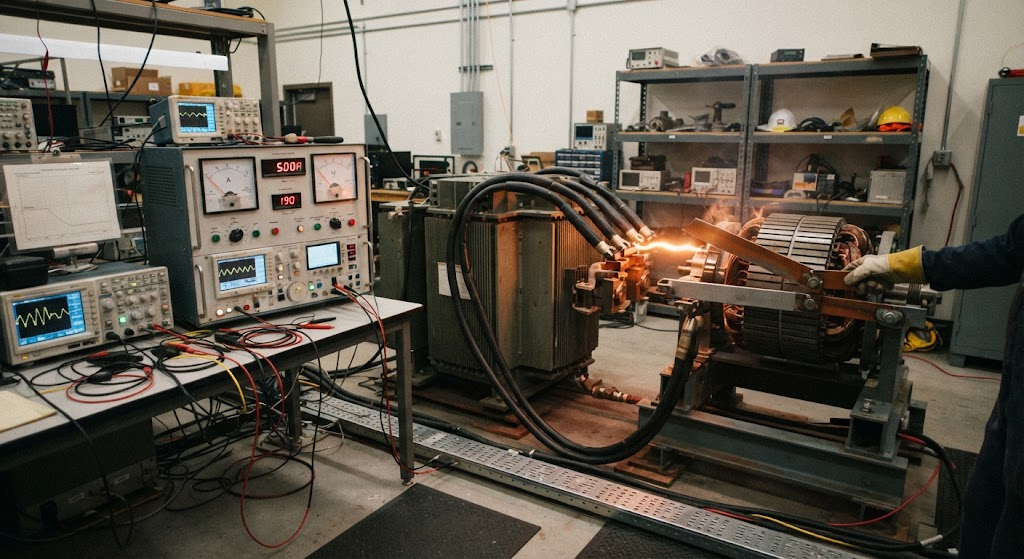
The physical reason is well documented in motor engineering literature. An AC induction motor, the type used in refrigerator and freezer compressors, well pumps, sump pumps, air conditioners, and many power tools, behaves electrically like a transformer with a stationary rotor at the moment power is applied. Because the rotor has not yet started turning, there is no back electromotive force (back-EMF) to oppose the applied voltage, so the only thing limiting current is the low resistance and leakage reactance of the windings.
This is called locked rotor current, and for a standard direct-on-line motor it commonly runs 5 to 8 times the motor’s full-load running current, occasionally higher for the first fraction of a second. As the rotor accelerates, back-EMF builds and current falls rapidly, typically settling to the running value within roughly half a second to a few seconds depending on motor size and the load being driven.
That means a compressor that pulls 150 W once running can briefly demand several hundred watts, not because something is wrong, but because that is how induction motors start. A power station’s surge rating exists specifically to cover that window without tripping.
Surge duration is short enough that it does not meaningfully heat the inverter, which is why the surge figure can be so much higher than the continuous figure without changing the thermal design. It also means surge power is the wrong number to use for anything running longer than a few seconds. A device with a genuinely continuous 3,000 W draw will not run on a station whose continuous rating is 2,000 W just because its surge rating is 4,000 W. Surge headroom buys a brief window, not sustained capacity.
How to Tell Which Rating a Device Actually Needs
The practical test is duration, not device type.
Continuous-only loads
If the appliance draws close to its full wattage for the whole time it operates (resistive heaters, incandescent and most LED lighting, laptop and phone chargers, routers, most kitchen appliances without a compressor, televisions), evaluate it purely against the continuous rating. Its nameplate wattage should sit comfortably under that number.
Loads with a real startup surge
Anything built around an electric motor or compressor needs both numbers checked. That includes refrigerators, freezers, window and portable air conditioners, well pumps, sump pumps, sewage ejector pumps, some power tools (particularly ones with universal or induction motors under load), and some furnace blowers. These devices have a modest running wattage but a startup current spike that only the surge rating covers.
Loads that specify their own starting wattage
Some appliance nameplates and manuals list a separate starting or locked-rotor wattage. When that figure is available, use it directly instead of estimating from a general multiplier; manufacturer-stated starting current is always more accurate than an industry rule of thumb. For a full walkthrough of matching total device load to a station, see what size portable power station you actually need.
Worked Example: Sizing for a Refrigerator
Take a small residential refrigerator with a nameplate running wattage of about 150 W, a common figure for compact and mid-size compressor refrigerators once averaged over a cooling cycle.
Step 1: Confirm the continuous requirement. Running load = 150 W. Any station with a continuous rating above roughly 300 to 400 W clears this with margin, so the continuous rating is rarely the limiting factor for a refrigerator on its own.
Step 2: Estimate the starting surge. Published guidance on refrigerator startup surge is not perfectly consistent, because it depends on compressor design, age, and ambient temperature, and different sources describe the multiplier differently. Industry sizing guides commonly place refrigerator starting surge in the range of roughly 3 to 5 times the running wattage, which for a 150 W unit works out to approximately 450 W to 750 W. That range is consistent with the general locked-rotor behavior described above, which puts single-phase compressor motors on the lower end of the 5 to 8 times multiplier that applies to larger three-phase induction motors.
Step 3: Apply a practical margin and select a station. A station with a continuous rating of roughly 500 to 600 W and a surge rating of at least 1,000 to 1,200 W provides comfortable headroom above both the running load and the higher end of the estimated starting surge, without requiring an oversized and more expensive unit. The chart below illustrates this calculation.
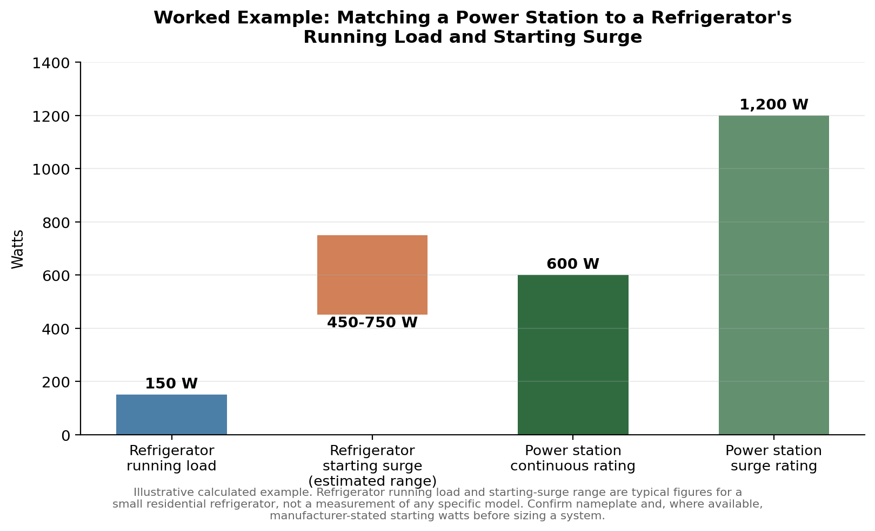
Figure 1. Worked example comparing a 150 W refrigerator’s running load and estimated 450-750 W starting surge against a station sized with a 600 W continuous / 1,200 W surge rating. Values are calculated and illustrative, not measurements of a specific product.
Step 4: Confirm with the nameplate when possible. If the refrigerator’s data plate or manual lists a starting or locked-rotor wattage directly, use that figure in place of the estimated range in Step 2. A directly stated value removes the uncertainty inherent in a general multiplier.
This same four-step process (confirm running load, estimate or find starting surge, size with margin on both numbers, verify against the nameplate where possible) applies to any motor-driven appliance, not only refrigerators. Once a station is sized for the load, calculating expected portable power station runtime is the natural next step, since surge sizing determines whether the appliance can start at all, while runtime determines how long the station will sustain it.
Why the Starting Current Pattern Looks the Way It Does
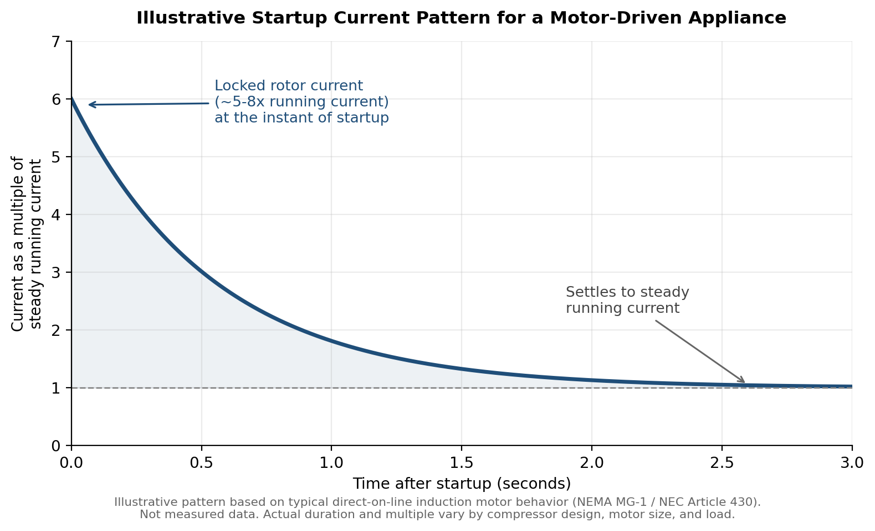
Figure 2. Pattern of direct-on-line induction motor starting current, based on typical behavior described in NEMA MG-1 motor design classification and NEC Article 430. Not measured data from a specific product.
The chart above illustrates the general shape of a direct-on-line motor’s startup current, not a measurement from a specific product. At the instant of startup the rotor is stationary, so current is limited only by winding resistance and leakage reactance, producing the locked rotor current described earlier. As the rotor accelerates, growing back-EMF opposes the supply voltage and current falls, typically reaching the steady running value within roughly half a second to a few seconds. The exact duration depends on motor size, design, and the mechanical load being started; small fractional-horsepower motors such as those in refrigerator compressors generally settle faster than large motors driving high-inertia loads.
This is why a power station’s surge rating only has to be sustained briefly. If the inverter can supply the required current for the fraction of a second the motor needs to begin accelerating, the load drops back toward the continuous rating on its own.
Common Mistakes
Treating the surge number as the station’s real capacity.
The surge rating describes a few seconds of headroom, not a higher continuous ceiling. A device that draws its full wattage continuously must fit under the continuous rating, full stop.
Assuming every appliance has a meaningful surge requirement.
Resistive loads such as heaters and most lighting draw essentially flat power from the moment they switch on. There is no startup spike to plan around, and shopping for surge headroom on these devices adds nothing.
Using a single generic multiplier for every motor.
The commonly cited “5 to 8 times running current” range describes locked rotor current for standard induction motors broadly. Compressor size, motor design, starting method, and load all shift the actual figure. Where the manufacturer states a specific starting or locked-rotor wattage, that figure should override a generic estimate.
Ignoring combined loads.
If a refrigerator is already running continuously and a second motor-driven appliance starts on the same station, the surge event has to be covered on top of whatever the refrigerator is already drawing, not from a fresh baseline of zero. Sizing for one device in isolation can understate the requirement when several loads share a station. This is where calculating total battery capacity for multiple appliances becomes relevant alongside the surge check.
Confusing a manufacturer’s boosted mode with an increase in true capacity.
Some manufacturers offer a software-enabled boost mode (marketed under names such as X-Boost) that raises the effective continuous output ceiling by tolerating a lower-quality output waveform or a wider voltage range for compatible loads. That is a different mechanism from the short-duration surge rating and does not apply to every connected device; check the manufacturer’s documentation for which loads the boosted mode actually supports.
Frequently Asked Questions
Is surge power the same as peak power?
Yes. Different manufacturers use “surge,” “peak,” and occasionally “starting watts” for the same short-duration rating. The terminology varies; the underlying meaning, a brief current spike the inverter can supply for a few seconds at most, does not.
Can I run a 2,500 W load on a station rated 2,000 W continuous and 4,000 W surge?
No, not if the 2,500 W is a sustained draw. The surge rating only covers a few seconds. A load that draws 2,500 W continuously needs a station whose continuous rating exceeds 2,500 W, regardless of how high the surge rating is.
Why does my refrigerator trip the power station even though its running wattage is well under the continuous rating?
This usually means the surge rating, not the continuous rating, is the limiting factor. The compressor’s startup current spike is likely exceeding what the inverter can briefly supply. Checking the station’s surge rating against the refrigerator’s estimated or stated starting wattage is the next step.
Do resistive heaters need surge headroom?
Generally no. Resistive heating elements do not have a startup current spike comparable to a motor. Their wattage is close to constant from the moment they switch on, so the continuous rating is the number that matters.
How long does a typical surge rating actually last?
Most portable power station surge ratings are sustained for well under a second up to a few seconds, matching the time it takes a motor to accelerate from a standstill to running speed. Manufacturers do not always publish the exact duration; where it matters for a specific load, checking the manufacturer’s specification sheet or contacting support is more reliable than assuming a fixed number.
The Bottom Line
A portable power station’s continuous rating determines what it can actually run, and its surge rating only determines what it can briefly start. Matching a device to a station means checking both numbers against how that specific device actually draws power: a flat continuous draw for resistive and electronic loads, and a running wattage plus a separate startup spike for anything built around a motor or compressor. Reading only the largest number printed on the box is how buyers end up with a station that looks oversized on paper but cannot actually run the appliance it was bought for.