Portable Power Station Refrigerator Runtime
A refrigerator is one of the few loads that has to keep running through an entire outage, which makes it the appliance most people actually mean when they ask how long a portable power station will last. The honest answer is not a single number. It depends on which of five very different refrigerator categories is plugged in, how hard the compressor is working, and which capacity of power station is doing the supplying.
This guide answers the question directly, with a runtime figure for five common refrigerator types across five common power station capacities, then works backward from that same data to show how much capacity a specific outage length actually requires.
Quick Answer
A power station in the 500Wh to 2000Wh range typically runs a standard refrigerator for roughly 6 to 26 hours, and a compact or mini fridge for 15 to 60 hours, because a refrigerator’s compressor cycles on and off rather than drawing power continuously. The formula behind every figure in this article is:
Runtime (h) = (Nominal Capacity (Wh) × 0.80) ÷ Average Continuous Draw (W)
Average continuous draw, not the compressor’s running wattage, is the number that belongs in this formula. A refrigerator rated at 150 running watts might only draw about 55 to 60W on average once its duty cycle is factored in. The 0.80 figure is the usable-energy derating factor used consistently across Sielectronix’s portable power station guides, combining roughly 95 percent usable depth of discharge with roughly 85 percent inverter efficiency. The full derivation is covered in How to Calculate Portable Power Station Runtime, and this article applies that same method specifically to refrigeration loads.
Why the Answer Depends on Three Variables
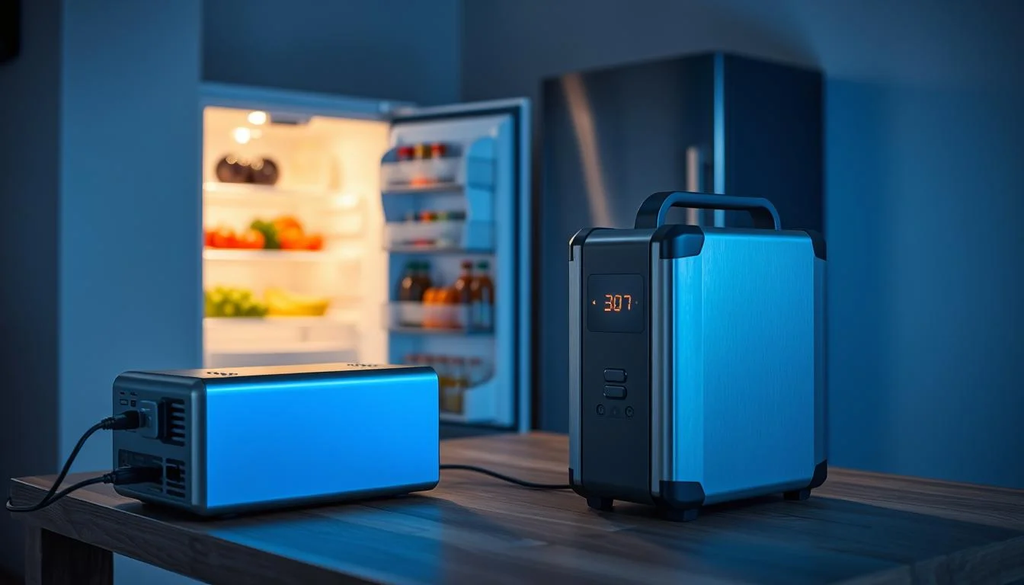
Three things change the result more than anything else, and treating any one of them as a fixed constant is what produces a wrong estimate.
1. Refrigerator type and size.
A compact 4-cubic-foot unit and a large side-by-side draw very different running watts. The gap between them is roughly tenfold.
2. Duty cycle.
The compressor is not on continuously. It cycles based on thermostat setting, insulation, ambient temperature, and how often the door opens, typically running 30 to 55 percent of each hour depending on the unit and conditions. The full mechanics of this are covered in How Much Power Does a Refrigerator Use?, which this article draws its wattage and duty cycle ranges from directly.
3. Power station capacity and derating.
A larger nominal Wh rating helps, but only after usable depth of discharge and inverter efficiency are subtracted from it. Two power stations with the same advertised Wh figure will not necessarily deliver the same runtime if their usable-energy derating differs.
Runtime by Refrigerator Type and Power Station Capacity
The table and chart below apply the runtime formula across five refrigerator categories and five common power station capacities. Running-watt and duty-cycle ranges for each category come from published Energy Guide data and manufacturer specifications, cross-checked in the Sielectronix refrigerator wattage guide referenced above. Average continuous draw uses the midpoint of each category’s running-watt range multiplied by the midpoint of its duty-cycle range.
| Refrigerator Type | Running Watts | Duty Cycle | Avg. Draw |
| Compact / mini | 40-100 W | 30-45% | 26 W |
| Top-freezer, standard | 100-250 W | 30-40% | 61 W |
| French-door / counter-depth | 150-400 W | 30-45% | 103 W |
| Side-by-side, large | 200-400 W | 35-50% | 128 W |
| Older unit (15+ years) | 300-800 W | 40-55% | 261 W |
Table 1. Average continuous draw assumptions, used as the load figure in the runtime table below.
| Refrigerator Type | 256 Wh | 500 Wh | 1000 Wh | 2000 Wh | 3000 Wh |
| Compact / mini | 7.8 h | 15.2 h | 30.5 h | 61.0 h | 91.4 h |
| Top-freezer, standard | 3.3 h | 6.5 h | 13.1 h | 26.1 h | 39.2 h |
| French-door / counter-depth | 2.0 h | 3.9 h | 7.8 h | 15.5 h | 23.3 h |
| Side-by-side, large | 1.6 h | 3.1 h | 6.3 h | 12.5 h | 18.8 h |
| Older unit (15+ years) | 0.8 h | 1.5 h | 3.1 h | 6.1 h | 9.2 h |
Table 2. Estimated runtime by refrigerator type and power station nominal capacity, using a 0.80 usable-energy factor. Calculated from stated wattage and duty-cycle assumptions, not a measured result for any specific product.
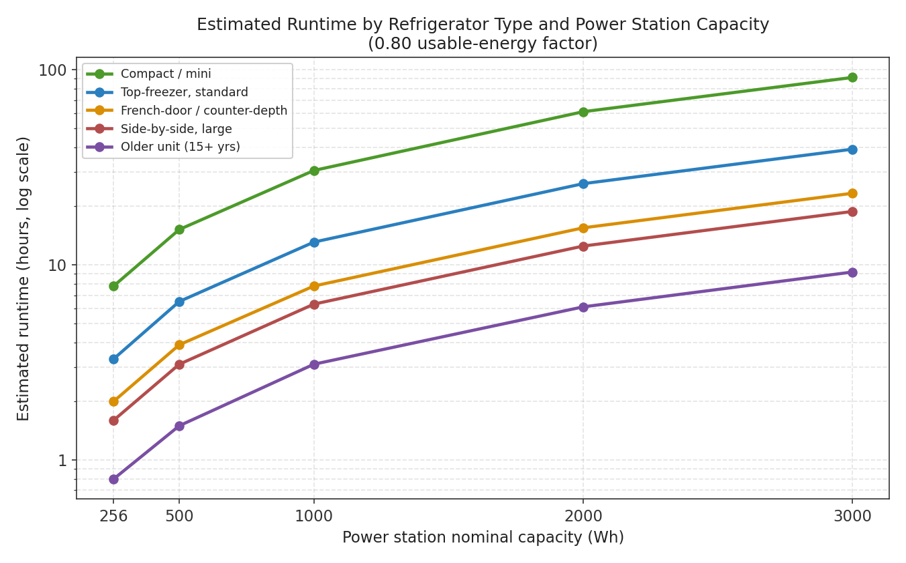
Figure 1. Estimated runtime by refrigerator type and power station capacity. Log scale on the vertical axis because the gap between a compact fridge and an older large unit spans roughly two orders of magnitude.
The gap between the top and bottom rows of Table 2 is not small. At 1000Wh, a compact refrigerator runs for roughly ten times as long as an older large unit on the exact same power station. Refrigerator category, not power station capacity alone, is often the bigger factor in whether a given battery is adequate.
How Much a Refrigerator Actually Draws, On Average
Every runtime figure above depends on the average continuous draw column in Table 1, and that number is not the same as the wattage printed on the compressor. A refrigerator’s nameplate or running-watts rating describes the load while the compressor is active, not the load averaged across an hour that includes idle time between cycles.
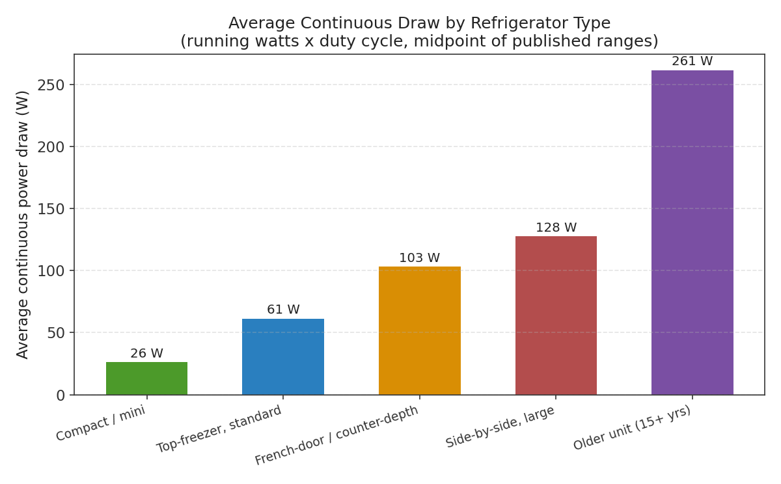
Figure 2. Average continuous draw by refrigerator type, calculated as running watts multiplied by duty cycle at the midpoint of each category’s published range.
An independent analysis of 2,450 ENERGY STAR-certified refrigerator models found average annual consumption of about 493 kWh per year, equivalent to a continuous average draw of roughly 56 watts, a figure that sits close to the top-freezer category used in this article. Manufacturer EnergyGuide labels report this same annual kWh figure for a specific model and are the most reliable source for a unit already owned, since they already account for that unit’s actual duty cycle rather than a category average.
Sizing a Power Station for a Refrigerator During an Outage
Runtime and sizing are the same formula solved for different variables. Instead of asking how long a given capacity lasts, sizing asks how much capacity a target outage length requires.
Required Nominal Capacity (Wh) = (Average Draw (W) × Outage Hours) ÷ 0.80
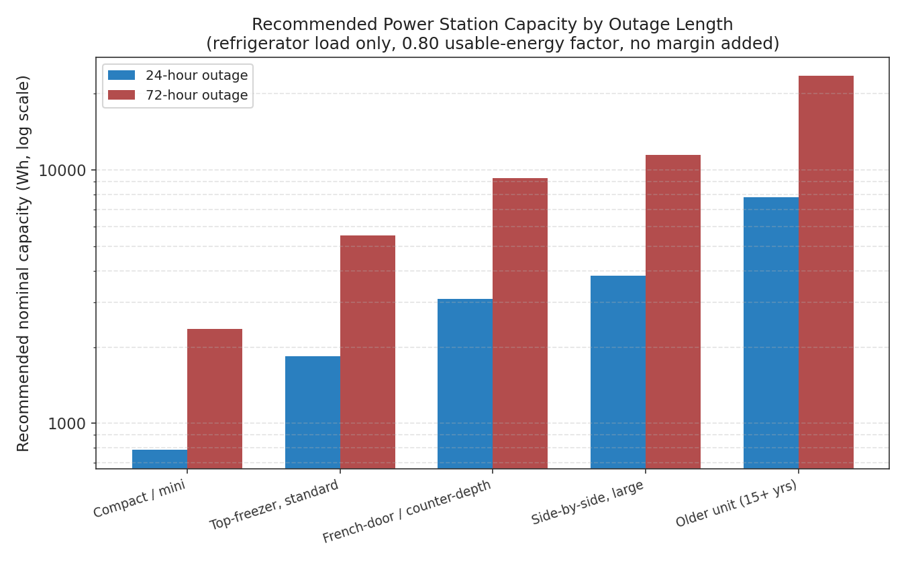
Figure 3. Recommended nominal power station capacity for the refrigerator load alone, at 24-hour and 72-hour outage lengths. No safety margin has been added; a real purchase decision should add one, discussed below.
| Refrigerator Type | 24-Hour Outage | 72-Hour Outage |
| Compact / mini | ≈ 790 Wh | ≈ 2,360 Wh |
| Top-freezer, standard | ≈ 1,840 Wh | ≈ 5,510 Wh |
| French-door / counter-depth | ≈ 3,090 Wh | ≈ 9,280 Wh |
| Side-by-side, large | ≈ 3,830 Wh | ≈ 11,480 Wh |
| Older unit (15+ years) | ≈ 7,840 Wh | ≈ 23,510 Wh |
Table 3. Recommended nominal capacity for refrigerator-only backup, calculated at 0.80 usable energy. These figures cover the refrigerator alone; lighting, a router, or device charging running alongside it add to the total.
A 72-hour outage for a side-by-side or older refrigerator lands well above what a single portable power station typically stores, which is one of the reasons multi-day refrigeration backup is often handled by a fixed home battery system rather than a portable unit. For a comparison of the two approaches, see
Best 100Ah Lithium Battery for Home Backup Power in Nigeria, which covers fixed 12.8V battery banks sized for exactly this kind of multi-day refrigeration and household load.
Worked Example: A Standard Refrigerator Through a 24-Hour Outage
A household with a standard top-freezer refrigerator (150W running watts, 35 percent duty cycle) wants enough capacity to keep it running through a full day without mains power.
| Step | Calculation | Result |
| Average continuous draw | 150 W × 0.35 | 52.5 W |
| Energy required for 24 hours | 52.5 W × 24 h | 1,260 Wh |
| Required nominal capacity (0.80 factor) | 1,260 Wh ÷ 0.80 | ≈ 1,575 Wh |
| With a 15% planning margin | 1,575 Wh × 1.15 | ≈ 1,810 Wh |
Table 4. Worked sizing example for a standard refrigerator through a 24-hour outage, including a planning margin for higher outage-condition duty cycle and battery aging.
A 2000Wh power station comfortably covers this load with margin remaining for a router or lighting running alongside it. The margin step matters because duty cycle tends to run higher during an actual outage, when the door gets opened more often to check on food, than during the normal daily conditions an Energy Guide label is tested under. This same 15 to 20 percent planning margin is used in the case study within How Much Power Does a Refrigerator Use? for the identical reason.
The inverter’s continuous and surge output ratings must also cover the refrigerator’s starting watts, typically 2 to 3 times its running watts for a few seconds at startup. Capacity in watt-hours and inverter output in watts are independent specifications, and sizing for one does not guarantee the other is adequate. See
What Size Portable Power Station Do I Need? for the full sizing method covering both figures together, and How to Calculate the Battery Capacity for Portable Power Station for the underlying capacity math applied more generally.
What Changes the Number
Ambient temperature.
A refrigerator in a hot kitchen or garage works harder to hold its setpoint, which raises duty cycle and average draw above the figures in Table 1.
Door openings during the outage itself
Occupants checking on food more frequently during a power cut is one of the most common reasons real-world duty cycle runs higher than a normal-day average, which is why the worked example above adds a planning margin rather than sizing to the bare calculated minimum.
Battery age and cold temperature.
A power station that has completed several hundred charge cycles typically delivers somewhat less than its original usable capacity, and cold ambient conditions reduce both usable capacity and inverter efficiency. Neither effect can be predicted precisely without manufacturer aging data for the specific unit.
Simultaneous loads.
A refrigerator sharing a power station with a router, lighting, or a phone charger reduces the runtime figures in Table 2 proportionally, since the formula divides total usable energy by total combined load, not by the refrigerator’s draw alone.
Common Mistakes When Estimating Refrigerator Runtime
Using running watts as a continuous load.
Dividing nominal Wh by a refrigerator’s running wattage, without applying duty cycle, typically overstates real consumption by a factor of two to three, and produces a runtime estimate far shorter than what the power station will actually deliver.
Skipping the usable-energy derating step
Dividing the full nameplate Wh by average draw ignores depth-of-discharge and inverter losses, producing a runtime figure the battery management system will not permit the unit to deliver.
Applying one duty cycle figure to every refrigerator.
Duty cycle varies by roughly 25 percentage points between a compact unit and an older large refrigerator, which is a large enough spread to change the runtime estimate by several multiples if the wrong category’s assumption is used.
Frequently Asked Questions
Can a 500Wh power station run a fridge overnight?
For a compact or mini fridge, yes, roughly 15 hours at the 0.80 derating factor, comfortably covering an overnight outage. For a standard top-freezer unit, a 500Wh station provides roughly 6.5 hours, which covers only part of an overnight period. A larger or older refrigerator will exhaust a 500Wh unit in 3 hours or less.
What size power station do I need for a refrigerator during a 3-day outage?
Table 2 above gives category-specific figures, ranging from roughly 2,360Wh for a compact fridge to over 23,000Wh for an older large unit. Multi-day figures at the higher end of that range typically exceed what a single portable power station stores, making a fixed home battery bank or a portable unit paired with solar recharging a more practical approach for a standard or larger refrigerator over 72 hours.
Does solar charging extend how long a power station can run a refrigerator?
Yes, but only during the hours solar input is actually available and only up to the panel’s rated output. Solar input should be treated as a partial daily energy addition to the starting capacity for a multi-day outage calculation, not as a way to avoid sizing the battery correctly for the hours without sun.
Is it safe to run a power station until it shuts off automatically?
Most portable power stations with LiFePO4 chemistry and a competent battery management system cut off discharge automatically before the cells reach a damaging voltage, so an indicated 0 percent generally reflects that cutoff rather than true cell depletion. Victron Energy’s LiFePO4 cycle-life documentation indicates occasional deep discharge does not meaningfully harm the cells, though routinely discharging to the cutoff on every cycle reduces total cycle life compared with a shallower routine discharge.
Conclusion
How long a portable power station runs a refrigerator depends far more on refrigerator category than most buyers expect. At the same nominal capacity, a compact fridge can run roughly ten times longer than an older, large side-by-side unit, because average continuous draw, not nominal wattage, is what the runtime formula actually depends on. The 0.80 usable-energy factor and average-draw method used throughout this article match the calculation approach used across the rest of the Sielectronix portable power station guides, so a reader working from a specific refrigerator’s Energy Guide label or measured draw can substitute that figure directly into the same formula for a more precise result than the category averages in Table 1 provide.
For a refrigerator-only capacity decision, start from How Much Power Does a Refrigerator Use? to establish the specific unit’s average draw, then apply that figure using What Size Portable Power Station Do I Need? to size the full household load rather than the refrigerator in isolation.
Sources
Refrigerator wattage and duty-cycle ranges, and the usable-energy and inverter-efficiency assumptions applied to them, were checked against the following published sources, consistent with the figures used across other Sielectronix portable power station guides:
1. ENERGY STAR, Refrigerator program information and efficiency standards.
2. Independent analysis of 2,450 ENERGY STAR-certified refrigerator models (average annual consumption, height 60 inches or greater).
3. U.S. Federal Trade Commission, EnergyGuide Labels / Energy Labeling Rule.
4. Victron Energy, Official Depth of Discharge Recommendations for LiFePO4 (cycle life versus depth of discharge, sourced from Victron’s published cell datasheet).
5. Anern, LiFePO4 DoD Guide: Maximize Usable Battery Capacity (usable-energy formula).
6. EcoFlow, DELTA Series portable power station specifications (manufacturer-published output efficiency figures).
Refrigerator running-watt, starting-watt, and duty-cycle ranges by category are general reference figures compiled from manufacturer Energy Guide data. Actual values vary by specific model and should be confirmed against the unit’s own nameplate rating or Energy Guide label before use in a purchase decision.