Can a Portable Power Station Run a Microwave?
Quick Answer
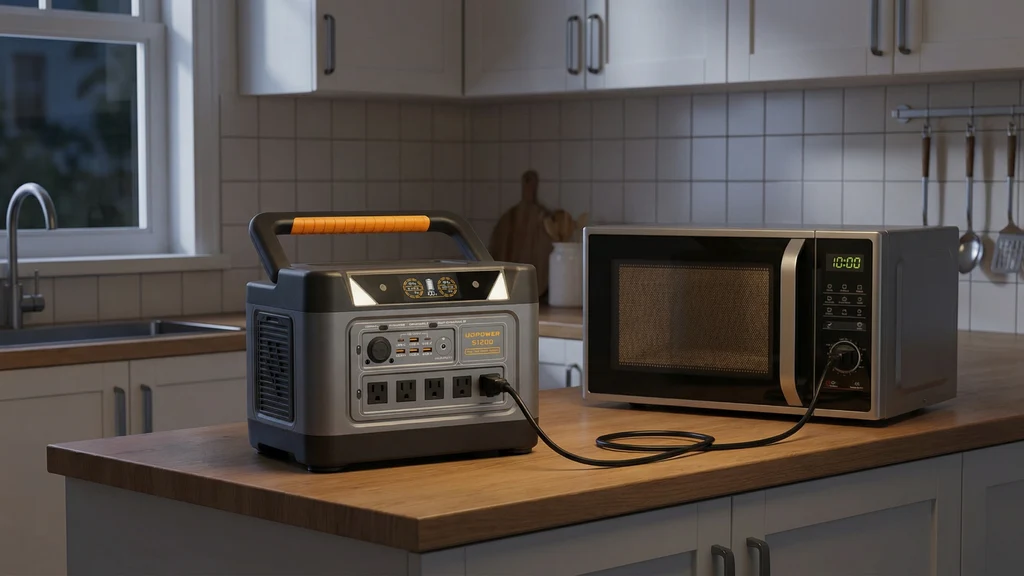
A portable power station can run a microwave, but the number that decides it is not the cooking wattage printed on the front of the appliance. It is the microwave’s actual input wattage, the electricity it pulls from the power source, which typically runs 40 to 70 percent higher than the cooking rating because of magnetron and transformer losses.
A power station needs three things to run a microwave: a continuous AC output rating that clears the microwave’s input wattage with margin, a pure sine wave inverter, and enough usable watt-hours to cover the cook time. Most current portable power stations already use pure sine wave output, so the continuous wattage rating and the watt-hour budget are usually the deciding factors.
Why a Microwave Behaves Differently From Most Backup-Power Loads
Phones, routers, laptops, and LED lighting draw a small, steady, and forgiving amount of power. A refrigerator complicates the picture with a compressor that cycles on and off, drawing a brief startup surge and then settling to a much lower running wattage. A fan or a router complicates it differently again, through inverter idle draw on a very small load. A microwave complicates the picture in a fourth way: for the entire time it is heating at full power, it draws close to its maximum load continuously, and that maximum load is considerably higher than the wattage printed on the appliance.
A portable power station is judged against a microwave on two ratings at the same time: how much continuous power the inverter can deliver, and how many watt-hours the battery holds. A microwave load tends to fail the first test more often than the second, which is the opposite of what most buying guides imply when they focus on battery size alone.
The Number That Actually Matters: Input Watts, Not Cooking Watts
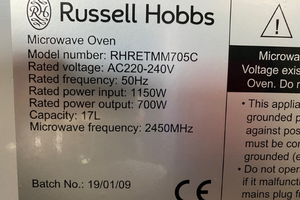
Every microwave carries two wattage figures, and only one of them describes the load it places on a power source.
Cooking wattage (also called output wattage) describes the microwave energy delivered to the food. This is the number printed on the front of the appliance and the number most product listings quote: 700W, 900W, 1000W, and similar.
Input wattage (also called draw wattage) describes the electricity the appliance actually pulls from the wall, or from a power station's outlet. This figure appears on the rating label, usually on the back panel or inside the door, and it is always higher than the cooking wattage.
The gap exists because a magnetron, the vacuum tube that generates the microwave energy, does not convert electricity into cooking energy with perfect efficiency. Some input power is lost as heat inside the magnetron and its high-voltage transformer, and additional power runs the cooling fan, turntable motor, interior lamp, and control electronics.
A frequently cited reference point in electrical engineering literature: a microwave with a 700W cooking rating typically draws around 1,100W from the supply, an efficiency of roughly 64 percent. Malaysia’s national Energy Commission, in its minimum energy performance standard for microwave ovens, tests exactly this input-to-output relationship using the IEC 60705 procedure, the same international test method most manufacturers use to establish the cooking wattage printed on the appliance.
Across conventional household microwaves, magnetron conversion efficiency generally runs from about 55 to 70 percent. Some units using inverter-technology magnetron control (see the terminology note below) report higher figures under specific test conditions. When a microwave’s input wattage is not printed anywhere on the unit, dividing the cooking wattage by 0.60 to 0.65 is a reasonable, moderately conservative planning assumption, not a substitute for the appliance’s own rating label.
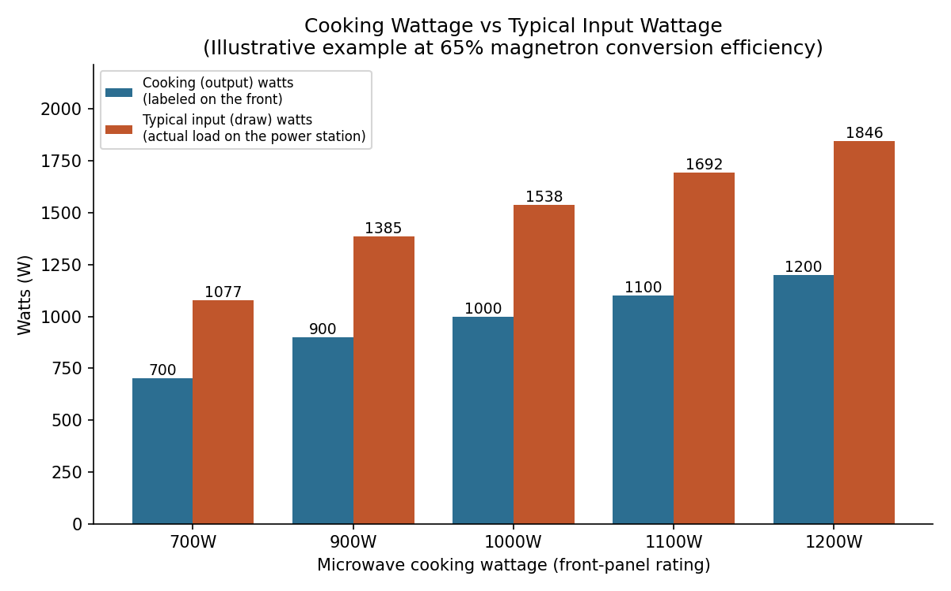
Figure 1. Cooking wattage versus typical input wattage, assuming 65 percent magnetron conversion efficiency. Always check the appliance’s own rating label first; this chart is a planning estimate for when that label is unavailable.
Cooking-to-Input Wattage
| Cooking (output) wattage | Typical input (draw) wattage* |
| 700 W | ~1,080 W |
| 900 W | ~1,385 W |
| 1,000 W | ~1,540 W |
| 1,100 W | ~1,690 W |
| 1,200 W | ~1,850 W |
*Illustrative estimate at 65 percent assumed efficiency. Actual input wattage varies by model and should be confirmed from the appliance’s rating label whenever possible.
A Terminology Trap: “Inverter” Means Two Different Things Here
The word inverter appears twice in this discussion with two unrelated meanings, and confusing them leads to bad sizing decisions.
- Inverter (power electronics): the circuit inside a portable power station that converts stored DC battery energy into AC household power. This is the inverter relevant to whether the power station can run the microwave.
- Inverter technology (magnetron control): a microwave design that varies the magnetron’s power continuously instead of cycling it fully on and off. This affects cooking evenness and, in some models, standby efficiency. It says nothing about the power source the microwave needs.
A microwave marketed as an “inverter microwave” is not inherently easier or harder to run from a portable power station’s inverter. The two uses of the word are unrelated.
Continuous Load, Not a Startup Surge
Articles about running refrigerators, sump pumps, and power tools from a portable power station spend most of their attention on startup surge: the brief multiple-of-running-wattage spike a motor or compressor draws for a fraction of a second while it starts turning. A microwave is different, and describing its elevated draw as a “surge” is a common but misleading shorthand that shows up across product blogs and buying guides.
A microwave’s high-voltage transformer does draw a modest inrush current for a fraction of a second when the appliance switches on, similar to any transformer-based appliance energizing. That brief inrush is not what makes a microwave demanding to run. The defining characteristic of a microwave load is that its elevated input wattage is sustained for the entire cook cycle at full power, not a brief spike that settles to a lower running wattage the way a refrigerator compressor does.
Practically, this means the power station’s continuous AC output rating, not its surge or peak rating, is the number that must clear the microwave’s input wattage with margin. A power station whose surge rating comfortably covers a microwave’s draw but whose continuous rating does not will often start the microwave and then shut off partway through the cook once the inverter’s thermal or continuous-current protection engages. See continuous power versus surge power for the full distinction and how it applies across other appliance categories.
Inverter Waveform: Why Pure Sine Wave Still Matters
Portable power stations sold today almost universally use pure sine wave inverters, unlike some older standalone inverters and portable generators that produced a stepped, modified sine wave to reduce manufacturing cost. This is a genuine advantage for the category, and it is worth confirming on the spec sheet rather than assuming, particularly with lower-cost or older units.
A magnetron’s high-voltage transformer and control electronics are designed around the smooth sine wave available from a standard wall outlet. A modified sine wave introduces harmonic content that these circuits were not designed to handle, and this has been widely reported, across marine and off-grid electrical practice, to reduce effective cooking power, cause audible transformer hum, and in some cases produce incorrect clock or timer behavior. For a portable power station with a pure sine wave inverter, which describes most current models, this concern does not usually apply, but it remains worth confirming for any unit that does not explicitly state pure sine wave output.
How Long Will a Power Station Run a Microwave?
Runtime for a microwave load follows the same usable-energy model used across Sielectronix runtime calculations, applying a combined derating factor for depth of discharge and inverter conversion losses. The underlying capacity concept is covered in how to calculate battery capacity for a portable power station and, for the difference between the two units doing the work here, watts versus watt-hours.
Formula
Runtime (hours) = Usable Energy (Wh) / Input Load (W)
Usable Energy (Wh) = Rated Capacity (Wh) x 0.80
The 0.80 factor reflects roughly 95 percent usable depth of discharge combined with approximately 85 percent inverter conversion efficiency, the same assumption used throughout this site’s runtime and sizing guides. It is a planning approximation, not a guarantee for any specific unit.
Worked Example
A 1,000Wh portable power station is paired with a microwave rated at 1,000W cooking power. The appliance’s rating label does not list input wattage, so the 65 percent planning assumption applies: input load is approximately 1,540W.
- Usable energy: 1,000Wh x 0.80 = 800Wh
- Runtime: 800Wh / 1,540W = 0.52 hours, approximately 31 minutes of continuous full-power operation
Most single reheating or cooking tasks run one to five minutes. At roughly 31 minutes of full-power runtime, that 1,000Wh station supports approximately six to eight full-power cook cycles at a 4-minute average before it needs recharging. This is a materially different picture from “31 minutes of runtime,” and it is the number a household actually needs when deciding whether a power station can carry a household through several days of intermittent microwave use during an outage.
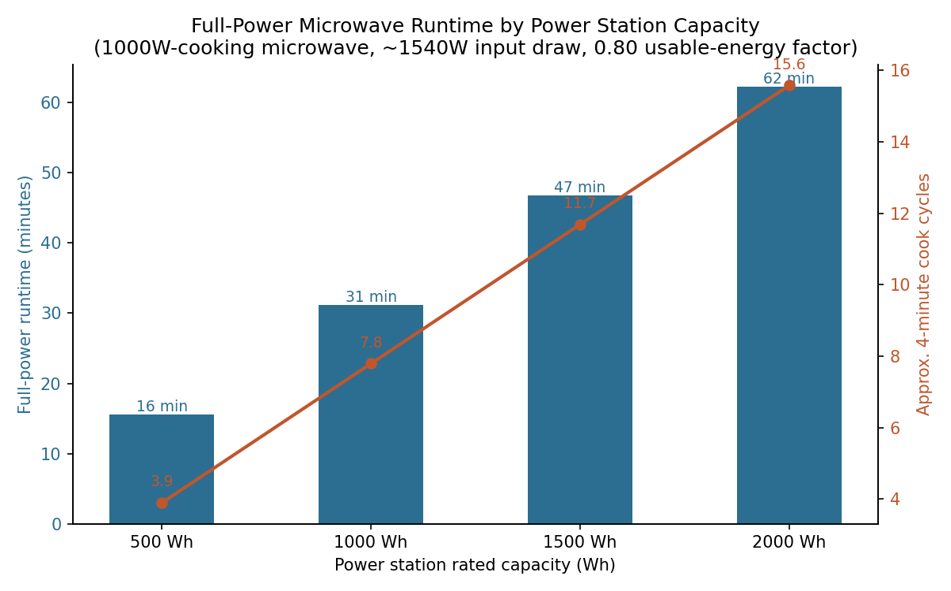
Figure 2. Full-power runtime and approximate number of 4-minute cook cycles by power station capacity, for a 1,000W-cooking microwave drawing an estimated 1,540W. Assumes the 0.80 usable-energy factor.
Runtime by Power Station Capacity
| Rated capacity | Usable energy (0.80) | Full-power runtime | Approx. 4-min cook cycles |
| 500 Wh | 400 Wh | ~16 min | ~4 |
| 1,000 Wh | 800 Wh | ~31 min | ~8 |
| 1,500 Wh | 1,200 Wh | ~47 min | ~12 |
| 2,000 Wh | 1,600 Wh | ~62 min | ~16 |
Assumes a fixed 1,540W input load (a 1,000W-cooking microwave at 65 percent assumed efficiency). Substitute the actual input wattage from a specific appliance’s rating label for a precise figure.
Reduced Power Settings Do Not Scale the Way They Appear To
Selecting a lower power setting, such as 50 or 70 percent, does not make most residential microwaves draw a steady, proportionally lower wattage for the full duration. Instead, the magnetron cycles fully on at close to maximum input wattage and fully off in a duty pattern timed to average out to the selected percentage over the cook cycle. This means the input wattage during the “on” portion of a reduced-power cycle stays close to the full draw, and the practical runtime benefit of a lower power setting is smaller than the percentage on the dial suggests, even though total energy consumed over the complete cycle is genuinely lower.
Matching a Power Station to a Microwave: What to Check
1. Find the microwave’s input wattage on its rating label (typically on the back panel or inside the door), not the cooking wattage printed on the front. If the input wattage is not listed anywhere, divide the cooking wattage by 0.60 to 0.65 as a conservative estimate.
2. Confirm the power station’s continuous AC output rating exceeds that input wattage with at least 15 to 20 percent headroom. Use the continuous rating for this comparison, not the surge or peak rating.
3. Confirm pure sine wave output on the power station’s specification sheet. This is standard on most current models but is worth verifying rather than assuming, especially for older or budget units.
4. Calculate usable watt-hours (rated capacity x 0.80) and divide by the input wattage to find full-power runtime, then compare that runtime against the realistic number of cook cycles needed before the next recharge.
5. Account for anything else drawing from the same power station at the same time, such as lighting, a router, or a refrigerator. These loads add directly to the continuous total the inverter must supply.
Common Mistakes
Sizing to Cooking Wattage Instead of Input Wattage
Matching a power station’s continuous output to the cooking wattage printed on the microwave’s front panel understates the real load by 40 to 70 percent. A power station sized this way may start the microwave and then shut down mid-cycle once its continuous-output protection engages.
Checking Only the Surge or Peak Rating
Because a microwave’s demanding wattage is sustained rather than momentary, a high surge rating does not compensate for an insufficient continuous rating. The continuous AC output figure is the one that governs sustained loads like a microwave.
Assuming Any Pure Sine Wave Power Station Runs a Microwave Indefinitely
A correct inverter waveform solves compatibility, not capacity. A power station can have a fully adequate pure sine wave inverter and still run out of usable watt-hours after a handful of cook cycles, particularly on smaller-capacity units.
Assuming a Lower Power-Level Setting Proportionally Cuts the Input Wattage
As explained above, most microwaves cycle the magnetron fully on and off to achieve a reduced power setting rather than running at a continuously lower wattage. The instantaneous load during the “on” portion remains close to full draw.
Frequently Asked Questions
Will a modified sine wave inverter damage a microwave?
Outright damage is not the most commonly reported outcome, but reduced cooking power, audible transformer hum, and incorrect clock or timer behavior are commonly reported. This is largely a non-issue for current portable power stations, since the large majority use pure sine wave inverters, but it remains worth confirming for older or unusually inexpensive units.
What size portable power station do I need to run a microwave?
As a starting point, a station with at least 1,500 to 2,000W continuous AC output comfortably covers most full-size household microwaves once input wattage is accounted for, with headroom for other simultaneous loads. See the site’s portable power station sizing guide for a full household-level calculation.
Can a small power station, around 300 to 500W continuous output, run a microwave at all?
Generally not for a full-size household microwave. A small, low-wattage compact microwave (600 to 700W cooking, roughly 1,000 to 1,100W estimated input) sits close to the edge of what some mid-tier 1,000 to 1,200W continuous-output stations can sustain, but a 300 to 500W continuous-output station is not a realistic match for most microwaves.
Does running a microwave drain a power station faster than other appliances?
In terms of watt-hours per minute, yes. A microwave’s high continuous wattage means it consumes stored energy faster than most household loads, even though the total cook duration is usually short. A household planning outage backup should budget microwave use as occasional, high-draw activity rather than a background load.
Conclusion
A portable power station can run a microwave when three conditions are met: the station’s continuous AC output rating clears the microwave’s actual input wattage, not its cooking wattage, with reasonable margin; the station uses a pure sine wave inverter, which most current models already do; and the battery holds enough usable watt-hours to cover the number of cook cycles actually needed before recharging. The cooking wattage on the front of the appliance is the wrong number to size against. The input wattage on the rating label, the continuous output rating on the power station’s spec sheet, and the usable watt-hour budget are the three figures that decide the outcome.
For a full household backup-power calculation that accounts for a microwave alongside other loads, see what size portable power station do I need and how to calculate portable power station runtime.