Wh vs Ah: What Is the Difference?
A 12V, 100Ah battery and a 48V, 100Ah battery carry the same amp-hour number on the label, but one stores four times as much usable energy as the other. That gap is the entire reason watt-hours and amp-hours are not interchangeable, and why comparing two batteries by Ah alone, without checking voltage, is one of the more common and more costly mistakes in battery shopping.
Ah and Wh both describe battery capacity, but they describe two different physical quantities. Confusing them leads to the wrong battery, an underpowered backup system, or, in the case of air travel, a battery that quietly violates airline rules the shopper never checked.
Quick Answer
Ah (amp-hours) measures electric charge: how many amps a battery can deliver for how many hours. Wh (watt-hours) measures energy: charge multiplied by voltage. Formula: Wh = V × Ah Why it matters: Ah only allows a fair comparison between batteries that share the same voltage. Wh allows a fair comparison across any voltage, which is why it is the figure used for runtime calculations, product comparisons, and airline lithium battery rules.
What Ah Actually Measures
Ah stands for amp-hour, a unit of electric charge. It describes how much current a battery can supply and for how long, without reference to voltage at all.
One amp-hour is the charge delivered by a current of one amp flowing for one hour. A 100Ah battery can, in principle, supply 100 amps for one hour, 50 amps for two hours, or 10 amps for ten hours. The total charge moved is the same in each case; only the rate changes. Real batteries do not behave perfectly across that whole range, since discharging at a very high rate typically delivers somewhat less total charge than discharging slowly, but the basic relationship holds closely enough for practical planning.
What Ah does not tell a buyer, on its own, is how much energy that charge represents. A 100Ah rating means nothing about total stored energy until the battery’s voltage is known.
What Wh Actually Measures
Wh stands for watt-hour, a unit of energy. It accounts for both the amount of charge a battery holds and the voltage at which that charge is delivered, which together determine how much actual work the battery can do.
Energy, in this context, is the quantity that actually runs an appliance. A load draws power (watts) for a period of time (hours), and the watt-hour figure is what limits how long that can continue before the battery is empty. This is the reason Wh, not Ah, is the number used for runtime calculations and the number printed on the specification sheet of almost every portable power station.
A full explanation of watts as a rate versus watt-hours as a total, and how that distinction affects runtime math, is covered separately in Watts vs Watt-Hours: What Is the Difference?. This article focuses specifically on the other half of the comparison: Ah versus Wh, and why voltage is the variable that connects them.
The Formula That Connects Ah and Wh
Ah and Wh are related by a single, fixed relationship:
Wh = V × Ah Where V is nominal voltage in volts, and Ah is amp-hour capacity.
The same relationship rearranges to solve for either of the other two variables:
- Ah = Wh ÷ V, used to find the amp-hour capacity a system needs at a given voltage to reach a target energy figure.
- V = Wh ÷ Ah, used far less often, mainly to sanity-check a label or a spec sheet.
Worked Example 1: The Same Ah Rating at Four Voltages
A 100Ah battery is not a fixed amount of energy. It is a fixed amount of charge, and its energy content scales directly with voltage:
| System Voltage | Ah Rating | Calculation | Stored Energy |
| 12V | 100Ah | 12 × 100 | 1,200 Wh |
| 24V | 100Ah | 24 × 100 | 2,400 Wh |
| 36V | 100Ah | 36 × 100 | 3,600 Wh |
| 48V | 100Ah | 48 × 100 | 4,800 Wh |
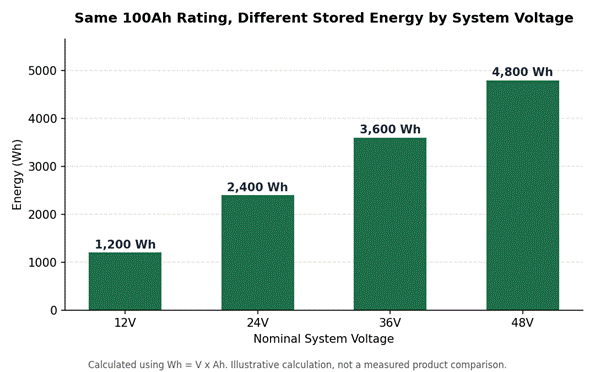
Figure 1. The same 100Ah rating stores four times as much energy at 48V as it does at 12V. Illustrative calculation using nominal voltage, not a measured product comparison.
A shopper comparing a 12V, 100Ah battery against a 48V, 100Ah battery on Ah alone would conclude they are equivalent. They are not. The 48V unit stores four times the usable energy, because Ah says nothing about voltage and voltage is exactly where the difference lives.
Worked Example 2: Reaching a Target Energy Figure at Different Voltages
The same logic runs in reverse when sizing a battery bank to hit a specific watt-hour target, such as matching a 1,000Wh portable power station’s energy content using a separate 12V, 24V, or 48V battery system.
| Target Energy | System Voltage | Calculation | Required Ah |
| 1,000 Wh | 12V | 1000 ÷ 12 | 83.3 Ah |
| 1,000 Wh | 24V | 1000 ÷ 24 | 41.7 Ah |
| 1,000 Wh | 36V | 1000 ÷ 36 | 27.8 Ah |
| 1,000 Wh | 48V | 1000 ÷ 48 | 20.8 Ah |
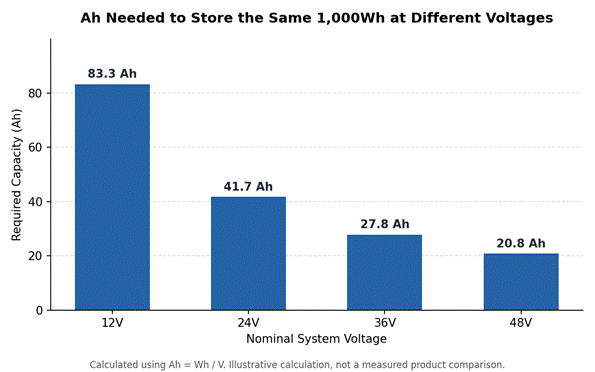
Figure 2. Reaching the same 1,000Wh energy target requires roughly four times less Ah capacity at 48V than at 12V. Illustrative calculation, not a measured product comparison.
This is why higher-voltage battery systems, common in larger portable power stations and off-grid solar setups, need a much smaller-looking Ah number to store the same energy as a 12V system. A 24Ah rating on a 48V system is not a small battery. Read against a 12V baseline, it can look unimpressive; read correctly, it stores roughly the same energy as an 83Ah battery at 12V.
For readers sizing a system from scratch rather than comparing existing units, How to Calculate Battery Capacity for a Portable Power Station walks through the full energy-requirement calculation, and What Size Portable Power Station Do I Need? applies it to specific appliance scenarios.
Why Ah Alone Cannot Be Used to Compare Two Batteries
Ah is only a fair comparison metric between batteries that share the same nominal voltage. Comparing Ah ratings across different voltage classes, which is extremely common when shopping across brands that use different battery architectures, produces a wrong conclusion almost every time.
A 12V, 200Ah lead-acid battery and a 48V, 50Ah lithium battery might appear at first glance to favor the first option, since 200 is a bigger number than 50. Converted to Wh, the comparison flips: 12 × 200 = 2,400 Wh against 48 × 50 = 2,400 Wh. The two batteries store identical energy despite Ah ratings that differ by a factor of four.
The only situation where Ah alone is a valid comparison tool is between two batteries of the same voltage class, for example two 12V batteries from different manufacturers. Outside that narrow case, Wh is the number that actually describes stored energy, and it is the number that should be used for any cross-voltage or cross-brand comparison.
Series and Parallel Wiring Change Ah and Wh Differently
Battery banks are frequently built from multiple identical cells or batteries wired together, and the wiring configuration determines whether the Ah rating or the voltage changes, which in turn affects how the system’s total Wh should be recalculated.
Series Wiring: Voltage Adds, Ah Stays the Same
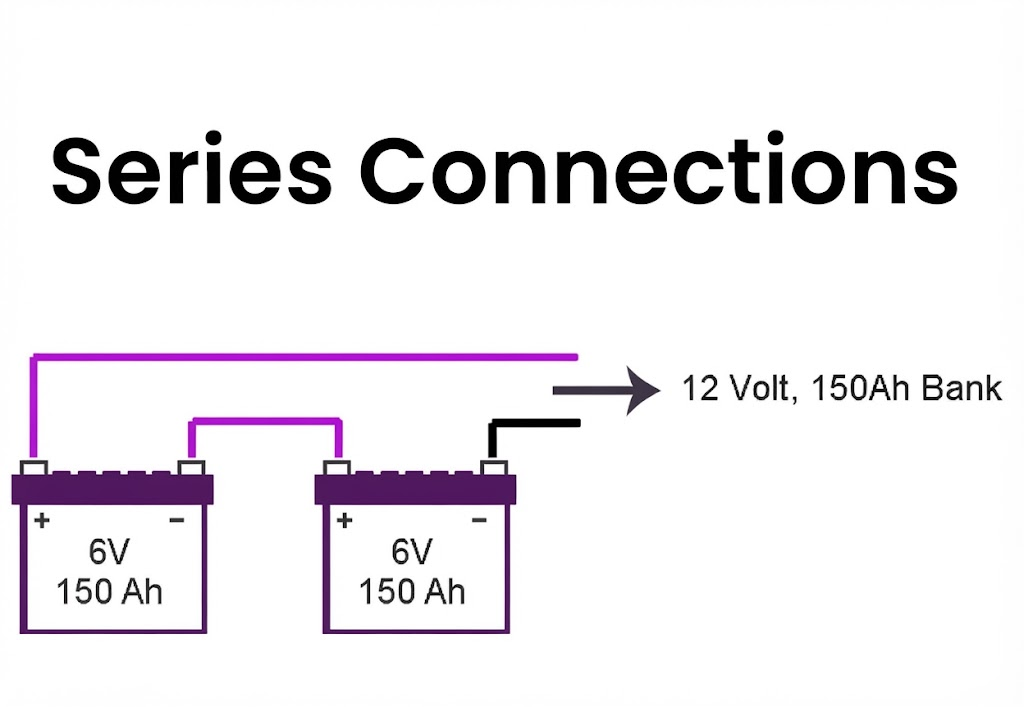
Connecting batteries in series adds their voltages together while the Ah rating of the combined bank stays equal to a single battery’s Ah rating. Two 12V, 100Ah batteries wired in series produce a 24V, 100Ah bank.
Energy check: 12 × 100 = 1,200 Wh per battery, and 24 × 100 = 2,400 Wh for the series bank. The total energy still doubles, as expected from adding a second battery, but the Ah figure printed on the combined bank did not change at all. A buyer who only looks at the Ah number after wiring two batteries in series would incorrectly conclude nothing improved.
Parallel Wiring: Ah Adds, Voltage Stays the Same
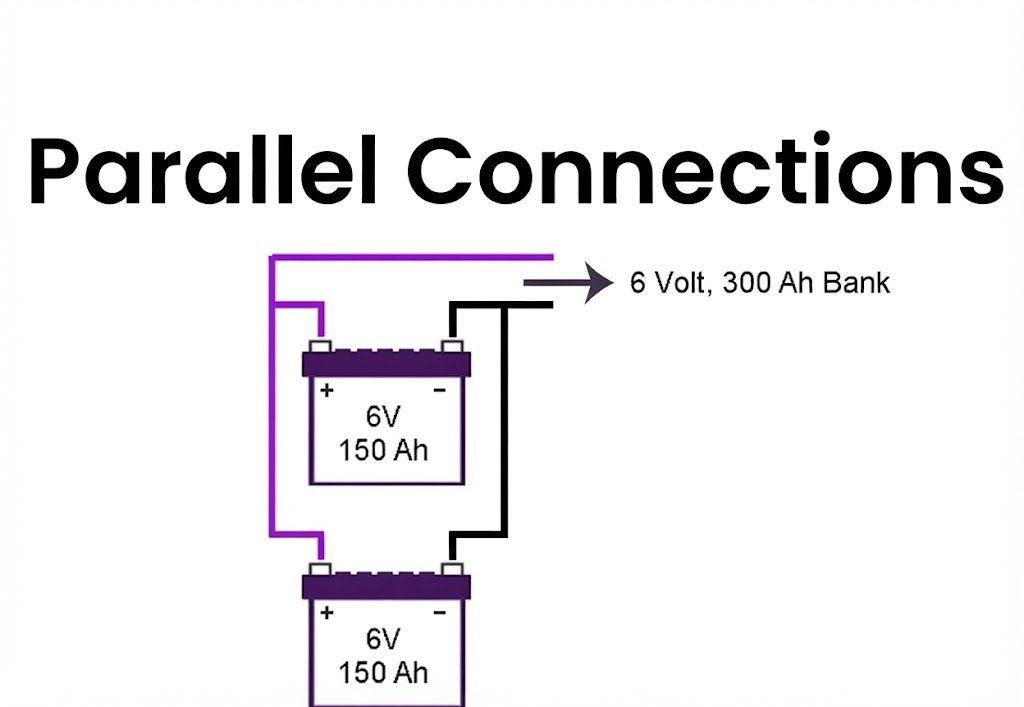
Connecting the same two batteries in parallel instead keeps the voltage at 12V while the Ah ratings add together, producing a 12V, 200Ah bank.
Energy check: 12 × 200 = 2,400 Wh, the same total as the series configuration. Both wiring methods store identical total energy from identical batteries. The difference is which label, voltage or Ah, reflects the change, and which stays fixed.
This distinction matters in practice because it explains why two battery banks built from the same components can display completely different Ah numbers while storing exactly the same energy, and why Wh, not Ah, is the only figure that stays consistent regardless of how the bank is wired.
mAh, Ah, and Wh on Product Labels
Small consumer electronics, particularly phone power banks, list capacity in milliamp-hours (mAh) rather than Ah. The unit is the same amp-hour measurement, scaled down by a factor of 1,000, and it is converted to Wh the same way once the cell voltage is known:
Wh = (mAh ÷ 1,000) × V
A 20,000mAh power bank built around a common 3.7V lithium-ion cell stores approximately (20,000 ÷ 1,000) × 3.7 = 74 Wh, not 20,000 of anything directly comparable to a device’s watt rating. Two power banks advertising the same mAh figure can store meaningfully different actual energy if their internal cell voltages differ, which is the same underlying issue as comparing two larger batteries by Ah alone.
Larger portable power stations skip mAh entirely and label capacity in Wh, precisely because their internal battery voltage varies far more between models than it does among small mobile electronics. The reasoning behind that labeling convention, along with the difference between rated and usable capacity, is covered in Watts vs Watt-Hours: What Is the Difference? and in 1000Wh Power Station: All You Need to Know.
Why This Matters When Flying With Lithium Batteries
The Ah versus Wh distinction is not only a shopping exercise. It determines whether a battery is legal to carry on a commercial flight, and the rule is written in watt-hours, not amp-hours.
Under current United States Federal Aviation Administration guidance, lithium-ion batteries rated up to 100 Wh are generally permitted in carry-on baggage without airline approval. Batteries rated between 100 Wh and 160 Wh require the operating airline’s approval and are limited to two spares per passenger. Batteries rated above 160 Wh are prohibited on passenger aircraft in the standard consumer travel case.
(Federal Aviation Administration, Airline Passengers and Batteries)
Many lead-acid and lithium jump-starter batteries, portable jump packs, and small backup batteries are labeled only in Ah and volts, with no Wh figure printed anywhere on the case. A traveler checking only the Ah number has no way to know whether the battery falls under, within, or over the FAA thresholds without doing the Wh = V × Ah calculation first.
| Battery | Calculation | Wh Result | FAA Carry-On Status |
| 12V, 8Ah jump pack | 12 × 8 | 96 Wh | Permitted, no approval needed |
| 12V, 10Ah SLA battery | 12 × 10 | 120 Wh | Requires airline approval, 2-spare limit |
| 12V, 20Ah portable battery | 12 × 20 | 240 Wh | Prohibited on passenger aircraft |
| 20,000mAh, 3.7V power bank | 20 × 3.7 | 74 Wh | Permitted, no approval needed |
The same 12V nominal voltage can put a battery in any of the three FAA categories depending entirely on its Ah rating, which is exactly why airlines and the FAA specify limits in Wh rather than Ah. Amp-hours alone cannot express a universal safety threshold, since the same Ah number represents wildly different energy content depending on voltage. Anyone traveling with a 12V-class battery that lists only Ah and volts on its label should calculate Wh before booking rather than assuming the number is fine.
Common Mistakes
Comparing Ah Ratings Across Different Voltage Systems
Treating a higher Ah number as automatically superior, without checking whether both batteries share the same voltage, is the single most common error in this comparison. The fix is straightforward: convert both figures to Wh before comparing anything.
Assuming a Higher mAh Power Bank Always Stores More Energy
Two power banks with identical mAh ratings can differ in actual stored energy if their internal cell voltage differs. This is rarer among phone power banks, which mostly use similar 3.6 to 3.7V lithium-ion cells, but it becomes relevant with multi-cell or higher-voltage power banks.
Assuming the Ah Number Changes When Wiring Batteries in Series
As shown above, series wiring changes total voltage while leaving the individual battery’s Ah rating as the bank’s Ah rating. The energy has still increased. The Ah label simply is not the number that reflects it in that configuration.
Ignoring Nominal Versus Actual Voltage
The Wh = V × Ah formula uses nominal voltage, the manufacturer’s standard reference value, not the battery’s exact voltage at any given moment. Actual voltage varies with state of charge, temperature, and load, so a calculated Wh figure is a close approximation built from a labeled Ah rating and a labeled nominal voltage, not a laboratory measurement of true stored energy.
The relationship between rated capacity and what a battery actually delivers under real conditions is explored further in Portable Power Station Battery Degradation Explained.
Wh vs Ah at a Glance
| Quantity | Symbol | Unit | What It Measures | Voltage-Independent? |
| Charge | Q | Ah / mAh | Amount of electric charge over time | No, meaningless without voltage |
| Energy | E | Wh | Total energy stored, charge × voltage | Yes, directly comparable across systems |
| Power | P | W | Rate of energy transfer at an instant | Not applicable, a rate, not a quantity |
| Utility-scale energy | E | kWh (1,000 Wh) | Same as Wh, scaled for household or grid use | Yes |
Frequently Asked Questions
Is a higher Ah rating always a better battery?
Not on its own. A higher Ah rating only means more stored energy if the comparison battery has the same or lower voltage. A lower Ah rating at a higher voltage can store more total energy than a higher Ah rating at a lower voltage, which is why Wh, not Ah, is the correct figure for comparing batteries of different voltage classes.
How do I convert Ah to Wh?
Multiply the amp-hour rating by the battery’s nominal voltage: Wh = V × Ah. For example, a 24V, 50Ah battery stores 24 × 50 = 1,200 Wh.
Why do power banks use mAh while portable power stations use Wh?
Small consumer electronics generally use similar internal cell voltages, so mAh remains a reasonably comparable shorthand between similar products. Portable power stations vary far more in internal battery voltage between brands and models, so a raw Ah or mAh figure would not allow a fair comparison. Wh removes voltage from the comparison entirely and is used instead.
Does a higher Ah rating mean a battery weighs more or lasts longer?
Higher Ah at the same voltage and chemistry generally does correspond to a physically larger, heavier battery, since more charge storage requires more active material.
Runtime, however, depends on the load’s power draw against the battery’s Wh capacity and conversion efficiency, not on Ah alone. A full runtime calculation is covered in How to Calculate Portable Power Station Runtime.
Can I calculate Wh myself if a product only lists Ah and volts?
Yes. Multiplying the two figures gives an approximate Wh value using the manufacturer’s nominal voltage, which is accurate enough for shopping comparisons and for checking airline battery thresholds. It is an approximation built from labeled values, not a substitute for a manufacturer-published Wh figure when one is available.
Conclusion
Ah measures charge. Wh measures energy. They describe two different physical quantities, and the number that connects them is voltage. A battery’s Ah rating only becomes meaningful once its voltage is known, and any comparison, purchase decision, or safety check that relies on Ah alone while ignoring voltage is working with incomplete information.
Wh is the figure that stays consistent regardless of system voltage, wiring configuration, or brand, which is why it governs runtime calculations, product comparisons, and even airline carry-on rules. Before comparing two batteries, sizing a backup system, or packing a battery for a flight, converting the label to Wh using Wh = V × Ah turns a potentially misleading Ah number into the figure that actually answers the question being asked.